

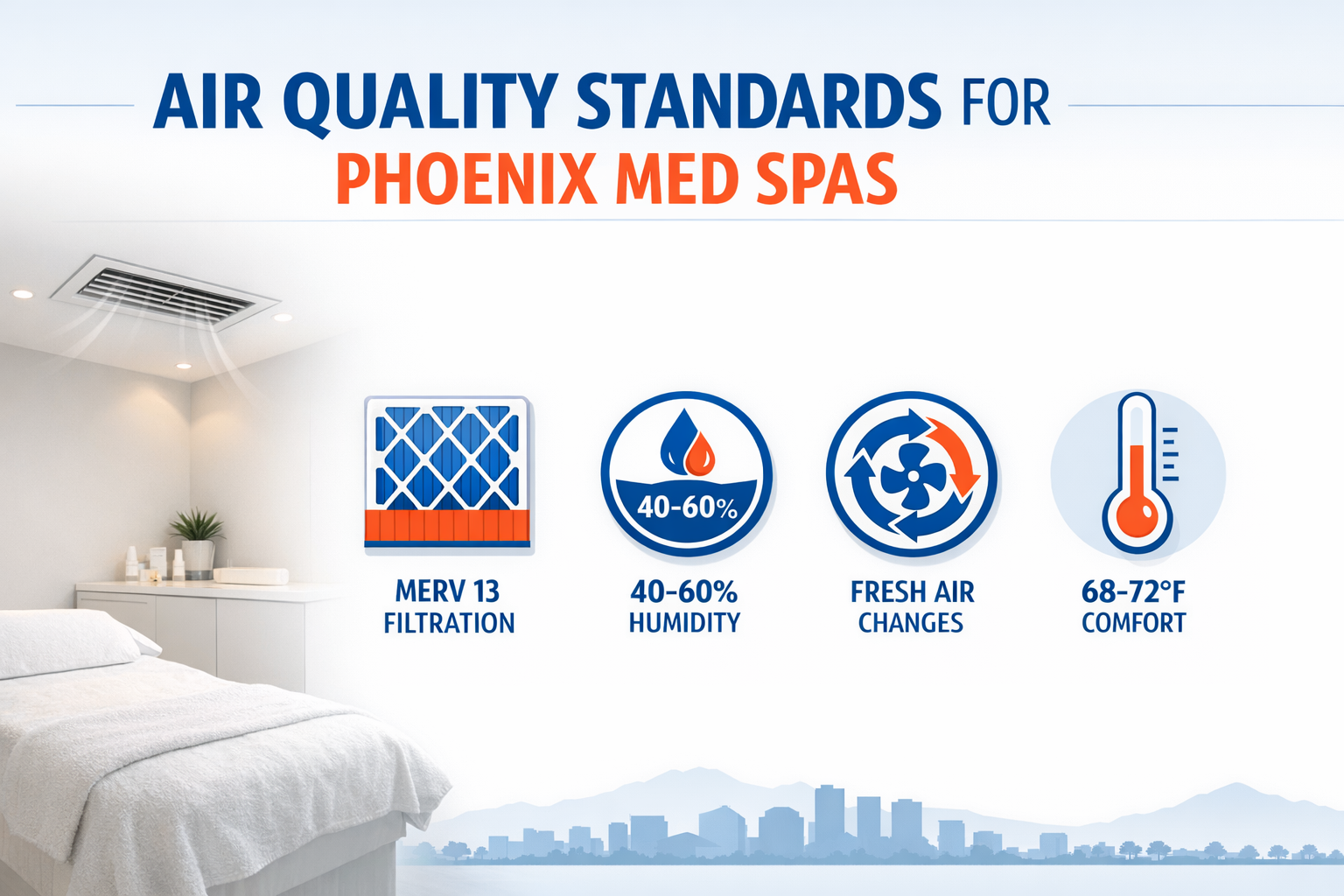
Med spa air quality in Phoenix depends on four things your HVAC must deliver: clean filtered air, controlled humidity, steady comfortable temperatures, and enough fresh-air exchange to clear fumes and plume. When those four work together, your treatment rooms feel calm, safe, and professional. When they fall short, clients notice the stale air, the lingering chemical smell, and the rooms that never cool evenly.
If you run a medical spa in the Valley, you already know the desert tests every system you own. Getting air quality med spa HVAC Phoenix standards right is not a luxury upgrade — it is part of protecting clients, staff, and your reputation. The good news is that the targets are clear and reachable. As a local team that designs, installs, and maintains commercial HVAC systems across the metro, we wrote this guide so you can see exactly what your equipment should be doing, why each number matters, and where most aesthetic clinics fall behind. Read it once and you will save yourself guesswork, wasted service calls, and uncomfortable conversations with clients.
Why Med Spa Air Quality Is Different From a Standard Office
A med spa is not a typical office, and it should never be treated like one. You combine three demanding worlds under one roof: a wellness environment clients expect to feel pristine, a clinical setting where injectables, lasers, and peels happen, and a high-traffic business in one of the hottest, dustiest climates in the country. Each of those raises the bar for what the air handling system has to manage.
Treatment rooms generate contaminants a waiting room never sees. Laser and electrocautery procedures release surgical plume. Chemical peels and acetone-based products give off vapors. Microneedling, body treatments, and high client turnover add moisture, heat, and airborne particles. Layer on Phoenix dust, pollen, and monsoon humidity pulled in every time the door opens, and the load on your system climbs fast. This is why we treat med spa work as a dedicated indoor air quality challenge rather than a simple cooling job.
The table below gives you the practical targets we design toward in Valley clinics. Use it as a quick reference when you walk your own space and ask whether each room is actually performing.
| Area / Room | What to Control | Target | Why It Matters |
|---|---|---|---|
| Treatment / procedure rooms | Fresh-air changes | 8+ ACH, no recirculation | Clears fumes & plume between clients |
| Laser / energy-based rooms | Source capture (smoke evacuation) | At the procedure site | Removes surgical plume at the source |
| Nail / chemical stations | Local exhaust | ~50 CFM/station, vented outdoors | Captures acetone & alcohol vapors |
| All clinical areas | Filtration (MERV) | MERV 11–13 | Captures dust, pollen & fine particles |
| All occupied spaces | Relative humidity | 40–60% RH (≤65% max) | Prevents mold; protects skin & products |
| Treatment rooms | Temperature | 68–72°F | Client comfort & consistent results |
| Reception / retail | Filtration | MERV 8+ baseline | Comfort & everyday dust control |
| Whole facility | Outdoor-air ventilation | Per ASHRAE 62.1 | Baseline for acceptable indoor air |
| Ductwork | Sealing & cleaning | Inspected regularly | Keeps desert dust out of rooms |
| Rooftop units | Service interval | Seasonal, pre-summer | Reliable cooling in extreme heat |
The Air Quality Standards Your Phoenix Med Spa HVAC Must Meet
There is no single rulebook written only for med spas, so the best operators borrow from the standards that govern ventilation, filtration, and healthcare spaces. Three matter most: ASHRAE Standard 62.1 for ventilation and acceptable indoor air quality, ASHRAE Standard 52.2 for rating filter efficiency, and ASHRAE Standard 170 for healthcare ventilation. Together they shape every recommendation below, and they inform how we size and configure each commercial AC installation we complete.
Ventilation and Fresh-Air Changes
Fresh air is the foundation. Air changes per hour (ACH) measures how many times the full volume of air in a room is replaced every hour. General commercial spaces often run on minimal outdoor air, but rooms with chemicals or procedures need far more. Salon and nail-treatment guidance calls for at least 8 air changes per hour with no recirculation of contaminated air, and clinical procedure spaces under ASHRAE 170 run higher still. For most med spa treatment rooms, we target generous outdoor-air delivery and dedicated exhaust so fumes leave the building instead of drifting into the next room.
- Reception and retail: comfortable, steady airflow with light filtration is usually enough.
- Treatment and procedure rooms: higher fresh-air rates plus exhaust, never simple recirculation.
- Nail and chemical stations: source-capture exhaust within roughly 12 inches of the work, vented outdoors.
Getting these rates right almost always means looking at your ductwork and air distribution. Undersized or leaky ducts choke airflow no matter how strong the unit on the roof is, which is why a real assessment starts with the duct system, not just the thermostat.
Filtration: MERV Ratings That Actually Protect Clients
Filtration is where many clinics quietly underperform. The MERV scale (Minimum Efficiency Reporting Value) ranges from 1 to 16 for standard commercial filters, and the higher the number, the smaller the particles captured. ASHRAE sets a floor of MERV 6 upstream of cooling coils, and areas with fine-particle pollution call for MERV 11 or better. Phoenix routinely battles dust and particulate, so a bare-minimum filter is rarely the right answer for a clinical setting.
- MERV 8: a basic baseline — better than nothing, but light for a med spa.
- MERV 11–13: our typical recommendation for treatment areas, capturing fine dust, pollen, and many airborne particles.
- HEPA or dedicated air purification: ideal for high-plume laser rooms when paired with proper smoke evacuation.
Higher-rated filters create more resistance, so the system has to be designed to handle them. Dropping a thick MERV 13 filter into equipment built for a flimsy one starves airflow and strains the blower. We match filtration to the unit, the duct system, and the room, then keep it on a schedule through our preventive maintenance program so performance never quietly degrades between visits.
Humidity and Temperature Control
Comfort and safety both live in the humidity range. ASHRAE 62.1 caps occupied-space relative humidity at 65% under design conditions, and for med spas we usually aim for a 40–60% band. Too humid and you invite mold, musty smells, and clammy treatment rooms. Too dry — common in our desert climate — and clients feel parched while certain products and skin treatments suffer. Steady humidity keeps both the clinical work and the experience on point.
Temperature should hold consistently in roughly the 68–72°F range for treatment rooms, with the flexibility to run cooler during energy-intensive procedures. Hot and cold spots are a sign of poor air distribution or a system fighting the building, and they undercut the premium feel clients are paying for. When zoning is the issue, options like VRF and VRV systems or ductless mini-split systems let us deliver room-by-room control without overcooling the whole suite.
Source Capture for Fumes and Surgical Plume
General ventilation dilutes contaminants; source capture removes them at the point they are created. For laser and energy-based treatments, a smoke evacuator pulls plume directly from the procedure site. For nail and chemical stations, local exhaust grabs vapors like acetone and isopropyl alcohol before they spread. Pairing source capture with strong general ventilation is the combination that keeps clinical air genuinely clean — not just masked with fragrance.
Phoenix-Specific Challenges That Push Your System Harder
What works for a med spa in a mild climate will not necessarily survive a Valley summer. For the med spas we serve across Phoenix, our conditions create pressures that show up directly in your air quality, and planning for them is the difference between a system that coasts and one that constantly struggles.
Extreme heat and long cooling seasons. When it is 110°F outside for weeks, your equipment runs nearly nonstop. That continuous demand wears components faster and makes reliable cooling capacity essential. A unit that is undersized or neglected will lose its grip on both temperature and humidity exactly when your schedule is busiest, which is when we see a spike in AC repair and diagnostic calls across the metro.
Dust and fine particulate. Desert dust loads filters quickly and infiltrates through every gap in the building envelope and duct system. Filters that might last a quarter elsewhere need closer attention here, and sealed, well-maintained duct runs keep that grit out of treatment rooms.
Monsoon humidity swings. For part of the year the air turns heavy and damp almost overnight. A system tuned only for dry heat can lose control of indoor moisture during monsoon season, so we plan dehumidification capacity into the design rather than hoping the cooling cycle handles it.
Rooftop equipment in brutal sun. Many Valley clinics run on rooftop package units that bake all day. Sun exposure, debris, and heat stress make consistent rooftop unit service a core part of keeping clean, conditioned air flowing below.
How We Design and Maintain Med Spa Air Quality the Right Way
We are Discount AC & Refrigeration of Phoenix, and we have spent years working on commercial and clinical HVAC across the Valley. Our technicians train continuously, hold the certifications this work demands, and follow the safety and refrigerant-handling standards that keep both buildings and people protected. That hands-on experience — not a sales script — is what shapes how we approach a med spa. You can read more about our background on our about us page and the ongoing technician training we invest in.
It Starts With an Honest Assessment
Before recommending anything, we walk the space. We measure airflow, inspect the duct system, check filtration and humidity, and look at how each room is actually used. A room hosting laser treatments has different needs than a relaxation lounge, and the plan should reflect that. We would rather tell you a targeted fix will solve the problem than sell you equipment you do not need — transparency is how we have earned the strong local reputation our clients leave in their reviews.
Right-Sized Equipment and Smart Zoning
Oversized systems short-cycle and never properly dehumidify; undersized systems give up in the heat. We size each commercial system to the real load and, where it makes sense, build in zoning so a busy treatment wing can run cooler without freezing out the lobby. For larger facilities, chiller systems and advanced controls give precise, scalable comfort.
Maintenance That Keeps Air Quality From Slipping
Air quality is not a one-time setup; it degrades quietly without upkeep. Filters clog, coils foul, refrigerant charge drifts, and humidity control slowly weakens. Our preventive maintenance plans keep filtration fresh, catch a refrigerant leak before it becomes a breakdown, and verify your system still hits its targets season after season. And because the desert does not wait for business hours, our 24/7 emergency service means a failed unit never has to shut down your appointment book for long. If you ever need fast help, our contact page and phone line are always open.
Frequently Asked Questions — Med Spa Air Quality in Phoenix
What air quality standards apply to a med spa in Phoenix? +
There is no rulebook written only for med spas, so we apply the most relevant standards: ASHRAE 62.1 for ventilation and acceptable indoor air quality, ASHRAE 52.2 for filter efficiency (MERV ratings), and ASHRAE 170 for healthcare-style ventilation in procedure spaces. Together they guide fresh-air rates, filtration, and humidity for clinical settings.
What MERV filter rating does a med spa need? +
For treatment areas we typically recommend MERV 11 to MERV 13, which capture fine dust, pollen, and many airborne particles common in the Valley. Reception and retail can run MERV 8 as a baseline. High-plume laser rooms benefit from HEPA-level air purification paired with smoke evacuation. The system must be designed to handle higher-rated filters so airflow is not starved.
How many air changes per hour should a treatment room have? +
Rooms with chemicals or procedures should not rely on recirculated air. Salon and chemical-treatment guidance calls for at least 8 air changes per hour with dedicated exhaust, and clinical procedure spaces under ASHRAE 170 run higher. We size outdoor-air delivery and exhaust to each room’s actual use so contaminants leave the building rather than drifting next door.
What humidity level is best for a Phoenix med spa? +
We aim for 40–60% relative humidity, staying under the 65% ceiling ASHRAE 62.1 sets for occupied spaces. Too humid invites mold and clammy rooms; too dry — common in our desert climate — leaves clients parched and can affect skin treatments and products. Steady humidity protects both comfort and clinical results, especially during monsoon swings.
Do laser treatment rooms need special ventilation? +
Yes. Laser and energy-based procedures release surgical plume that general ventilation alone will not clear fast enough. A smoke evacuator captures plume right at the procedure site, and we pair that source capture with strong fresh-air delivery and quality filtration. That combination keeps clinical air genuinely clean rather than simply masked with fragrance.
How often should med spa HVAC be serviced in Phoenix? +
At minimum, we recommend a thorough service before the cooling season and again mid-year, with more frequent filter checks because desert dust loads filters quickly. A preventive maintenance plan keeps filtration fresh, catches refrigerant or airflow issues early, and verifies your system still hits its air quality targets. Call us at (602) 889-1367 to set up a schedule that fits your clinic.
Give Your Clients Air They Can Trust — Let’s Build It Together
Clean, comfortable, safe air is the quiet backbone of every great med spa visit, and getting your air quality med spa HVAC Phoenix setup right is one of the highest-value investments you can make in your clinic. The standards are clear, the climate is demanding, and the payoff — confident clients, protected staff, and a space that feels as professional as the work you do — is worth it. If your treatment rooms run hot, smell stale, or never feel quite right, that is your system telling you it needs attention, not something to ignore.
We would love to walk your space and show you exactly where it stands. You can reach Discount AC & Refrigeration of Phoenix at (602) 889-1367, request an inspection through our contact page, or stop by and find us on our Google Maps listing to see why Valley businesses keep choosing our team. We proudly serve med spas and clinics throughout Phoenix and the surrounding cities, and you can explore our full range of commercial HVAC services or browse more practical guides on our blog any time.
If you found this helpful, you may also like our deeper look at building a complete med spa HVAC maintenance checklist — it pairs perfectly with the standards above. When you are ready to give your clients air they can truly trust, visit our local Google listing or call us today. Let’s make your med spa breathe better.