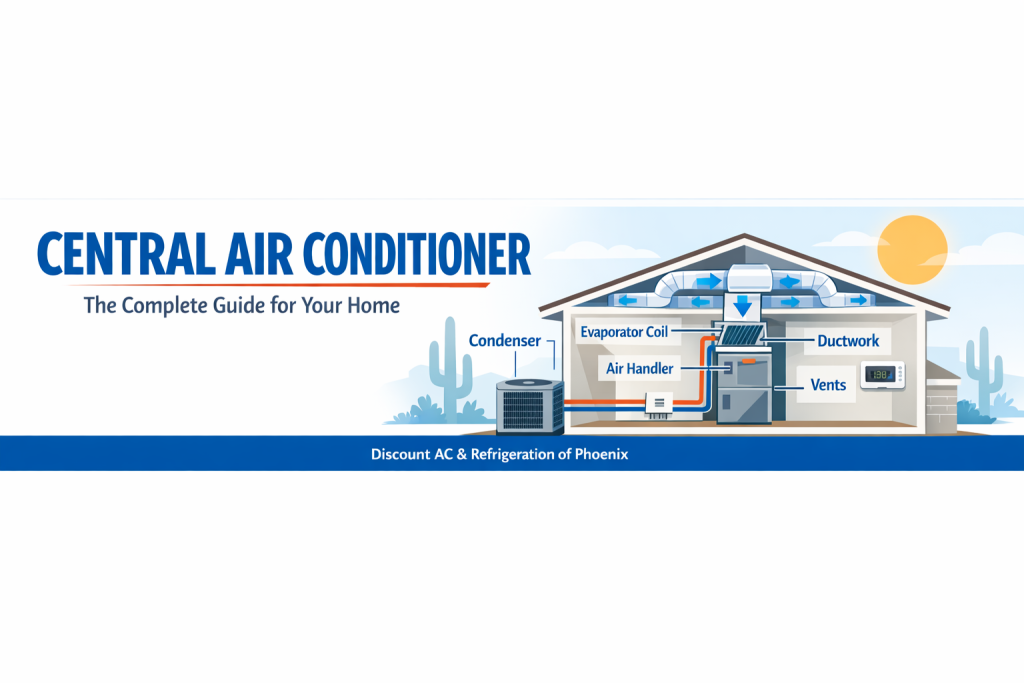


If your AC is cooling but not removing humidity, it usually means your system is dropping the air temperature without running long enough—or in the right way—to pull moisture out of the air. In Phoenix, that most often points to an oversized unit that short-cycles, a blower fan set too high, a dirty or frozen evaporator coil, or low refrigerant. The result is a home that feels cold and clammy at the same time. Below, we explain exactly why this happens during our monsoon season and what we, as a local team of certified AC repair and diagnostics technicians, do to fix it for good.
High Humidity With the AC Running: Why It Happens
Your air conditioner does two jobs at once. It lowers the temperature of the air (sensible cooling), and it condenses moisture on the cold evaporator coil, draining it away (latent cooling). When everything works, warm humid air passes over the coil, water beads up, and drips out through the condensate line. When your AC is cooling but not removing humidity, that second job is failing even though the first one still looks fine on the thermostat.
We hear about this most from July through September, when the Arizona monsoon pushes dew points up across the Valley. A system that felt perfect in dry June suddenly leaves rooms feeling sticky at 74 degrees. That contrast is the tell. If you have noticed foggy windows, a musty smell near the return, or condensation on supply vents, those are classic signs that latent cooling has dropped off. Our residential HVAC team tracks humidity as closely as temperature, because in a desert climate the two do not always move together.
Before we replace anything, we measure. A properly functioning system in Phoenix should hold indoor relative humidity in a comfortable range—roughly 40 to 55 percent during monsoon weeks. When we read 60 percent or higher while the compressor is running, we know the moisture-removal side of the equation needs attention. The table below shows the causes we check first and what each one typically means for you.
| Likely Cause | What You Notice | What It Usually Means |
|---|---|---|
| Oversized system (short-cycling) | Cools fast, cycles off quickly, still humid | Runtime too short to dehumidify |
| Blower fan speed too high | Strong airflow but clammy rooms | Air moves past coil too fast to shed moisture |
| Dirty or frozen evaporator coil | Weak airflow, ice on lineset, water leaks | Coil can’t condense moisture properly |
| Low refrigerant charge | Longer runtimes, higher bills, warm spots | Coil temperature off; possible leak |
| Clogged condensate drain | Standing water, safety-switch shutdowns | Removed moisture has nowhere to go |
| Leaky return ductwork | Dusty air, hot attic smell, high humidity | Humid attic air pulled into the system |
An Oversized System That Short-Cycles
The single most common reason an AC is cooling but not removing humidity is an air conditioner that is simply too big for the home. It sounds counterintuitive—bigger should be better—but dehumidification takes time. An oversized unit blasts a room to the set temperature in just a few minutes, satisfies the thermostat, and shuts off. Because the compressor and coil never run long enough, moisture that was starting to condense on the coil re-evaporates back into the airstream. You get cold, damp air and a system that never quite finds its rhythm.
We see oversizing constantly on homes where a previous contractor “rounded up” the tonnage or replaced a unit without a load calculation. When we handle an AC installation or replacement, we run a Manual J load calculation that accounts for square footage, insulation, window orientation, and Phoenix’s brutal summer design temperature. Right-sizing is the difference between a system that dehumidifies naturally and one that fights itself all season. For homes with rooms that never seem to match, a ductless mini-split system can also deliver longer, gentler run cycles that pull out more moisture.
If replacement is not on the table yet, there are still options. A variable-speed or two-stage system, or a smart thermostat with a dedicated dehumidify mode, can extend runtimes on an existing setup. During a visit our technicians will tell you honestly whether your current equipment can be tuned or whether the sizing problem is baked in. We would rather give you a straight answer than sell you hardware you do not need.
Fan Speed Set Too High
Airflow and moisture removal are directly linked. If the blower fan pushes air across the evaporator coil too quickly, that air does not spend enough time against the cold surface to give up its water. The system still reads as “cooling,” but latent removal drops. In our experience, aggressive fan settings are one of the easiest fixes for an AC that is cooling but not removing humidity—and one of the most overlooked.
Many Phoenix systems are set to a high fan speed by default because installers want strong airflow to combat our extreme heat. That helps with sensible cooling but hurts dehumidification. Our technicians measure airflow in cubic feet per minute per ton and adjust the blower so the coil runs cold enough to condense moisture without freezing. On systems with an ECM (electronically commutated) motor, we can dial this in precisely. On older PSC motors, we adjust tap settings. Either way, the goal is a coil that stays wet long enough to drain water away rather than recirculating it.
Fan behavior also depends on ductwork. If undersized or leaky ducts force the blower to work harder, airflow patterns shift and humidity control suffers. That is why we inspect the duct system, not just the air handler, when moisture is the complaint. A well-balanced system quietly does both jobs at once, and you stop noticing the humidity entirely.
Dirty Coils, Low Refrigerant, and Drainage
Beyond sizing and fan speed, a few mechanical issues routinely rob a system of its dehumidifying power. A dirty evaporator coil insulates the cold surface so moisture cannot condense on it efficiently. A coil that freezes into a block of ice—often from restricted airflow or low charge—stops condensing entirely and then dumps water when it thaws. Low refrigerant throws off coil temperature and can hint at a leak that needs proper repair, not just a “top-off.” And a clogged condensate drain means the water you did remove has nowhere to go, backing up until a float switch shuts the system down.
These are the checks our team runs during AC repair and diagnostics, and the reason we recommend seasonal service before monsoon arrives. Enrolling in one of our maintenance programs keeps coils clean, drains clear, and refrigerant verified—so humidity problems get caught early instead of on the hottest, stickiest night of the year. When a system fails at the worst moment, our 24/7 emergency AC repair team is available across the metro.
Dehumidification Solutions That Actually Work
Once we know why your AC is cooling but not removing humidity, the fix is usually a combination of corrections rather than a single magic part. Here is how we approach it, in the order that gets homeowners the best results for the least money.
First, we tune what you already own. Adjusting fan speed, cleaning the coil, clearing the condensate line, and verifying refrigerant charge often restores proper moisture removal on the same visit. We also confirm the thermostat is set to “auto” rather than “on,” because leaving the fan running continuously re-evaporates water off the coil between cooling cycles—a small setting with a big humidity impact.
Second, we right-size and modernize when the equipment is the problem. If a load calculation confirms your system is oversized, we discuss two-stage or variable-speed options during an AC replacement that run longer at lower capacity—exactly the runtime profile that pulls moisture out of Phoenix air. Homes with a heat pump benefit from the same principles, and our heat pump service team keeps those systems dehumidifying efficiently year-round. Where zoning or add-on rooms are involved, a mini-split often solves both comfort and humidity at once.
Third, for stubborn cases—think tightly sealed newer homes, casitas, or spaces near pools—we install a dedicated whole-home dehumidifier that ties into the ductwork. It removes moisture independently of the cooling call, so you get comfort without overcooling the house. We pair this with sealed and insulated ductwork and, where needed, improvements from our indoor air quality lineup. Every recommendation is backed by measurement, not guesswork, and we explain the trade-offs clearly before you spend a dollar.
Indoor Air Quality in a Dry Climate Like Phoenix
People assume the desert is always dry, and for much of the year the opposite problem—air that is too dry—is what we manage. But during monsoon season, and inside homes with heavy cooking, showering, or pool exposure, moisture builds up fast. That swing is exactly why comfort in Phoenix is about balance, and why an AC that is cooling but not removing humidity is more than an annoyance—it affects your health and your home.
Excess indoor humidity encourages mold and mildew, aggravates allergies and asthma, and can warp wood floors and doors. It also makes you feel warmer than the thermostat reads, tempting you to lower the temperature and drive up your bill. Getting moisture under control often lets you raise the set point a couple of degrees while feeling more comfortable—a real saving over a Phoenix summer. Our indoor air quality solutions, from media filtration to UV and ventilation upgrades, work best when the humidity side is already handled.
Because our climate is unusual, generic advice often misses the mark here. We have spent years serving neighborhoods from central Phoenix out to the East Valley, and we tailor every recommendation to how your specific home behaves. Whether you are in Phoenix, Scottsdale, Tempe, Mesa, Chandler, or Gilbert, the fundamentals stay the same but the details change house to house.
Why Homeowners Trust Our Team
Discount AC & Refrigeration of Phoenix has built its reputation on hands-on experience and straight answers. Our technicians are trained and certified, including EPA Section 608 certification for refrigerant handling, and we hold ourselves to strict safety and workmanship standards on every call. We invest in ongoing technician training because HVAC technology keeps advancing, and a well-trained crew is what separates a lasting fix from a temporary patch. You can read more about our company and the values that guide our work.
That same expertise extends beyond homes. We keep restaurants, markets, and facilities running with commercial HVAC and commercial refrigeration service, where humidity and temperature control are critical to food safety and equipment life. If you want to see how we think about comfort and efficiency, our blog covers practical topics for Valley homeowners, and our heat pump and furnace service pages explain how we care for systems in every season.
Frequently Asked Questions — AC Cooling but Not Removing Humidity
Why is my AC cooling but not removing humidity? +
Usually the system reaches the set temperature and shuts off before it can pull moisture out of the air. Common culprits are an oversized unit that short-cycles, a blower fan set too high, a dirty or frozen evaporator coil, or low refrigerant. A measured diagnosis pinpoints which one applies to your home.
What indoor humidity level should I aim for in Phoenix? +
During monsoon season we aim for roughly 40 to 55 percent relative humidity indoors. Above 60 percent while the AC runs signals a moisture-removal problem worth diagnosing. Below 30 percent can feel uncomfortably dry, which is a separate issue we also address.
Can a bigger air conditioner fix high humidity? +
No—usually the opposite. An oversized unit cools quickly and shuts off before it can dehumidify, leaving air cold and clammy. Right-sizing with a proper load calculation, or choosing a two-stage or variable-speed system, is the reliable fix.
Should I run the AC fan on “on” or “auto” for humidity? +
Use “auto.” Leaving the fan on “on” runs it continuously, which re-evaporates water off the coil between cooling cycles and pushes that moisture back into your rooms. “Auto” lets the coil drain properly.
Do I need a whole-home dehumidifier in the desert? +
Sometimes. Tightly sealed newer homes, casitas, and spaces near pools can hold more moisture than the AC alone can manage during monsoon weeks. If tuning the system is not enough, a ducted dehumidifier removes moisture without overcooling. We recommend it only after measuring your home.
Ready for a Home That Feels As Cool As the Thermostat Says?
A house that is cold and clammy at the same time is not something you have to live with through another Arizona summer. When your AC is cooling but not removing humidity, the fix starts with a real diagnosis—airflow, coil temperature, refrigerant, and sizing measured, not guessed—followed by the least invasive correction that solves it. That is the standard we hold ourselves to on every visit, and it is why so many Valley families call us first. If you are also curious how sizing affects your energy bills, our related guide on choosing the right AC for your home is a helpful next read.
Call Discount AC & Refrigeration of Phoenix today at (602) 889-1367 to schedule your humidity diagnosis, or reach us through our contact page. We proudly serve the entire Phoenix metro area, and you can find us, read our reviews, and get directions on our Google Business Profile and map location. Stop by our local listing on Google Maps to see why homeowners across the Valley trust our certified team to keep their homes cool, dry, and comfortable—monsoon season and beyond.