
Heat Pump vs Furnace: Which Is Right for Your Arizona Home?
When Phoenix homeowners ask us about a heat pump vs furnace, the short answer is that a heat pump usually wins in our desert climate — it heats and cools in a single system and runs more efficiently through our mild winters. A gas furnace still has its place, especially where natural gas is inexpensive or winters run colder at higher elevations. As the team at Discount AC & Refrigeration of Phoenix, we install and service both every week. Below, we break down the real differences, the operating costs you can expect in Arizona, and how to choose the right system for your home.
Heat Pump vs Furnace: The Core Differences
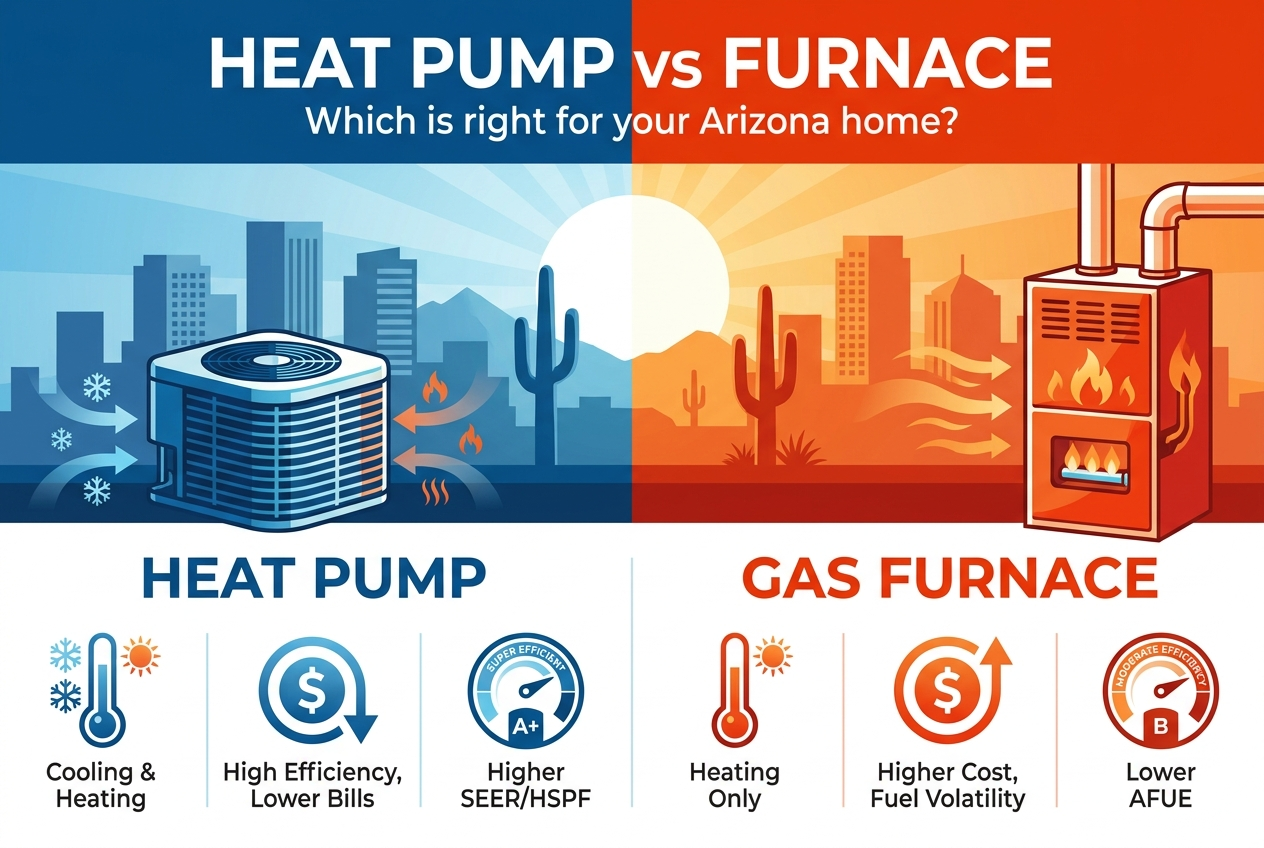
The simplest way to understand a heat pump vs furnace decision is to look at how each machine makes heat. A furnace creates heat by burning natural gas (or, less commonly here, using electric resistance elements). A heat pump doesn’t create heat at all — it moves it, pulling warmth from the outside air and transferring it indoors during winter, then reversing the process to cool your home in summer. That single design choice drives almost every practical difference between the two systems.
Because moving heat takes far less energy than generating it, a heat pump can deliver two to three units of heating energy for every unit of electricity it uses. A furnace, by contrast, can never exceed the energy stored in the fuel it burns. In our years serving the Valley, that efficiency gap is the number one reason we recommend heat pumps for most Phoenix-area homes — and it’s why our heat pump service and furnace service and repair teams stay busy year-round.
There’s another difference that matters for homeowners: a heat pump is a two-in-one system. It replaces both your air conditioner and your heater. A gas furnace only heats, so it must be paired with a separate AC unit. For a hot climate like ours, that consolidation simplifies maintenance, reduces the number of components that can fail, and often lowers your total ownership cost over the life of the equipment.
| Factor | Heat Pump | Gas Furnace |
|---|---|---|
| How it works | Moves heat — heats and cools in one unit | Burns gas to create heat — heating only |
| Efficiency rating | SEER2 (cooling) + HSPF2 (heating) | AFUE (% of fuel converted to heat) |
| Typical efficiency | Up to ~300% (2–3× energy delivered) | 80%–98.5% AFUE |
| Approx. annual heating cost (Phoenix) | ~$700 | ~$900 |
| Separate AC needed? | No — one system does both | Yes — pairs with an AC unit |
| Best climate fit | Mild winters like Phoenix & Tucson | Colder, higher-elevation areas |
| Approx. 15-year system cost | ~$28,500–$32,500 | ~$38,000–$42,000 (furnace + AC) |
| Rebates & incentives (2026) | Strong (Efficiency AZ HEAR, SRP Cool Cash) | Limited |
Operating Costs in Arizona
Operating cost is where the heat pump vs furnace comparison gets real for Phoenix budgets. In our climate, heat pumps are roughly 30% less expensive to run than gas furnaces during the heating season. A high-efficiency heat pump costs the typical Valley homeowner around $700 a year to heat with, while a comparable high-end furnace runs closer to $900. That’s a savings of $170 to $280 every winter — and because the same heat pump also handles your summer cooling, you’re maintaining one system instead of two.
The upfront picture matters too. A heat pump and an air conditioner cost roughly the same to install, but the heat pump also gives you heating in that single purchase. When you look at the full 15-year cost of ownership, a heat pump for a Phoenix home typically lands around $28,500–$32,500, compared with $38,000–$42,000 for a gas furnace paired with a separate AC. Utility rates, home size, and how well your ductwork is sealed all move those numbers, which is why our ductwork services team often finds easy savings before we ever quote new equipment.
Incentives tilt the math further toward heat pumps in 2026. Arizona’s Efficiency Arizona HEAR program offers up to $8,000 per heat pump for income-qualified households, and SRP’s Cool Cash program provides rebates up to roughly $1,125 for a high-capacity system. It’s worth noting that the federal HVAC tax credit expired on December 31, 2025, and APS eliminated its residential rebates for 2026 — so the strongest savings today come from the state and SRP programs. We help homeowners confirm current eligibility rather than promising a specific dollar amount, because these programs change and depend on your income and equipment.
Energy Efficiency
Understanding the ratings makes the efficiency conversation much clearer. A furnace is measured by AFUE (Annual Fuel Utilization Efficiency), a percentage that tells you how much of the fuel becomes usable heat — 80% is the standard baseline, and 90% to 98.5% is considered high-efficiency. A heat pump uses two different numbers: SEER2 for cooling efficiency and HSPF2 for heating efficiency. Both are ratios where a higher number means less wasted energy.
For 2026, the federal minimums for a new split-system heat pump are 14.3 SEER2 and 7.5 HSPF2. When you shop for equipment, remember that the “2” versions of these ratings come from a tougher DOE test that better reflects real ductwork, so an HSPF2 number will read about 15% lower than the older HSPF figure for the exact same unit — that’s a testing change, not a downgrade. Our AC installation and replacement specialists walk every customer through these numbers so the efficiency you pay for is the efficiency you actually get. Pairing a high-SEER2 system with clean filters and good indoor air quality practices protects that rating for years.
Which One Should You Choose for Your Home
For the vast majority of homes in Phoenix, Scottsdale, Tempe, Mesa, and the surrounding Valley, a heat pump is the better fit. Our winters are short and mild — Arizona sees only about 500 to 1,500 heating hours a year, and temperatures rarely dip below 40°F in the low desert. That’s exactly the range where a heat pump performs at its best, so it almost never gets cold enough here to challenge the equipment. If you’re weighing a heat pump vs furnace for a single-family home in the metro area, the heat pump’s two-in-one efficiency is hard to beat.
There are still situations where a furnace, or a hybrid setup, earns its keep. If your home sits at a higher elevation with genuinely cold nights, or you already have inexpensive natural gas service and value the intense, immediate warmth a furnace throws on a frosty morning, a gas furnace can be the right call. Some homeowners choose a dual-fuel (hybrid) system: a heat pump that carries most of the season efficiently, with a gas furnace that only kicks in on the coldest nights. We size and install these regularly and can tell you honestly whether the added complexity is worth it for your specific home.
Home layout matters as well. If you’re heating and cooling an addition, a casita, or a room with no ductwork, a ductless mini-split system — which is a type of heat pump — can be more practical than extending your central system. Older homes with tired ducts, on the other hand, sometimes benefit from a duct repair before any new system goes in. Whatever direction fits, our residential HVAC services team starts with your home, not with a product we’re trying to sell.
Neighborhood also plays a role in scheduling and service. We serve homeowners across the Valley, including Phoenix, Scottsdale, Tempe, Mesa, Chandler, Gilbert, and Glendale. You can see our full coverage on our service areas page.
Service and Installation
Choosing between a heat pump vs furnace is only half the job — the install and the ongoing service determine whether you actually get the comfort and savings the equipment promises. A perfectly good heat pump that’s oversized, undersized, or connected to leaky ducts will underperform and cost you more. That’s why every project we take on begins with a proper Manual J load calculation, a look at your ductwork, and an honest conversation about your budget and goals.
Experience is the difference here. Our company has spent years serving Phoenix-area homes and businesses, and our technicians are trained and certified to work on both heat pumps and gas furnaces safely and to code. Gas appliances in particular demand respect: we follow strict combustion-safety and gas-line procedures, verify proper venting, and test carbon monoxide levels on every furnace we touch. We invest in ongoing technician training because refrigerants, controls, and efficiency standards keep evolving, and we’d rather our team stay ahead of the curve than guess.
Once your system is in, keeping it healthy is straightforward. Regular tune-ups protect your warranty, hold onto that SEER2 and HSPF2 efficiency, and catch small problems before they become breakdowns during a July heat wave. Our maintenance programs keep both heat pumps and furnaces running at their rated performance, and if something does go wrong, our AC repair and diagnostics and 24/7 emergency repair teams are a phone call away. Transparency is part of how we work — we explain what we find, show you the options, and let you decide, which is a big reason for the positive reviews our customers leave. You can learn more about our company or browse more guides on our blog.
Frequently Asked Questions — Heat Pump vs Furnace in Arizona
Is a heat pump or furnace better for Phoenix winters? +
For most Phoenix-area homes, a heat pump is the better choice. Our winters are mild, which is exactly where a heat pump operates most efficiently, and it also handles your summer cooling in the same unit. A furnace makes more sense at higher elevations or where very cold nights are common.
How much does it cost to run a heat pump vs a furnace in Arizona? +
A high-efficiency heat pump typically costs around $700 a year to heat a Phoenix home, versus roughly $900 for a comparable gas furnace — about 30% less. Your exact cost depends on home size, insulation, and utility rates, so we recommend a load calculation for an accurate estimate.
Do heat pumps still work when it gets cold at night in the desert? +
Yes. Low-desert temperatures in the Valley rarely fall below 40°F, which is well within a heat pump’s efficient operating range. Modern units also include a backup heating element for the occasional cold snap, so your home stays comfortable on the coldest mornings.
What is a dual-fuel (hybrid) system, and do I need one in Phoenix? +
A dual-fuel system pairs a heat pump with a gas furnace. The heat pump handles most of the season efficiently, and the furnace only runs on the coldest nights. In the low desert, most homes don’t need one, but it can be worthwhile at higher elevations or for homeowners who want maximum comfort on frosty mornings.
What efficiency ratings should I look for in 2026? +
For a new split-system heat pump, the 2026 federal minimums are 14.3 SEER2 (cooling) and 7.5 HSPF2 (heating). Furnaces are rated by AFUE — 80% is standard and 90%–98.5% is high-efficiency. We’re happy to explain which numbers make sense for your budget and home.
Can you replace my old furnace with a heat pump? +
In most cases, yes. Converting from a gas furnace to a heat pump is a common upgrade in Phoenix, and it lets one system cover both heating and cooling. Our team evaluates your ductwork, electrical panel, and home size first, then recommends the right approach — reach out for a consultation.
The Bottom Line: Making the Right Call for Your Home
If you take one thing from this heat pump vs furnace breakdown, let it be this: in the Phoenix desert, the climate does the deciding for you. Mild winters, a two-in-one design, lower operating costs, and stronger 2026 incentives make the heat pump the practical choice for most Valley homes — while a gas furnace or a dual-fuel setup stays a smart option for colder pockets and specific comfort priorities. There’s no single “best” system, only the best system for your home, and the only way to know for sure is a professional load calculation and an honest look at your ductwork and budget. If you’re already thinking about summer performance, our guide to keeping your AC running efficiently is a good next read.
When you’re ready to talk it through, we’d love to help. Call Discount AC & Refrigeration of Phoenix at (602) 889-1367, or reach us through our contact page, and one of our trained technicians will give you a straight, no-pressure recommendation. Prefer to see us first? Visit and review our Google Business listing on the map — you can find our location, hours, and customer reviews there. We’re proud to keep Phoenix-area families comfortable in every season, and we’d be glad to add your home to the list. Stop by our local Google Maps listing, then contact us to schedule your heat pump vs furnace consultation today.