

Condensation in Commercial Fridge: Why It Sweats and What to Do About It
Condensation in a commercial fridge is one of the most common — and most misunderstood — warning signs restaurant owners and facility managers encounter. If your unit is sweating, dripping, or developing ice in places it shouldn’t, something in the refrigeration system is out of balance, and the longer it goes unchecked, the more expensive the repair will be. In this guide, we walk through every root cause of commercial refrigerator sweating, how to identify a serious fault before it escalates, and what our Phoenix-based technicians do to resolve it quickly — so you can protect your product, your equipment, and your health inspection score.
At Discount AC & Refrigeration of Phoenix, we have responded to hundreds of condensation-related service calls across the Valley. The pattern is almost always the same: a small moisture problem that looked manageable turned into a compressor failure, a corroded drain pan, or a failed evaporator coil — because the early signs were dismissed. This guide is designed to change that for your operation.
What Causes Condensation in a Commercial Fridge?
Condensation forms when warm, humid air contacts a cold surface. In a properly functioning commercial refrigeration unit, the system controls internal humidity, maintains a consistent temperature, and prevents warm outside air from infiltrating the cabinet. When any part of that system fails — the door seal, the defrost cycle, the condenser, or the drain — moisture accumulates where it should not. Here are the most common root causes our certified technicians identify during service calls:
- Worn or damaged door gaskets allowing warm kitchen air to infiltrate the cabinet continuously
- Defrost cycle malfunctions causing ice buildup on the evaporator followed by uncontrolled water release
- Dirty condenser coils forcing the compressor to overwork and disrupting the internal temperature balance
- High kitchen humidity overwhelming the unit’s moisture-rejection capacity
- Thermostat calibration drift causing the unit to run warmer than the setpoint indicates
- Loading warm product without pre-cooling, rapidly elevating interior humidity
- Blocked condensate drain lines allowing standing water to re-evaporate inside the cabinet
| Symptom | Most Likely Cause | Urgency | Professional Service Needed |
|---|---|---|---|
| Light exterior moisture on glass doors | High ambient humidity / monsoon conditions | Low | Gasket + HVAC check if persistent |
| Exterior moisture + warm product temps | Worn or failed door gasket | High | Gasket inspection & replacement |
| Water dripping inside the cabinet | Clogged condensate drain / defrost fault | High | Drain clearing + defrost system check |
| Ice on evaporator coil or back wall | Defrost heater or timer failure | High | Defrost system repair — schedule same day |
| Standing water under the unit | Drain pan overflow / blocked drain | High | Full drain system inspection |
| Constant fog on glass doors | Gasket failure + elevated kitchen humidity | Medium | Gasket replacement + humidity assessment |
| Frost or ice on door frame | Air infiltration + defrost fault combined | High | Urgent service — same-day call recommended |
| Rust or corrosion on interior components | Chronic long-term moisture exposure | Critical | Full system assessment — do not delay |
| Erratic temps + asymmetric condensation | Low refrigerant charge / refrigerant leak | High | Leak detection & system recharge |
Worn or Damaged Door Gaskets: The Most Common Root Cause
The door gasket is the first component we inspect on any condensation call involving a reach-in cooler or display case. A compromised magnetic seal allows warm, humid air from the kitchen to infiltrate the cabinet continuously — not just when the door is opened. Our technicians evaluate gasket integrity using a simple dollar-bill test: a properly sealing gasket holds a bill in place with firm resistance when the door is closed. If the bill slides out freely, the gasket needs replacement immediately.
In Phoenix kitchens operating at 95°F ambient, a leaking gasket doesn’t just cause sweating on your commercial refrigerator — it forces the compressor to run nearly continuously trying to compensate for the constant heat infiltration. We have seen compressors fail at three years of service life because a $40 gasket was never replaced. For reach-in coolers, prep tables, and display cases throughout the Valley, gasket replacement is among the most cost-effective preventive maintenance investments available.
Defrost System Malfunctions
Every commercial refrigerator runs a controlled defrost cycle to remove ice that accumulates on the evaporator coil during normal operation. When the defrost heater, defrost timer, or termination thermostat fails, the cycle either runs too long — flooding the drain pan and overflowing — or not long enough — allowing ice to build up until the evaporator is completely blocked. Both scenarios produce severe condensation problems, erratic cabinet temperatures, and accelerating mechanical stress on every downstream component. Our commercial refrigeration team diagnoses defrost faults using electronic data logs, temperature probes, and direct component testing during every inspection visit.
Condenser Coil Contamination
In commercial kitchens, condenser coils clog faster than most manufacturer maintenance schedules account for. Grease particles, dust, and debris accumulate on the condenser fins, reduce airflow across the coil, and force the system to raise head pressure to maintain cooling capacity. This directly affects the internal temperature balance of the cabinet and the unit’s ability to control condensate accumulation. Thorough condenser cleaning is part of every commercial refrigeration service we perform, and we recommend monthly cleaning for high-use restaurant equipment in Phoenix’s dusty, grease-laden kitchen environments.
Normal Sweating vs. a Serious Problem: How to Tell the Difference
Some exterior surface moisture on a commercial refrigerator is expected under specific conditions — particularly during Phoenix’s monsoon season (July through September) when outdoor dew points rise sharply and kitchen humidity spikes. The key is knowing what is situational and what indicates a fault that requires immediate action.
Signs That Are Generally Normal
- Light exterior moisture on glass doors during the first hour of a humid morning service period
- Brief fogging of door glass immediately after opening in a high-humidity kitchen environment
- Minimal moisture at door-frame edges during extended peak-humidity periods (monsoon weeks)
Warning Signs That Require Immediate Service
- Standing water on the floor beneath or inside the unit at any time
- Visible ice accumulation on the evaporator coil or cabinet back wall through the interior
- Fluctuating product temperatures occurring alongside visible moisture or dripping
- Mold or mildew growth around door frames, drain pans, or interior liner surfaces
- Puddles forming inside the cabinet during or immediately after a defrost cycle
- Rust or corrosion appearing on internal metal components, brackets, or shelf supports
- Ground fault circuit interruption (GFCI) tripping due to water contact with electrical components
If you are observing any of these in your operation, this is not a situation to monitor and wait. Our emergency commercial refrigeration service team responds quickly across the Phoenix metro. You can find our location and read what local businesses say about our response times on Google Maps.
How Our Technicians Troubleshoot Condensation in a Commercial Fridge
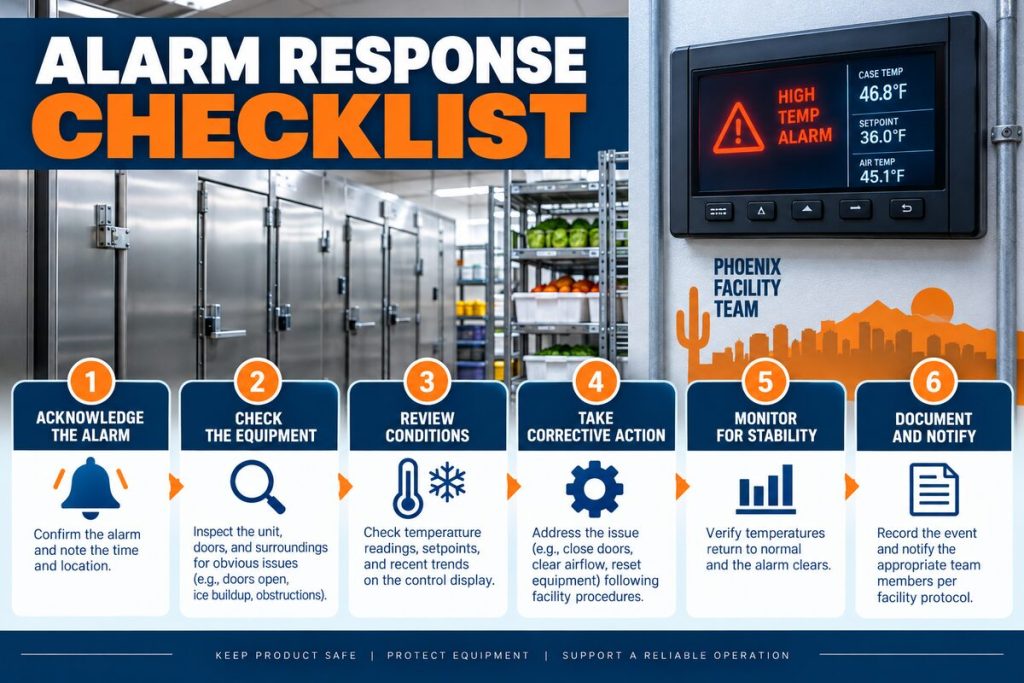
When we receive a service call about a sweating or dripping commercial refrigerator, our diagnostic sequence follows a consistent process designed to find the root cause — not just address the symptom. Here is what our technicians check, in order:
1. Door gasket inspection — Full perimeter evaluation on every door of reach-in units and walk-in coolers and freezers. We check magnetic seal strength, physical integrity along the full gasket, compression at the hinge side and latch side, and overall door alignment.
2. Defrost cycle review — We pull defrost event history from the electronic controller or manually cycle defrost on older mechanical units. We inspect drain pan condition, drain line clearance, heater element continuity, and termination thermostat function in sequence.
3. Condenser coil inspection — Full visual and airflow evaluation. In Phoenix’s kitchen environments, contaminated condensers are among the most consistent findings on units without a regular cleaning program in place.
4. Refrigerant charge verification — A low refrigerant charge causes the evaporator to run unevenly cold in certain zones, creating asymmetric condensation patterns that are characteristic of a leak. Our technicians are licensed for full refrigerant leak detection and system recharge across all commercial refrigerant types.
5. Controller and thermostat calibration — Electronic controllers on modern commercial refrigerators can develop calibration drift over time. A setpoint of 38°F reading as 44°F means the cabinet is running warmer than intended, directly increasing internal humidity and reducing the unit’s ability to prevent condensation. We recalibrate controllers and verify sensor accuracy as part of every diagnostic visit.
6. Drain line clearing and inspection — A blocked condensate drain is among the most common and most easily corrected problems we encounter — and among the most frequently missed during busy kitchen operations. We flush and verify every drain line as part of any condensation service call. For walk-in coolers and freezers where drain line access is limited, we use specialized clearing tools that reach blockages without requiring unit disassembly.
Why Phoenix Heat Makes Condensation Worse in Every Unit
Operating commercial refrigeration equipment in Phoenix is fundamentally different from operating the same equipment in a temperate climate. On a 110°F summer afternoon, the temperature differential between the inside of a commercial refrigerator running at 38°F and the surrounding kitchen can exceed 75°F. Every small imperfection — a slightly worn gasket, a partially dirty condenser coil, a defrost cycle miscalibrated by 10 minutes — has a proportionally larger effect than it would in a 72°F environment. The thermal stress our equipment faces here accelerates every failure mode associated with condensation.
Our monsoon season (July through September) compounds the challenge further. When outdoor dew points rise sharply and kitchen environments fill with steam from cooking and dishwashing, refrigeration units that performed adequately in April will often show condensation symptoms in August — not because anything failed, but because the operating conditions changed enough to exceed the system’s design tolerance. This is precisely why we recommend a scheduled preventive maintenance program for all commercial refrigeration equipment operating in the Valley, and why our full commercial services team addresses HVAC and refrigeration under one service relationship — because the two systems directly affect each other’s performance.
We serve restaurant owners, facility managers, grocery operations, and commercial kitchens across Phoenix, Scottsdale, Mesa, Chandler, Tempe, Gilbert, and the surrounding area. If you want to see our exact service coverage and read reviews from operations like yours, visit us on Google Maps.
Preventive Maintenance: How to Stop Condensation Before It Starts
The most effective strategy against condensation in commercial refrigerators is a structured preventive maintenance schedule. The specific tasks that deliver the greatest impact on condensation control are:
Quarterly gasket inspection and replacement — Do not wait for a gasket to fail visibly. Gaskets degrade gradually: the slow increase in air infiltration that begins months before complete failure raises the thermal load on every downstream component. Our walk-in cooler and freezer service team includes full gasket evaluation at every PM visit for both walk-in and reach-in units.
Monthly condenser coil cleaning — In a Phoenix commercial kitchen environment, monthly cleaning is appropriate for high-use equipment. The combination of cooking grease and desert dust creates a contamination rate that exceeds standard manufacturer cleaning intervals. Performance degradation from a dirty condenser is immediate and directly measurable on the unit’s run time and discharge pressure.
Defrost cycle verification every 90 days — Confirming that the defrost cycle completes correctly, the drain flows freely, and the heater element is functional takes less than 30 minutes per unit and prevents the most common condensation-related failures we see in the field. We include this verification in every commercial refrigeration maintenance visit.
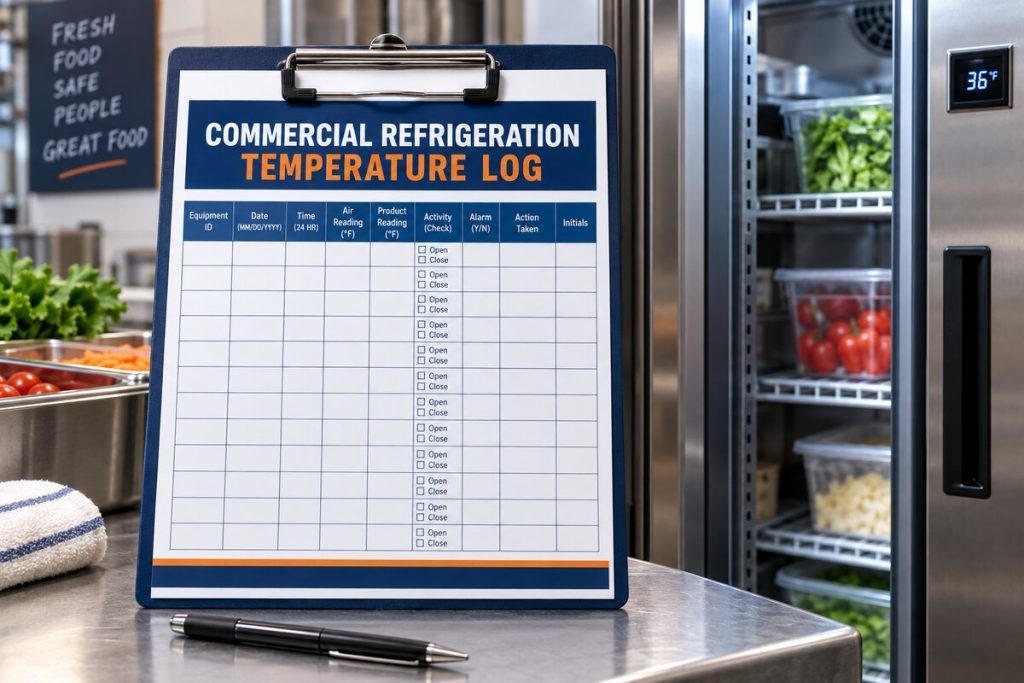
Temperature and humidity data logging — Modern commercial refrigerators support data logging that allows our technicians to review temperature trend histories, identify defrost pattern anomalies, and flag developing problems before they manifest as a condensation event or product loss incident. We configure data logging on new equipment installations and retrofit solutions on older units as needed.
HVAC ventilation assessment — If your kitchen’s mechanical ventilation system is not maintaining adequate air exchange and negative pressure relative to the dining area, the humidity environment surrounding your refrigeration equipment will elevate regardless of how well the refrigerators themselves are maintained. Our commercial HVAC team can assess kitchen ventilation as part of a combined service plan that covers both systems under one relationship.
If you also operate a commercial ice machine, condensation issues can affect both ice production quality and machine sanitation. Our ice machine service team handles preventive maintenance and emergency repairs on all major commercial ice machine brands. And if you have a unit with an aging compressor showing signs of thermal stress alongside condensation, our compressor replacement team can evaluate whether a targeted replacement makes more economic sense than continued repair. Learn more about our certifications and service history on our About Us page — we want every Phoenix kitchen manager to understand who they are trusting with their critical equipment.
Frequently Asked Questions — Condensation in Commercial Fridges
Is condensation in a commercial fridge always a sign of mechanical failure? +
Not always. Light exterior moisture during Phoenix’s monsoon season or during periods of very high kitchen humidity can be normal if it clears on its own and product temperatures remain stable. However, any moisture inside the cabinet, water pooling on the floor, ice buildup on the evaporator, or product temperature fluctuations alongside visible sweating are reliable indicators of a mechanical fault that requires professional diagnosis. When in doubt, call our team — a 30-minute diagnostic visit is far less costly than a failed compressor or a health inspection citation.
How often should a commercial refrigerator be serviced in Phoenix to prevent condensation? +
For restaurant and foodservice operations in Phoenix, we recommend a quarterly preventive maintenance schedule at minimum — with monthly condenser coil cleaning for high-use equipment. Phoenix’s combination of extreme heat, desert dust, and kitchen grease accelerates every condensation-related failure mode compared to equipment operating in milder climates. Units with a documented history of condensation issues should be inspected more frequently until the root cause is fully resolved and confirmed stable over multiple service intervals.
Can high kitchen humidity cause my commercial fridge to sweat even if nothing is broken? +
Yes — particularly during Phoenix’s monsoon season. If your kitchen’s mechanical ventilation is not maintaining adequate air exchange and the relative humidity around your refrigeration equipment is elevated, you will see surface condensation even on a unit with no faults. However, persistent sweating under elevated humidity conditions is also a signal that your kitchen HVAC and ventilation system needs evaluation. Our team addresses both refrigeration and HVAC, so we can assess the full environment and recommend integrated solutions that stop the problem at its source.
What happens if I ignore condensation in my commercial refrigerator? +
Ignoring condensation leads to a predictable cascade of failures. Chronic moisture accelerates corrosion of internal components, creates mold and bacterial growth in drain pans and around gaskets, causes premature evaporator and compressor failure, drives up energy consumption as the unit compensates for heat infiltration, and — most critically — puts your food safety compliance at risk. In Arizona, a health inspector finding standing water, mold, or product temperature violations directly related to a failing refrigeration system can result in citation, temporary closure, or required disposal of affected product. The cost of a service call is always a fraction of those outcomes.
How quickly can a technician respond to a condensation emergency in Phoenix? +
We offer same-day service for commercial refrigeration emergencies across the Phoenix metro area. When you call (602) 889-1367, our dispatch team will connect you with the nearest available certified technician and provide an estimated arrival time. For operations where refrigeration downtime creates immediate food safety risk or significant product loss, we treat the call as a priority dispatch. Our service vehicles are stocked with the most common gaskets, drain components, defrost parts, and controls so most repairs can be completed in a single visit.
Does Discount AC & Refrigeration of Phoenix also service walk-in coolers and walk-in freezers? +
Yes — walk-in coolers and walk-in freezers are among our most commonly serviced equipment types. Condensation in walk-in units presents additional complexity compared to reach-in coolers because the cabinet volume is larger, drain line runs are longer, and the thermal envelope depends on panel seal integrity across a much greater surface area. Our technicians are trained and equipped to diagnose and repair condensation issues in walk-in equipment of all sizes, brands, and configurations across the Phoenix metro area.
Stop Paying for Moisture Problems — Talk to Our Phoenix Refrigeration Team Today
Condensation in a commercial fridge is not a cosmetic inconvenience. Left unaddressed, it causes food safety violations, accelerates compressor and evaporator failure, drives up energy costs, and creates the mold and moisture conditions that trigger health department citations. We have worked alongside restaurant owners, commercial kitchen managers, grocery operations, and convenience stores across the Phoenix metro for years — and the operations that manage costs best treat a dripping refrigerator as an urgent maintenance item, not a minor nuisance.
Our certified technicians at Discount AC & Refrigeration of Phoenix are trained and equipped to diagnose and resolve every cause of condensation in commercial fridges, with the parts to complete most repairs in a single visit. Whether you need a same-day gasket replacement, a full defrost system rebuild, a compressor replacement, or a structured commercial refrigeration maintenance program for your entire fleet of equipment, our team is ready to help. You can also explore our service areas across the Phoenix metro to confirm we cover your location.
📞 Call us at (602) 889-1367 to schedule an inspection or request emergency service today. You can also contact us online for non-urgent requests, or find our team directly on Google Maps to read reviews from Phoenix businesses who trust us with their refrigeration equipment every season. Don’t let condensation in your commercial fridge turn into a $10,000 breakdown — reach out to our team and we’ll get your unit running right.