
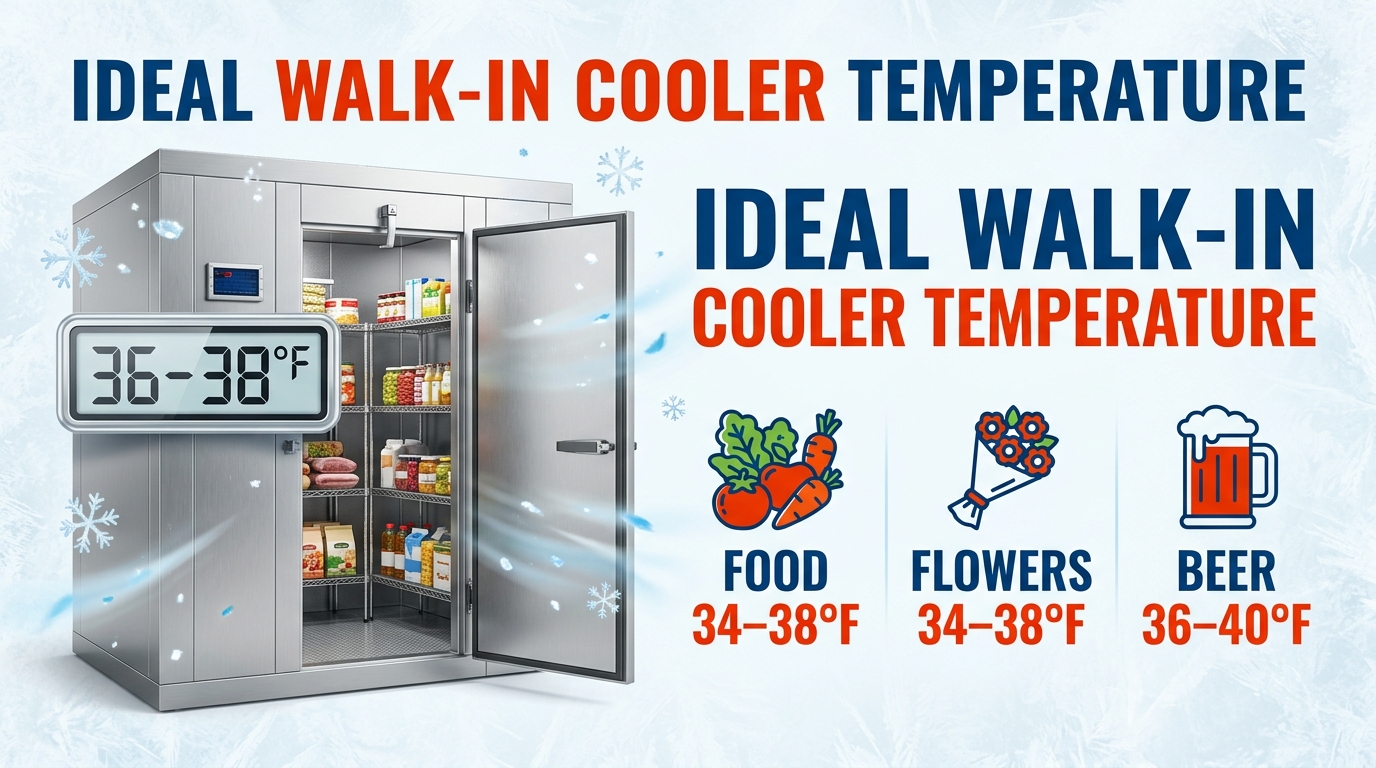
The ideal walk-in cooler temperature is between 34°F and 38°F, with most Phoenix operators dialing in a set point of 36°F to 38°F. That range keeps perishable inventory safely below the FDA cold-holding limit of 41°F while leaving a buffer for door openings and restocking. Walk-in freezers are a different story and should sit at 0°F or below. In this guide, our certified refrigeration team explains the correct settings by product, how to monitor them, and how we fix the temperature problems we see most often in Valley kitchens.
What Is the Correct Temperature for a Walk-In Cooler?
For a standard cooler storing food, we recommend a target of 36°F to 38°F, comfortably inside the safe 34°F–38°F window. The reason we aim a few degrees below the legal maximum is simple: every time a door opens on a busy line, warm Phoenix air rushes in and the interior climbs briefly. Setting your walk-in cooler to 37°F gives you a working cushion so the product never drifts into the danger zone above 41°F, where bacteria on temperature-controlled-for-safety (TCS) foods can double roughly every 20 minutes.
The correct number also depends on what you store. A restaurant cooler, a grocery display case, and a florist’s box each have slightly different needs. That is why we treat every unit as its own system when we service commercial refrigeration across the Valley, and why we always ask what is going inside before we recommend a set point. The chart below sums up the ranges we set most often.
| Stored Item | Ideal Temperature | Humidity | What We Watch For |
|---|---|---|---|
| Fresh produce & prepared food | 34–38°F | 80–90% | Stays below the 41°F FDA limit for TCS foods |
| Dairy & eggs | 34–38°F | 75–85% | Keep off the floor and away from door drafts |
| Raw meat & poultry | 32–36°F | 80–90% | Store on the lowest shelf to prevent drips |
| Cut flowers | 34–38°F | 80–95% | Needs a dedicated floral cooler with gentle airflow |
| Beer & beverages | 36–40°F | Low | Drier, higher-velocity air is fine here |
| Frozen goods (freezer) | 0°F or below | — | Requires a separate walk-in freezer, not a cooler |
Food vs. Flowers vs. Beer: Why One Setting Doesn’t Fit All
The three products we get asked about most — food, flowers, and beer — land in a similar temperature band but demand very different conditions inside the box. Getting the number right is only half the job; humidity and airflow matter just as much.
Food. For restaurants and the commercial kitchens we service, 34°F–38°F with 80–90% humidity keeps produce crisp and prevents the dry-out and freezer burn that eat into food cost. Raw proteins do best at the colder end, around 32°F–36°F, stored low so nothing drips onto ready-to-eat items. If you also run a reach-in cooler or display case up front, hold it to the same range so product moving from back to front never warms up.
Flowers. Cut flowers want the same 34°F–38°F but with much higher humidity — 80% to 95% — and slow, gentle airflow. A standard beverage box will technically hit the temperature, yet its dry, high-velocity air gives petals “wind burn” and shortens vase life by days. That is why florists need a purpose-built floral cooler rather than a repurposed beverage unit.
Beer. Beverages are the most forgiving. Most bars and restaurant operations hold beer between 36°F and 40°F, and the drier, higher-airflow environment that would ruin flowers is perfectly fine for kegs and bottles. If you serve draft, a stable set point matters more than an especially cold one, since temperature swings cause foaming and pour problems at the tap.
Why Walk-In Cooler Temperature Matters More in Phoenix
Holding a steady walk-in cooler temperature is harder in the desert than almost anywhere else, and we see the proof every summer. When outdoor air pushes past 110°F, your refrigeration system works against a punishing heat load. The condenser has to reject heat into air that is already scorching, so a unit that held 37°F all winter can start creeping upward in July if it has not been serviced.
Across Phoenix, Scottsdale, and Mesa, we regularly find coolers that run fine at night but lose the battle during afternoon peaks. Dirty condenser coils caked with dust, a rooftop compressor baking in direct sun, and refrigerant that has slowly leaked over a season all reduce capacity right when you need it most. Placement matters too — a condenser mounted in full afternoon sun or crowded against a wall runs hotter and loses efficiency, which is why we look at where and how the equipment is installed, not just the number on the gauge. Newer inverter compressor technology handles these extremes better, but any system — new or old — depends on airflow, a clean coil, and a proper refrigerant charge.
This is also where refrigeration and climate control overlap. A commercial kitchen that is not itself well cooled adds load to every cold box inside it, which is one reason we look at the whole building, including commercial HVAC, when a cooler struggles to hold temperature. You can always find us on the map and reach our Phoenix crew directly.
How to Monitor Your Walk-In Cooler Temperature
You cannot manage what you do not measure. The built-in dial on the wall tells you what the controller thinks is happening near the evaporator — not what the product on the middle shelf is actually experiencing. Reliable monitoring is the difference between catching a problem early and finding spoiled inventory at open.
Tools We Recommend
- A calibrated dial or digital thermometer placed in the warmest part of the box — usually near the door — so your reading reflects worst-case product temperature.
- A wireless data logger that records around the clock and sends an alert to your phone if the walk-in cooler temperature rises above a threshold you set. For high-value inventory, this pays for itself the first time it prevents a loss.
- A well-maintained digital controller that manages the defrost cycle correctly, so ice never builds up on the evaporator and throws off your readings.
Where to Place the Thermometer and How Often to Log
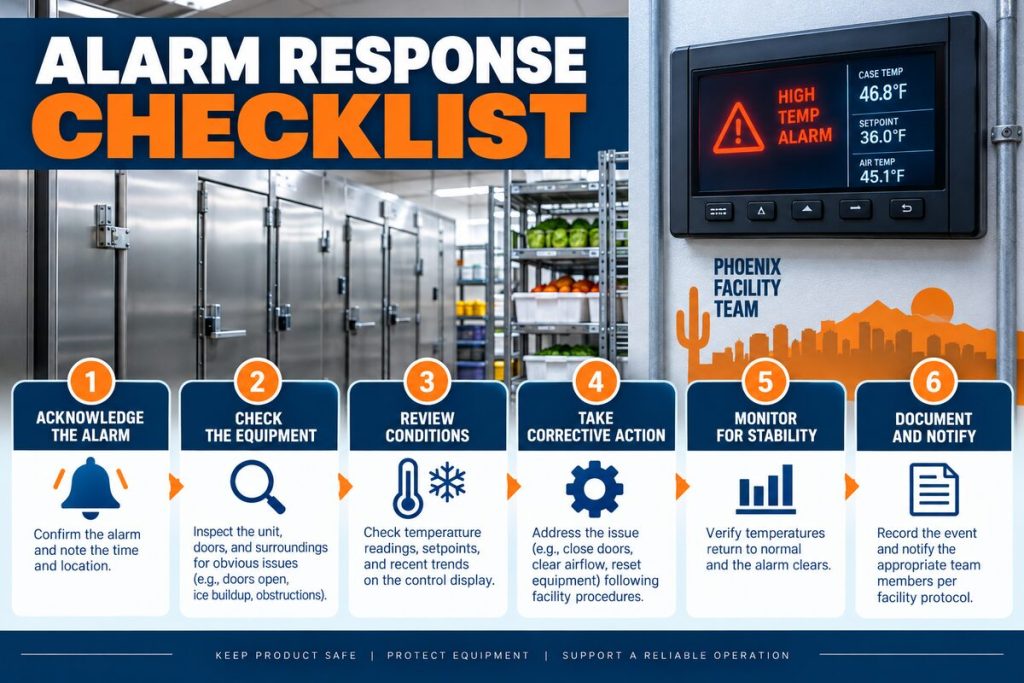
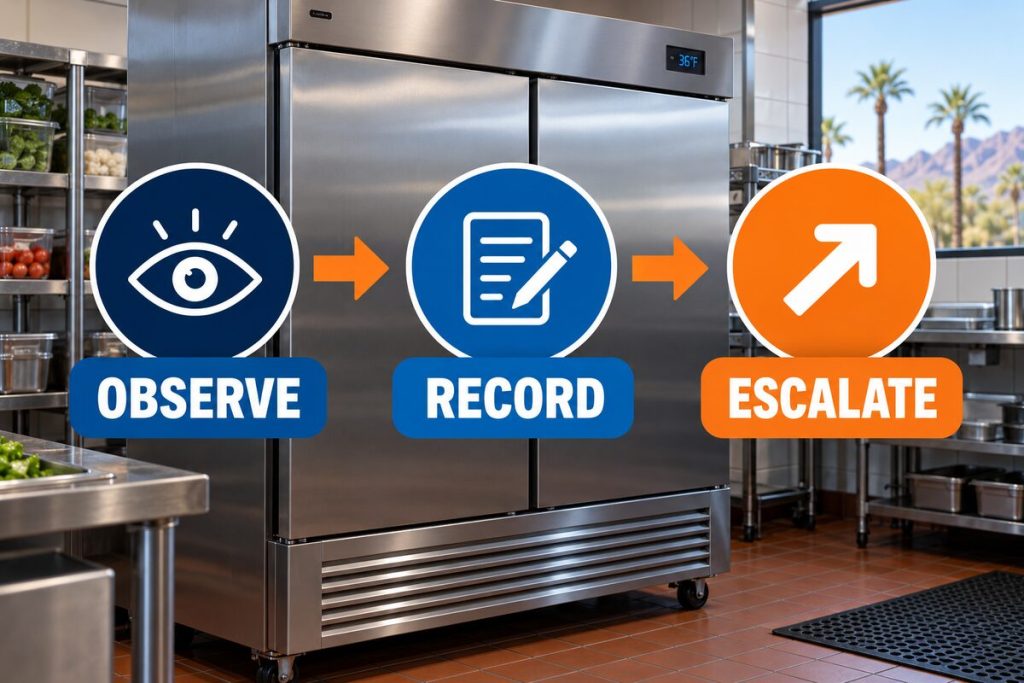
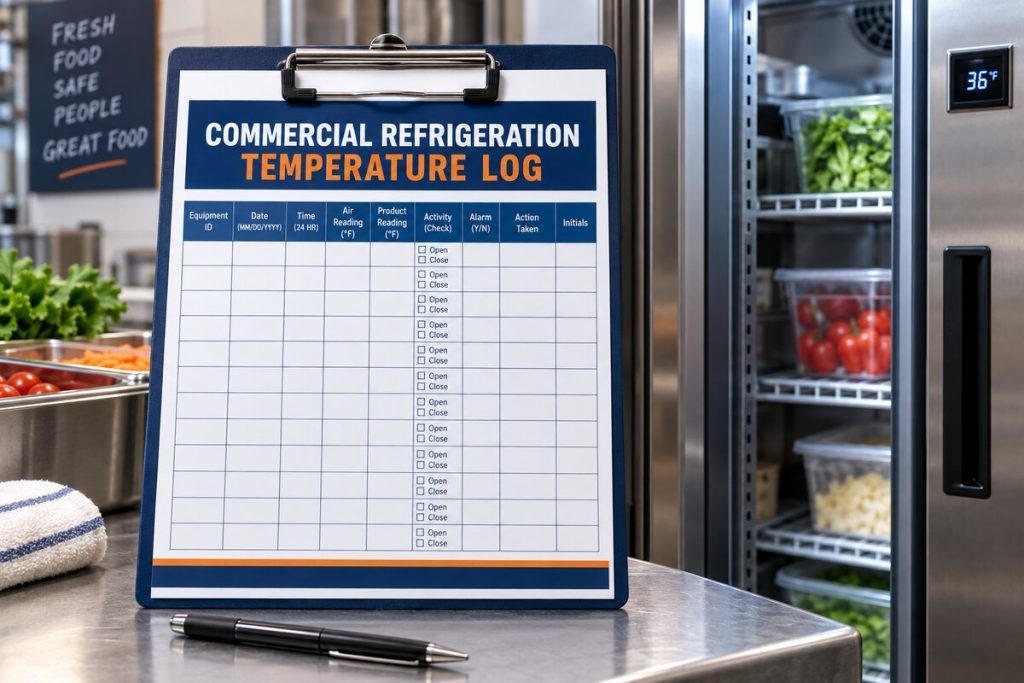
Keep the thermometer away from the evaporator’s direct airflow and out of the door draft, at product height. Health inspectors and HACCP plans expect a temperature log, so we tell our clients to record readings at least twice a day — once at open and once during peak service. If you see the number sitting at 40°F or higher, treat it as a warning and investigate before it becomes a violation. A simple habit of logging, paired with a preventive maintenance plan, catches most issues long before product is at risk. One habit we wish more operators kept is calibrating their thermometers: a dial can drift several degrees over a year, so a quick ice-water check — a properly calibrated probe reads 32°F in a slush of ice and water — tells you whether the number on the wall can be trusted. Persistent condensation or dripping is another early flag — our guide on condensation in a commercial fridge explains what it means and, when it points to a hidden leak, why refrigerant leak detection is the right next step.
Common Walk-In Cooler Temperature Problems and Solutions
Over decades of service calls across Maricopa County, the same handful of temperature complaints come up again and again. Here is how we diagnose each one and what usually fixes it.
The Cooler Is Running Too Warm
A cooler that will not get below 41°F is the call we get most in summer. The usual suspects are a dirty condenser coil, a failing door gasket that lets warm air leak in, an overloaded box with no room for air to circulate, or a low refrigerant charge from a slow leak. We start with the simple, no-cost checks — coil cleaning, gasket inspection, and airflow — before testing the charge. Loading a large delivery of room-temperature product all at once also spikes the box, so we coach staff to stagger big loads and keep the door closed between trips. When the compressor itself is worn out and can no longer pull the box down, compressor replacement restores full capacity. If your inventory is already at risk, our emergency refrigeration team responds fast.
The Cooler Is Too Cold or Freezing Product
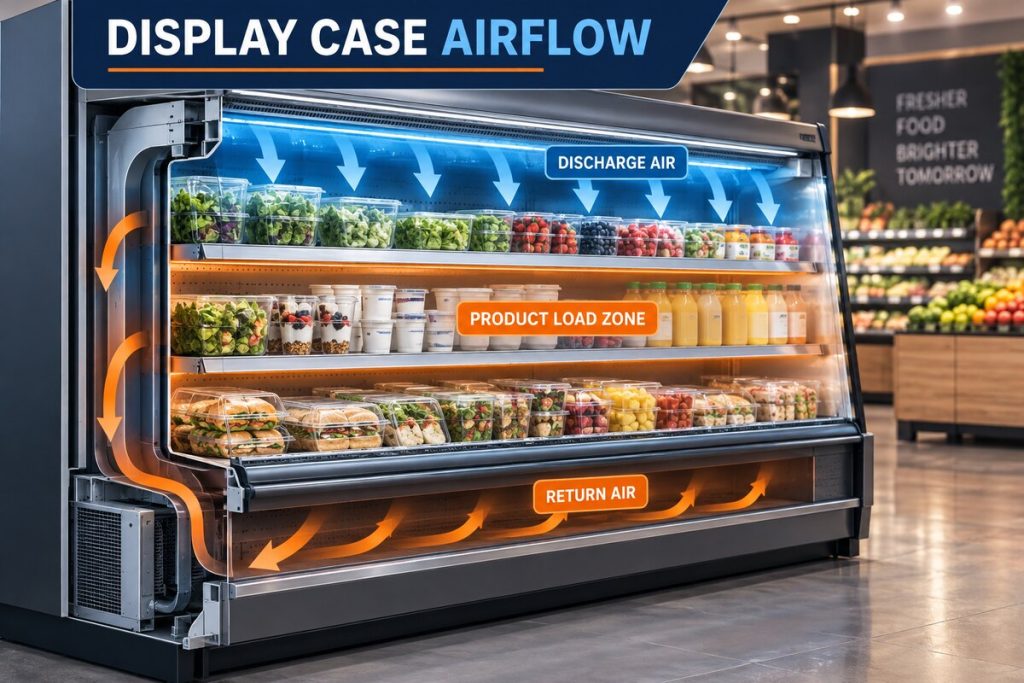
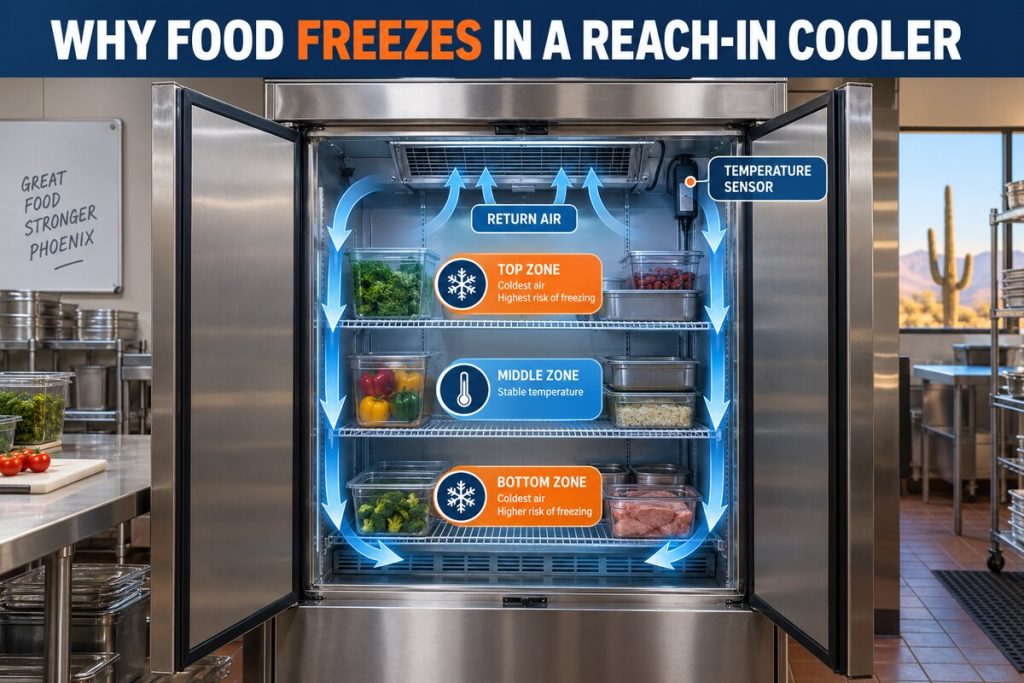
The opposite problem — lettuce freezing on the back shelf — usually points to a miscalibrated thermostat, a stuck controller, or product stacked directly in front of the evaporator’s cold discharge. Recalibrating the control and rearranging storage so nothing sits in the airflow path solves most cases. If the thermostat is failing outright, we replace it and verify the box holds a steady set point afterward. Our walk-in cooler repair guide walks through the warning signs and typical costs in more detail.
Temperature Swings and Short-Cycling
A box that bounces between 34°F and 44°F is often short-cycling — the compressor kicks on and off too frequently — or fighting an oversized load it was never sized for. If you are constantly running out of room and the unit never rests, the box may simply be too small for your volume; our walk-in freezer capacity guide shows how proper sizing prevents exactly this. We also check defrost timing, since a unit that defrosts too rarely ices over and reads erratically. If you rely on an attached ice machine, the same swings can disrupt its harvest cycle, so we look at the whole cold system together.
Our Experience Keeping Phoenix Coolers Dialed In
We are not guessing at these numbers — we set them every day. Discount AC & Refrigeration of Phoenix is a family-owned company with more than 20 years serving Arizona, and refrigeration is core to what we do. Our technicians hold EPA Universal certification, which is the federal requirement for anyone handling refrigerant, and we operate under Arizona ROC license 361623.
That experience spans real Phoenix kitchens: restaurants, breweries, grocery operations, and florists that all depend on holding the right walk-in cooler temperature through triple-digit summers. We invest in our people through an in-house training program so every technician who shows up understands both the food-safety stakes and the mechanical fix. Just as important, we believe in transparent, up-front pricing — we explain what we find, show you the reading, and give you the options before we do the work. That approach is why local businesses keep calling our team back.
Frequently Asked Questions — Walk-In Cooler Temperature
What is the ideal walk-in cooler temperature? +
The ideal walk-in cooler temperature is 34°F to 38°F, and we recommend a set point of 36°F to 38°F for most food storage. That keeps product safely below the 41°F FDA cold-holding limit while leaving a buffer for door openings.
What temperature is too warm for a walk-in cooler? +
Anything above 41°F is too warm, because that is where TCS foods enter the bacterial danger zone. If your cooler is holding at 40°F or climbing, treat it as a warning sign and investigate the condenser, door gaskets, and refrigerant charge right away.
How often should we check the temperature? +
Log the temperature at least twice a day — once at open and once during peak service — to satisfy HACCP and health-inspection expectations. A wireless data logger is even better, since it records continuously and alerts you the moment the box drifts out of range.
Why does our walk-in cooler temperature keep fluctuating? +
Swings usually trace back to worn door gaskets, a dirty condenser coil, an overloaded box, low refrigerant, or a short-cycling compressor. In the Phoenix heat, a dust-caked coil is one of the most common causes. A quick service visit will identify which one is at play.
What should a walk-in freezer be set to? +
A walk-in freezer should hold 0°F or below to keep frozen goods solid and safe. A cooler and a freezer are different systems, so never try to run one box for both — if you need frozen storage, you need a dedicated walk-in freezer.
Keep Your Walk-In Cooler Temperature Right, Season After Season
Dialing in the correct walk-in cooler temperature is not a one-time setting — it is an ongoing partnership between your team’s daily logging and a refrigeration crew that knows Arizona’s brutal summers firsthand. When the box is holding a steady 37°F, your inventory is protected, your inspections go smoothly, and you are not scrambling at 6 a.m. over a warm shelf of product. When it is not, the sooner someone with the right tools takes a look, the less it costs you. If a system is already struggling, our walk-in cooler repair guide is a good next read.
Whether you need a set point checked, a nagging temperature swing solved, or a full commercial refrigeration tune-up before summer, our certified Phoenix technicians are ready to help. Contact Discount AC & Refrigeration of Phoenix or call (602) 889-1367, and be sure to visit our Google Business listing on the map to see reviews from Valley businesses we already keep cold. Let’s keep your walk-in cooler temperature exactly where it needs to be.