

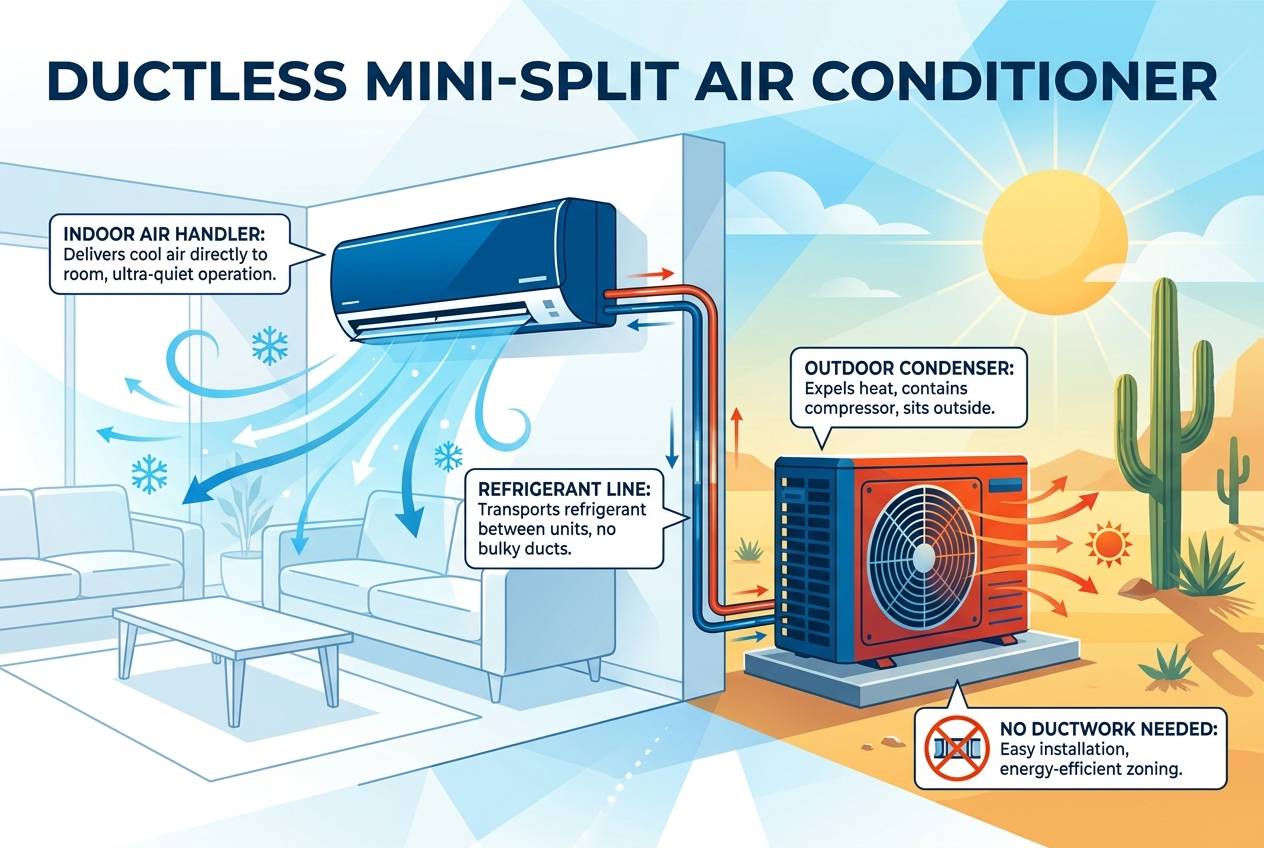
A ductless air conditioner, often called a mini-split, cools individual rooms without any ductwork by pairing a small indoor air handler with an outdoor condenser. It runs quietly, sips electricity, and is ideal for room additions, garages, and older Phoenix homes where extending ducts is impractical or too costly.
At Discount AC & Refrigeration of Phoenix, we install and service these systems across the Valley every week, so we know exactly why a ductless air conditioner appeals to so many homeowners. Whether you are cooling a converted garage, a sunroom, or a back bedroom that never quite gets comfortable, a ductless mini-split system delivers targeted comfort with strong efficiency numbers. In this guide we explain what these systems are, how they work, their real advantages and trade-offs, the situations where they shine, and what a professional installation looks like for homes near our Phoenix service area.
What Is a Ductless Mini-Split System
A ductless mini-split is a two-part cooling and heating system. One part hangs on an interior wall (or mounts on the ceiling or floor) and blows conditioned air directly into the room. The other part sits outside and does the heavy lifting of moving heat. Instead of pushing air through a network of sheet-metal ducts hidden in your attic, the two units are joined only by a slim bundle of refrigerant lines, a power cable, and a condensate drain that pass through a three-inch hole in the wall.
Because there are no ducts, the system avoids the energy losses that plague traditional central systems. In many homes, air traveling through leaky or poorly insulated ducts loses a meaningful share of its cooling before it ever reaches the room, and in a Phoenix attic that can climb well past 140°F in summer, those losses add up fast. A ductless setup sidesteps that problem entirely, which is one reason we often recommend it alongside our broader residential HVAC services.
Mini-splits come in two main configurations. A single-zone system pairs one outdoor unit with one indoor head, perfect for a single problem room. A multi-zone system connects one outdoor unit to several indoor heads, so you can cool a whole addition, a casita, or multiple bedrooms independently. Each indoor head has its own remote and thermostat, so one person can keep a home office cool while the rest of the house stays warmer.
| Feature | What to Know |
|---|---|
| System type | Two-part heat pump: indoor air handler + outdoor condenser, no ducts |
| Zones | Single-zone (1 room) or multi-zone (up to 5–8 indoor heads) |
| Efficiency | High SEER2 ratings; inverter compressors modulate instead of cycling on/off |
| Heating | Provides both cooling and heating year-round |
| Best for | Additions, garages, casitas, sunrooms, older homes without ducts |
| Typical lifespan | 15–20 years with regular maintenance |
| Install time | Often one day for a single zone; longer for multi-zone |
How a Ductless Air Conditioner Works
Every ductless air conditioner is a heat pump, and understanding that one fact explains almost everything about how it behaves. Rather than “creating” cold air, the system moves heat from one place to another using refrigerant. In cooling mode it absorbs heat from inside your home and releases it outdoors; in heating mode it simply reverses that flow, pulling heat from the outdoor air and delivering it inside.
The refrigerant cycle, step by step
Warm indoor air is pulled across a cold evaporator coil inside the wall-mounted head. As the refrigerant in that coil absorbs the room’s heat, it evaporates into a low-pressure gas and the now-cooled air is blown back into the room. That gas travels down the refrigerant line to the outdoor condenser, where the compressor pressurizes it. The hot, high-pressure gas then passes through the outdoor coil, dumps its heat to the outside air, and condenses back into a liquid before returning indoors to start again. It is the same principle used in our heat pump service work and in every refrigeration system we maintain.
Why inverter technology matters in the desert
The biggest difference between a mini-split and an older central unit is the inverter-driven compressor. A conventional system runs at full blast until the thermostat is satisfied, then shuts off completely, repeating that cycle all day. A ductless system instead ramps its compressor up and down to match the exact cooling demand of the room. On a 112°F Phoenix afternoon it can run at full capacity, then throttle back to a whisper once the space is comfortable. That steady modulation holds temperatures within a degree or two, reduces humidity swings, and trims energy use compared with the constant stop-start of older equipment. When a mini-split does lose its cooling touch, our AC repair and diagnostics team can pinpoint whether the culprit is refrigerant, the compressor, or a sensor.
Each indoor head also filters the air as it circulates, capturing dust and allergens. It is not a substitute for a whole-home solution, but paired with our indoor air quality services, a clean mini-split filter noticeably helps households sensitive to the fine dust that blows in during monsoon season.
Advantages and Disadvantages of Going Ductless
No single system is right for every home, so we always walk homeowners through both sides before they invest. A ductless air conditioner has clear strengths, but it also carries a few trade-offs worth understanding up front.
The advantages
Efficiency tops the list. With no duct losses and an inverter compressor, mini-splits routinely post some of the highest SEER2 ratings in residential cooling, which shows up directly on your APS or SRP bill. Zoning is the second big win: you cool only the rooms you use, when you use them, instead of paying to condition an empty guest room. Installation is far less invasive than adding ducts, so there is no tearing open ceilings or walls. They run remarkably quietly, the indoor heads are compact, and because each unit provides heating too, one system covers you through the mild Phoenix winter without a separate furnace.
The disadvantages
The honest trade-offs are cost and aesthetics. The upfront price per zone can be higher than simply extending existing ductwork, especially once you add several heads. Some homeowners also dislike the look of a unit mounted on the wall, though ceiling-cassette and low-profile floor options soften that concern. Multi-zone systems need careful load calculations, because an oversized system short-cycles and an undersized one never keeps up in July. And like any equipment, mini-splits need routine care; skipping filter cleanings or condensate maintenance shortens their life. That is exactly why we encourage customers to enroll in our maintenance programs and, for anything urgent, lean on our 24/7 emergency AC repair.
For homes that already have healthy ducts in good condition, a traditional replacement handled by our AC installation and replacement team can still be the better value. When ducts are leaky or missing, though, ductless usually pulls ahead, and improving existing runs through our ductwork services is another path we compare honestly.
Ideal Use Cases: Room Additions, Garages, and More
The clearest way to know whether a ductless air conditioner is right for you is to look at where it consistently outperforms other options. Over the years our technicians have installed mini-splits in nearly every scenario the Valley can throw at them.
Room additions and converted spaces
When you add a room, your existing central system was never sized to cool it. Tapping into those ducts often robs the rest of the house of airflow. A dedicated mini-split solves the new space without touching the original system, which is why additions are our single most common ductless request from homeowners in Scottsdale and Tempe.
Garages and workshops
A Phoenix garage can turn into an oven. Homeowners who use that space as a gym, workshop, or hobby room love how quickly a ductless head tames the heat, and because the unit heats too, it stays usable on cool winter mornings. Garages are rarely on the home’s duct plan, so ductless is often the only practical answer.
Casitas, sunrooms, and older homes
Detached casitas and guest suites benefit from independent control and separate billing zones. Sunrooms with lots of glass gain and lose heat quickly, so a modulating mini-split keeps up far better than a duct run ever could. And in the Valley’s older, historic homes that were built before central air, ductless lets us add real comfort without gutting original plaster and woodwork. We see this constantly in neighborhoods around Chandler and across our other service areas. For light commercial spaces, the same logic scales up through our commercial HVAC and VRF/VRV systems offerings.
Ductless Installation in Phoenix
A ductless air conditioner is only as good as its installation, and in our climate the margin for error is thin. Proper sizing, placement, and refrigerant charging are what separate a system that quietly performs for two decades from one that struggles by its second summer.
What a professional install involves
We start with a load calculation that accounts for square footage, insulation, window exposure, and ceiling height, because Phoenix sun load is unforgiving and a guess is not good enough. From there we choose head locations for even air distribution, mount the outdoor condenser where it can breathe and stay serviceable, run and pressure-test the refrigerant lines, and verify the charge to the manufacturer’s spec. A correct charge is critical in the desert; even a small deviation costs efficiency and capacity when you need it most. You can read more about our standards and background on our about us page.
Experience and training you can verify
Our team brings years of hands-on desert HVAC experience, and we invest in ongoing technical education through our in-house training program so our technicians stay current on the latest inverter systems and refrigerants. That experience shows up in the details, from clean line-set routing to honest recommendations about whether ductless is truly your best option. We are proud of the reputation we have earned with Valley homeowners, and we hold ourselves to strict safety and workmanship standards on every job. When you are ready to talk specifics, our contact page and phone line are the fastest way to reach us, and you can always find directions and hours on our Google Business listing.
Frequently Asked Questions — Ductless Air Conditioners
How much does a ductless air conditioner cost in Phoenix? +
Cost depends on the number of zones, the capacity you need, and the complexity of the install. A single-zone system for one room is the most affordable option, while multi-zone setups cost more because they add indoor heads and refrigerant runs. We provide a firm quote after a load calculation so there are no surprises.
Can one ductless system cool my whole house? +
Yes, with a multi-zone system. A single outdoor condenser can support several indoor heads, each with its own thermostat. We size the outdoor unit to the combined load of every room so the system keeps up even during peak summer demand.
Does a ductless air conditioner also provide heat? +
Nearly all modern mini-splits are heat pumps, so they cool in summer and heat in winter. For the mild Phoenix winter, a ductless heat pump easily handles a room’s heating needs without a separate furnace.
How long does installation take? +
A single-zone install is often finished in one day. Multi-zone systems take longer because each indoor head adds line-set routing, mounting, and testing. We confirm the timeline during your estimate.
How much maintenance does a mini-split need? +
Plan to clean the washable filters every few weeks during heavy use and schedule an annual professional tune-up. Regular service keeps efficiency high, protects the compressor, and helps the system reach its full 15-to-20-year lifespan in our dusty climate.
Is ductless better than central AC for my home? +
It depends. Ductless wins for additions, garages, and homes without good ducts. If your home already has healthy ductwork, a central replacement may offer better value. We assess both and give you an honest recommendation rather than a one-size-fits-all answer.
Ready to Cool That Room the Right Way?
Choosing a ductless air conditioner comes down to matching the system to your space, and that is a conversation worth having with people who install them in Phoenix homes every single week. If a stubborn hot room, a new addition, or a scorching garage has you weighing your options, we would rather help you decide honestly than sell you something you do not need. If you are still comparing approaches, our blog covers related topics like duct sealing and system sizing in more depth.
Reach out to Discount AC & Refrigeration of Phoenix to schedule a free assessment, call us directly at (602) 889-1367, and stop by our Google Maps listing to see reviews from your neighbors and get directions. Let’s find the right comfort solution for your home together.