

Struggling with fogged-up windows, a musty smell, or rust creeping across the equipment in your therapy pool room? Effective hydrotherapy HVAC water treatment in Phoenix keeps air, water, and machinery in balance—controlling humidity, protecting the people who use the space, and stopping corrosion before it starts. This guide breaks down how the system actually works and how to keep yours running reliably in the desert.
A hydrotherapy room is one of the most demanding spaces any building can have. Warm water, nonstop evaporation, and our dry desert air create a moisture load that ordinary air conditioning was never built to handle. At Discount AC & Refrigeration of Phoenix, we approach hydrotherapy HVAC water treatment in Phoenix as one connected system rather than three separate problems. Whether you run a physical-therapy clinic, a Phoenix wellness studio, an assisted-living community, or a home therapy pool, the goal is the same: steady comfort, clean air, and equipment that lasts. You can also find us on Google Maps to see where our team works across the Valley.
Why Hydrotherapy Rooms Are the Hardest Spaces to Climate-Control in Phoenix
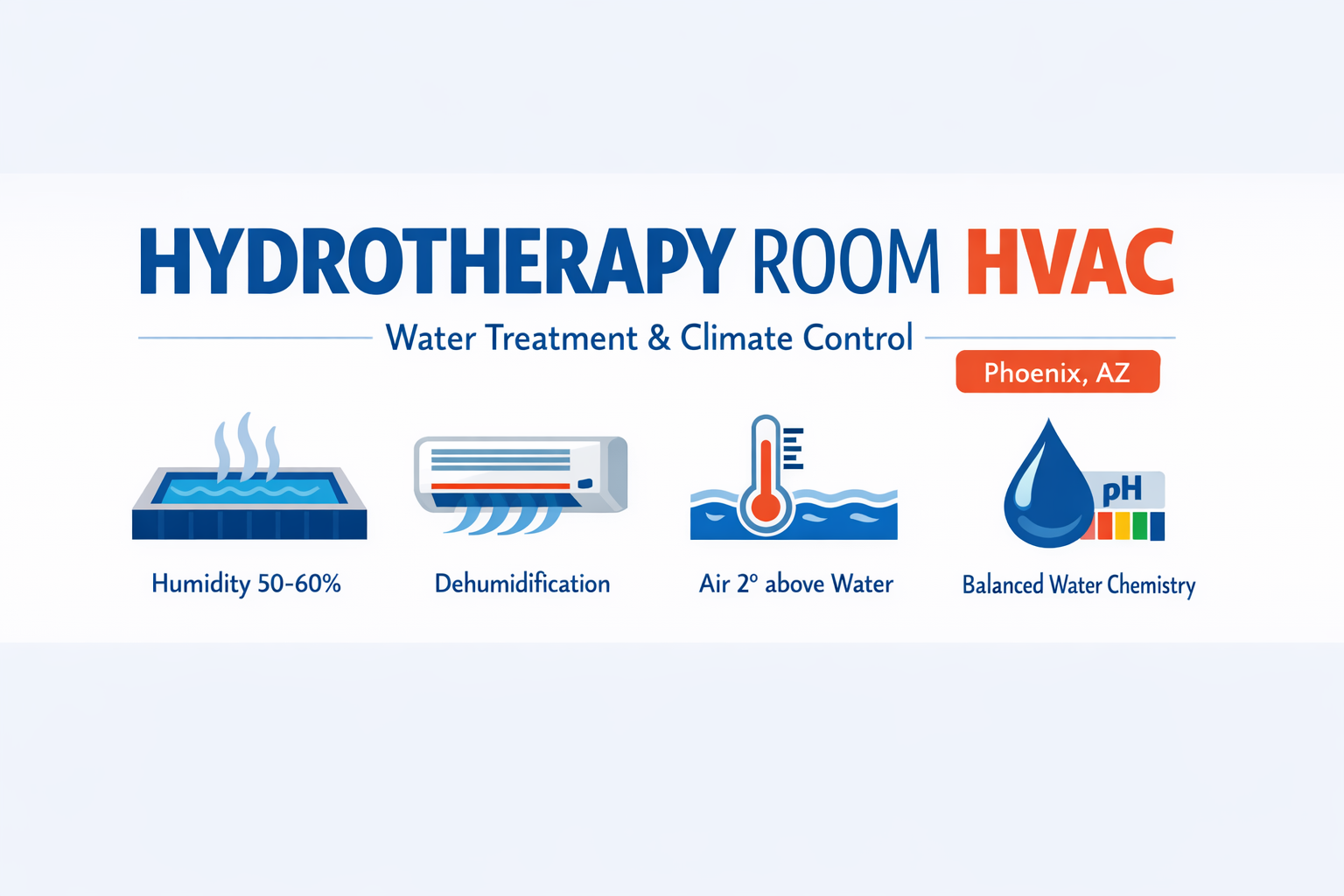
Most rooms hold a fairly stable amount of moisture. A hydrotherapy room does the opposite: it pumps water vapor into the air every minute the pool is open. The warmer the water, the faster it evaporates—and therapy pools run hot, often between 90°F and 94°F, far warmer than a recreational pool. That warmth is great for sore joints and circulation, but it turns the room into a humidity machine. The table below gives you the quick-reference targets we work toward on every project, so you can see the moving parts at a glance.
| Parameter | Recommended Target | Why It Matters |
|---|---|---|
| Relative humidity | 50%–60% RH | Limits condensation, mold, and corrosion |
| Air temperature | ~2°F above water temp (max ~86°F) | Slows evaporation, keeps wet bathers comfortable |
| Therapy water temp | 90°F–94°F | Therapeutic warmth; also drives a high moisture load |
| Air changes per hour | 4–6 ACH (8–10 with heavy glass) | Clears chloramines and stale, humid air |
| pH | 7.2–7.8 (ideal ~7.4) | Sanitizer efficiency; prevents etching and scale |
| Free chlorine | 1.0–3.0 ppm | Effective, safe sanitation |
| Total alkalinity | 60–180 ppm | Buffers pH against sudden swings |
| Warm-water sanitizer | Bromine often preferred | Stable in hot water and across a wide pH range |
| Coil & duct material | Corrosion-resistant / coated | Survives chloramine-laden, humid air |
| Make-up water | Minimized at 50% RH | Holding humidity saves thousands of gallons vs. dry air |
The Evaporation Problem in a Desert Climate
Here is the part that surprises many owners: our dry Phoenix air makes evaporation worse, not better. The lower the surrounding humidity, the faster water leaves the pool surface. In very dry conditions, a mid-sized therapy pool can shed dozens of pounds of water into the air every hour. Hold the room at a steady 50% relative humidity, and that evaporation rate drops sharply—which protects the building and saves a remarkable amount of make-up water over a year. The same desert dryness that defines life in Scottsdale and across our service areas is exactly why a purpose-built dehumidification strategy matters here more than in humid states.
What Happens When Humidity Is Left Unmanaged
When a room runs too humid for too long, the damage shows up everywhere at once. We are often called in after the warning signs have already appeared:
- Condensation pooling on windows, skylights, and cold wall surfaces
- Mold and mildew in corners, behind drywall, and inside duct runs
- Rust on grilles, fasteners, light fixtures, and the HVAC unit itself
- Peeling paint, swollen trim, and a persistent “indoor pool” odor
- Slippery floors and a heavy, uncomfortable feeling for staff and bathers
Left alone, these issues move from cosmetic to structural. That is why we treat humidity control and indoor air quality as the foundation of any healthy hydrotherapy space.
The Climate-Control Side: Temperature, Humidity, and Airflow
Climate control in a therapy room is a balancing act between three dials—air temperature, relative humidity, and air movement. Get one wrong and the other two suffer. Here is how we tune each one.
Air Temperature vs. Water Temperature
The rule of thumb is to keep the air about 2°F warmer than the water, up to a comfortable ceiling near 86°F. Warmer air slows evaporation and stops that chill bathers feel when they step out. Because therapy water often sits above 90°F, we cannot always keep air a full 2°F above it without overheating the room, so we plan for a slightly higher moisture load and size the dehumidification to match. Proper heating and reheat capacity is part of that calculation, and a reliable boiler or water-heating system keeps the pool itself at therapeutic temperature.
Relative Humidity and Dehumidification
A standard air conditioner removes some moisture as a side effect of cooling, but it cannot hold a room at a precise humidity setpoint. A dedicated pool dehumidifier can. It wrings moisture out over a cold coil, then adds that captured heat back through a reheat coil so the room does not get cold and clammy. Many modern units also recover heat to warm the pool water, which trims operating costs. When a project calls for flexible, zoned comfort, we may pair this with VRF/VRV systems or a compact ductless mini-split for adjacent locker rooms and offices, and on larger facilities a chiller system handles the cooling load.
Air Changes and Duct Design
Moving the right volume of air—and aiming it correctly—is just as important as the equipment. We design for roughly 4 to 6 air changes per hour, and up to 8 to 10 in rooms with large windows or glass walls. The supply air is deliberately washed across cold glass and exterior surfaces to keep condensation from forming. Thoughtful ductwork design determines whether that air actually reaches the trouble spots, and on commercial buildings the rooftop unit has to be matched to the real load, not a generic square-footage guess. Our full commercial HVAC team handles these layouts every week.
The Water-Treatment Side: Chemistry That Protects Air and Equipment
Air and water are not separate problems—the chemistry in the pool directly determines what your HVAC system has to breathe. Balanced water means cleaner air and longer-lasting equipment, so water treatment is half the job.
pH, Sanitizer, and Alkalinity
We keep pH in the 7.2 to 7.8 window, ideally right around 7.4. Drift below that and the water turns aggressive, etching plaster and attacking metal; drift above it and you get scale and cloudy water. Free chlorine generally belongs in the 1.0 to 3.0 ppm range, with total alkalinity from 60 to 180 ppm acting as a buffer that keeps pH from bouncing around. For the warm water of a therapy or spa setting, bromine is frequently the better sanitizer because it stays stable at high temperatures and works across a wide pH range.
Chloramines, Off-Gassing, and Corrosion
When sanitizer combines with sweat, oils, and other contaminants, it forms chloramines—the source of that sharp “pool smell.” Chloramines off-gas into the air, carry a low pH, and settle on every surface they touch. That is why indoor pool rooms rust so aggressively: the air itself is corrosive. The fix is twofold—keep the water balanced so fewer chloramines form, and move that contaminated air out with proper ventilation before it condenses on metal. We also specify corrosion-resistant, coated coils and components, and we keep a close eye on refrigerant leak detection because chloramine attack on coils is a leading cause of slow leaks. For facilities that run coolers or ice machines nearby, our commercial refrigeration crew protects that equipment from the same corrosive environment.
How We Approach Hydrotherapy HVAC Water Treatment in Phoenix
Specialized spaces call for specialized hands. As a family-owned company with more than 20 years serving Arizona, our team has built and maintained the kind of high-humidity environments that defeat general contractors. Here is what guides our work:
- Real hands-on experience: two decades of HVAC and refrigeration work across homes, clinics, restaurants, and large facilities throughout the Valley
- Certified, trained technicians: EPA-certified professionals who refine their craft through our ongoing technician training program
- Safety first: we follow established electrical, refrigerant-handling, and water-chemistry safety standards on every visit
- Honest, transparent service: clear diagnostics, upfront pricing, and no pressure to buy what you do not need
- Right-sized solutions: from new installation to careful repair and diagnostics, we match the system to the actual load
That approach is reflected in our reputation with local businesses—from restaurants to wellness facilities—who rely on us to keep demanding systems running. We serve owners across the greater Phoenix area and throughout Mesa, Tempe, and the wider metro, and you can always visit our Google Business listing to read what clients say.
Maintenance That Keeps the Whole System Healthy
A hydrotherapy room rewards consistency. Because the environment is so aggressive, small problems escalate fast, and scheduled care is far cheaper than emergency repair. We build maintenance around the realities of this kind of space:
- Inspect and clean coils, blowers, and drains where corrosion and biofilm love to hide
- Verify humidity setpoints, sensors, and dehumidifier performance
- Check dampers, exhaust, and airflow over glass to confirm condensation control
- Review water chemistry logs alongside HVAC performance—they tell one story
- Catch refrigerant and corrosion issues early before they become failures
For commercial sites, our preventive maintenance programs put this on a dependable schedule, and homeowners with therapy pools or spas can lean on our residential maintenance programs. When something does go wrong at the worst possible time, our 24/7 emergency service is ready, and a well-maintained heat pump or dehumidifier simply lasts longer.
Frequently Asked Questions — Hydrotherapy Room HVAC & Water
What humidity level should a hydrotherapy room maintain? +
Aim for 50% to 60% relative humidity. That range keeps bathers comfortable while limiting condensation, mold growth, and corrosion. Holding a steady 50% also slows evaporation, which protects the building and reduces how much make-up water the pool needs.
Why does my therapy pool room rust everything? +
Chloramines—formed when sanitizer reacts with sweat and oils—off-gas into the air with a low pH. That makes the air itself corrosive, so it rusts grilles, fasteners, and HVAC coils wherever it condenses. Balanced water and strong ventilation are the two fixes that work together.
Should the air be warmer than the water? +
Yes. Keeping the air roughly 2°F above the water temperature—up to a ceiling near 86°F—slows evaporation and prevents the chill bathers feel when leaving the pool. With very warm therapy water, we plan for a higher moisture load and size dehumidification accordingly.
Chlorine or bromine for a hydrotherapy pool? +
Both sanitize effectively, but bromine is often the better choice for warm therapy water because it stays stable at high temperatures and remains effective across a wide pH range. Many facilities use a chlorine shock to start, then maintain the water with bromine.
How often should the HVAC and water system be serviced? +
Water chemistry needs daily attention, while the dehumidification and HVAC equipment should be professionally serviced at least twice a year—more often for heavy-use facilities. The corrosive environment means proactive maintenance pays for itself many times over.
Can a regular air conditioner handle a hydrotherapy room? +
Not on its own. A standard AC removes some moisture but cannot hold a precise humidity setpoint or stand up to chloramine-laden air. These rooms need dedicated dehumidification with reheat plus corrosion-resistant components designed for the environment.
Keep Your Phoenix Hydrotherapy Space Healthy, Year-Round
Your therapy pool should be an asset, not a source of repair bills and worry. When the air, the water, and the equipment are managed as one system, the room stays clean, comfortable, and corrosion-free—and the people who use it get the full benefit of the water. That balance is exactly what hydrotherapy HVAC water treatment in Phoenix is meant to deliver, and it is what we build for every clinic, gym, care facility, and homeowner we work with. If you are also planning a new build or weighing an upgrade, our guide to indoor air quality solutions is a natural next read, and our blog covers more on keeping Arizona systems running strong.
Ready to protect your space? Contact Discount AC & Refrigeration of Phoenix for a hydrotherapy room inspection or emergency service. Call us at (602) 889-1367, and be sure to visit our Google Maps listing to see our reviews and find the fastest way to reach our Valley-wide team. Let’s keep your air clear, your water balanced, and your equipment running for years to come.