
Quiet HVAC for Spa Treatment Rooms in Phoenix: Noise-Reduction Solutions That Work
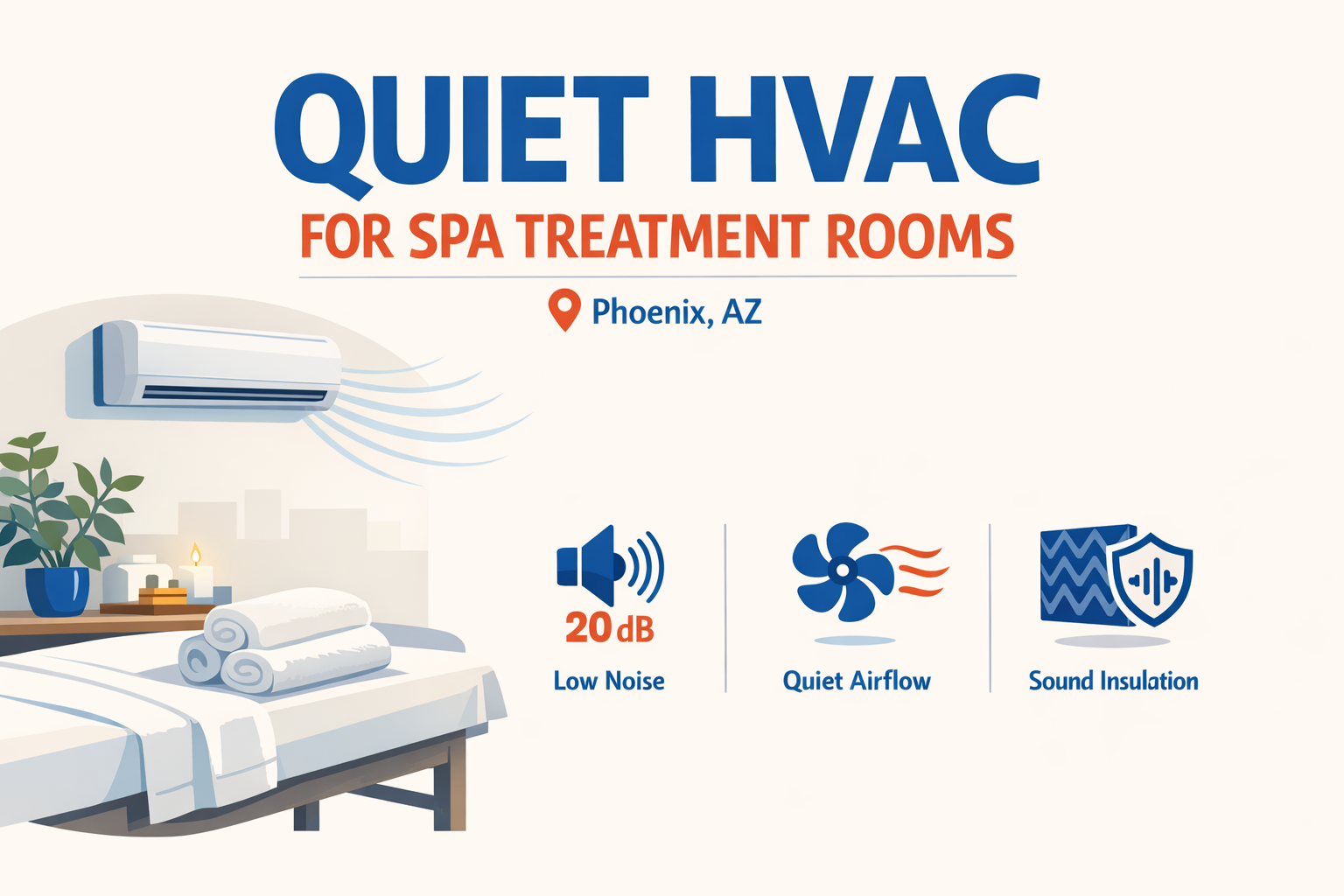
If a buzzing vent or a rattling air handler is pulling your clients out of their calm, you are not imagining the problem. A quiet HVAC spa treatment room in Phoenix is absolutely achievable, even in the middle of a 110°F summer when your equipment is working its hardest. In the next few minutes, we will walk you through where the noise comes from, which fixes deliver the biggest drop in decibels, and how we keep treatment rooms cool, comfortable, and whisper-quiet year-round. The short answer: the right equipment selection, smart duct design, and disciplined maintenance solve the vast majority of cases. Here is how we do it.
We are Discount AC & Refrigeration of Phoenix, and our technicians have spent years tuning climate systems for wellness businesses across the Valley. From day spas in Arcadia to medical spas downtown, we have learned that sound control is not a luxury add-on — it is part of the treatment experience. When you book a trusted Phoenix HVAC and AC repair team, you should expect a system that disappears into the background, exactly the way good spa design intends.
Why Treatment Room Noise Is a Bigger Challenge in Phoenix
Phoenix puts unusual demands on cooling equipment. Our long cooling season means air conditioners run more hours per year than in almost any other U.S. metro, and longer runtimes give worn bearings, loose panels, and undersized ducts more opportunities to make themselves heard. On top of that, many spa suites are built inside strip malls, mixed-use buildings, and converted retail spaces where the original ductwork was never designed for the hushed environment a treatment room requires.
There is also a comfort balancing act. Estheticians and massage therapists often keep rooms warmer than the rest of a building, so the system cycles in short, frequent bursts — and every start-up is a chance for a thump, a whoosh, or a vibration to travel through the walls. Understanding these local realities is the first step, and it is why our commercial HVAC services begin with listening to the space before we touch a single component. The quick-reference table below shows how the most common noise sources compare and what each one usually takes to fix.
| Noise You Hear | Likely Source | Typical Loudness | Recommended Fix |
|---|---|---|---|
| Whooshing / rushing air | Undersized or restrictive ducts | 40–50 dB | Resize ducts, add returns, lower velocity |
| Low-frequency hum / vibration | Compressor or blower transmitting through structure | 35–55 dB | Vibration isolators, spring mounts, flex connectors |
| Rattling / buzzing panels | Loose access panels, screws, or grilles | 30–45 dB | Tighten, gasket, and balance the unit |
| Clicking / popping ducts | Thin sheet metal expanding under pressure | 30–40 dB | Reinforce, add liner, soften pressure spikes |
| High-pitched whine | Worn blower bearing or motor | 45–60 dB | Replace bearing/motor, lubricate, realign |
| Sudden on/off “thump” | Single-stage unit short-cycling | 40–55 dB | Upgrade to variable-speed / mini-split |
| Gurgling near the unit | Condensate drain or low refrigerant | 25–40 dB | Clear drain, check charge, inspect for leaks |
Where Treatment Room Noise Actually Comes From
Before we can quiet a space, we identify exactly what is making the sound and how it is reaching your client’s ears. In our experience, the culprits fall into three buckets: airflow noise, mechanical noise, and structure-borne vibration. Sorting the problem into the right bucket keeps us from throwing parts at a symptom and missing the cause.
Airflow Noise
This is the rushing, whistling, or whooshing sound that happens when air moves too fast through ducts and grilles. It usually points back to undersized supply runs, too few return-air pathways, or registers that are simply too small for the airflow they carry. Our ductwork specialists measure static pressure and air velocity, then redesign the path so the same amount of cool air moves more slowly and quietly.
Mechanical Noise
Compressors, blower motors, and bearings all generate sound, and that sound climbs as components wear. A high-pitched whine or grinding hum is a classic sign that a part is approaching the end of its life. Catching it early through AC repair and diagnostics means a quiet, planned repair instead of a noisy breakdown in the middle of a fully booked Saturday.
Structure-Borne Vibration
Even a healthy unit vibrates, and those vibrations love to travel through shared walls, ceilings, and floor joists. In multi-room spas, a rooftop unit two suites away can hum straight into a treatment room. Proper isolation — spring mounts, rubber pads, and flexible duct connectors — interrupts that path so the energy never reaches the room. For rooftop equipment, our rooftop unit service team checks curb mounting and isolation as part of every visit.
Proven Solutions for a Quiet HVAC Spa Treatment Room in Phoenix
Here is where the real progress happens. Most treatment rooms get dramatically quieter through a combination of the following measures, and we tailor the mix to your building, budget, and how the suite is used.
1. Choose Variable-Speed Equipment
The single biggest upgrade for sound is moving away from old single-stage units that slam on at full power and shut off with a thump. Ductless mini-split systems and variable-speed air handlers ramp up gently and run at low, steady speeds most of the day. They hold temperature within a tight band and produce a fraction of the noise. When a treatment room sits far from the main system or needs independent control, a mini-split is often our first recommendation, and our AC installation and replacement crew sizes it precisely for the room.
2. Slow the Air Down
Quiet airflow is slow airflow. By upsizing supply ducts, adding return-air grilles, and choosing larger low-velocity registers, we move the same cooling capacity with far less turbulence. Lining ductwork with acoustic insulation absorbs the remaining sound before it reaches the room. These improvements also reduce strain on the blower, which supports better long-term reliability through our maintenance programs.
3. Isolate Every Source of Vibration
We mount equipment on spring isolators and neoprene pads, connect ducts with flexible canvas collars, and float noisy condensers away from shared walls. For larger properties running central plants, the same principles apply to chiller systems and VRF/VRV systems, where a single well-isolated unit can serve many quiet rooms at once.
4. Add Acoustic Treatment to the Room
Sometimes the equipment is fine and the room is the problem. Hard surfaces — tile, glass, polished concrete — bounce sound around. Adding sound-absorbing ceiling panels, solid-core doors, weatherstripping, and even a duct silencer on the supply run keeps the calm sealed inside. We coordinate these touches with your indoor air quality upgrades so you improve comfort and freshness at the same time.
5. Right-Size the System
An oversized unit cools too fast, short-cycles, and announces every start and stop. A correctly sized system runs longer, quieter cycles. We perform a load calculation rather than guessing, which is why our commercial AC installation process always begins with the math, not the model number.
Keeping Comfort and Humidity in Balance
A quiet room still has to feel good. In the desert, that means managing both temperature and the surprisingly important question of humidity. Treatment rooms with hot towels, steam, and aromatherapy can build up moisture that makes the air feel stuffy even at a comfortable 72°F. Variable-speed equipment helps here too, because longer, gentler run times pull more moisture from the air than short bursts ever could.
We also pay attention to heating, since Phoenix mornings can dip into the 30s and 40s in winter and clients expect warmth on the table. Whether your suite uses a heat pump, a furnace, or dedicated commercial heating, we tune the controls so the transition between cooling and heating stays smooth and silent. For boiler-based hydronic setups in larger wellness centers, our boiler service keeps that comfort steady without the knocking and banging older systems are known for.
How We Keep Spa HVAC Systems Running Quietly
Even the best installation drifts out of tune without care. Filters load up, belts loosen, bearings dry out, and a once-silent system slowly finds its voice again. A consistent service rhythm is the most reliable way to protect both the quiet and the equipment. Through scheduled preventive maintenance, we catch the small issues — a loose panel, an early bearing whine, a slipping belt — long before they disrupt a session.
Our maintenance visits include tightening fasteners and grilles, lubricating moving parts, checking refrigerant charge, clearing condensate drains, and verifying that every isolation pad and flexible connector is still doing its job. When something does fail unexpectedly, our 24/7 emergency AC repair and 24/7 commercial emergency service keep your downtime — and your noise — to a minimum. Spas that pair quality equipment with routine care rarely call us about sound at all.
Experience You Can Trust With Your Wellness Space
Quieting a treatment room is part building science, part craftsmanship, and we take both seriously. Our technicians train continuously and hold industry certifications, and you can read more about our training and certification standards and our team and history on our site. We follow manufacturer specifications and safety standards on every job, document our readings, and explain what we find in plain language so you can make confident decisions.
We have built our reputation across the Valley by showing up on time, doing careful work, and standing behind it — a record reflected in the reviews our clients leave. From residential services for spa owners who work from home suites to full commercial HVAC projects for multi-room wellness centers, our goal is the same: a comfortable, healthy, quiet space your clients never have to think about. You can explore the full range of areas we cover on our service areas page, and we proudly keep treatment rooms calm for spas throughout Phoenix and the surrounding Valley.
Frequently Asked Questions — Quiet Spa HVAC in Phoenix
How quiet should a spa treatment room actually be? +
A relaxing treatment room generally measures around 30 to 40 decibels — roughly the sound level of a quiet library or soft whisper. When HVAC noise climbs above that range, clients start to notice it. Our goal is to keep the system below the threshold where the room feels anything but calm.
Are ductless mini-splits really quieter than central AC? +
In most treatment rooms, yes. Modern ductless mini-splits run on variable-speed compressors that operate at low, steady speeds and produce very little airflow noise indoors. Because the loud compressor sits outside, the indoor head stays remarkably soft — which is why we often recommend them for individual suites that need independent, quiet control.
Why does my AC get louder during Phoenix summers? +
Long, intense cooling demand means the system runs more hours and works harder, which makes worn parts, loose panels, and undersized ducts more noticeable. Heat also expands sheet metal, causing clicking and popping. Routine maintenance before peak season is the best way to keep summer operation quiet and reliable.
Can you reduce noise without replacing my whole system? +
Often, yes. Many rooms get noticeably quieter through targeted fixes — adding return-air pathways, lining ducts with acoustic insulation, installing vibration isolators, tightening loose components, and adding a duct silencer. We always diagnose first and recommend full replacement only when it is the most sensible long-term solution.
How often should a spa schedule HVAC maintenance? +
For a busy Phoenix spa, we recommend professional maintenance at least twice a year — once before the cooling season and once before heating season. High-traffic suites with constant runtime may benefit from quarterly visits. A maintenance plan keeps the system quiet, efficient, and far less likely to fail during business hours.
Do you serve spas outside central Phoenix? +
Yes. We care for wellness businesses across the Valley, including Scottsdale, Tempe, Mesa, Chandler, Gilbert, and the surrounding communities. Visit our service areas page to confirm coverage for your location, or simply reach out and we will let you know how quickly we can get to you.
Give Your Treatment Rooms the Silence They Deserve
Your clients come to escape the noise of Phoenix, not to trade traffic for a humming vent. A truly quiet HVAC spa treatment room in Phoenix is the result of thoughtful equipment choices, low-velocity airflow, careful vibration isolation, and steady maintenance — and it is well within reach for your space. If you are also weighing comfort upgrades, our guide to balancing temperature and humidity in the desert pairs naturally with everything you have read here, and our blog covers more ways to keep your wellness space at its best.
Let us take a listen. Our certified technicians will measure your rooms, pinpoint the real noise sources, and build a quiet-comfort plan that fits your budget. Call Discount AC & Refrigeration of Phoenix at (602) 889-1367, contact our team online, and find us on our Google Maps business listing to see reviews and directions. You can also save our location on Google Maps so quiet, dependable comfort is only a tap away the next time your spa needs us. We look forward to helping your treatment rooms feel as serene as they are meant to be.