

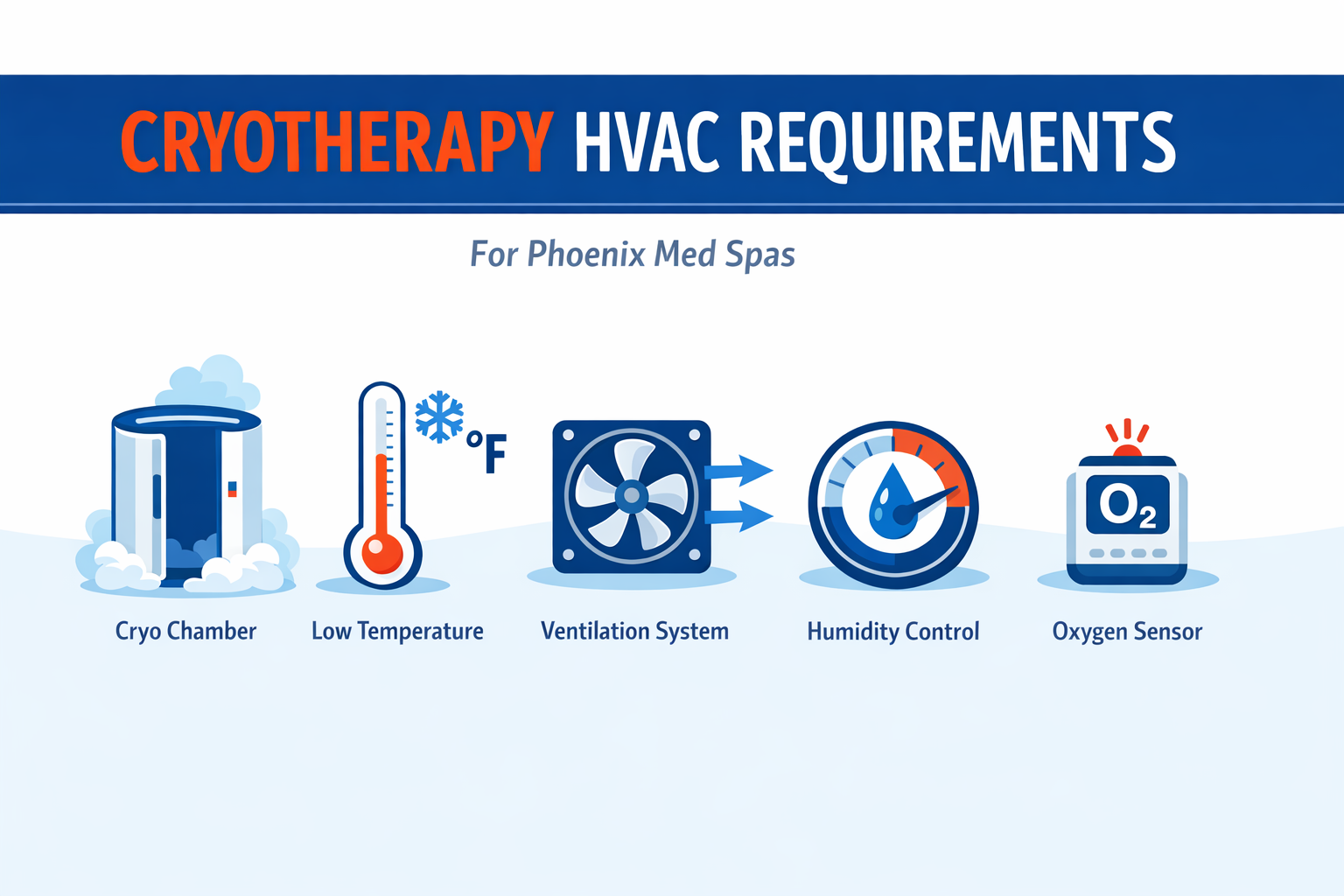
Cryotherapy HVAC for a Phoenix med spa is a specialized cooling and ventilation problem, not a standard comfort-AC job. A whole-body cryotherapy chamber rejects heat, displaces oxygen, or both, so the room around it needs dedicated cooling, mechanical exhaust, and safety monitoring engineered to handle that load in the Arizona heat.
If your cryotherapy room runs warm, trips its compressor, or fogs the glass on a summer afternoon, the room’s mechanical design is almost always the cause. We are Discount AC & Refrigeration of Phoenix, and we install and service the commercial HVAC and refrigeration systems that keep wellness facilities across the Valley running safely. Below, we walk through exactly what a cryotherapy HVAC Phoenix med spa setup requires, why our local climate raises the stakes, and how we size each component so your chamber performs through July and August. For owners serving clients in central Phoenix, we cover the same standards on every Phoenix service call, and you can also find us on our Google Maps listing.
Why a Cryotherapy Chamber Changes Your Med Spa’s HVAC Load
Most med spa treatment rooms are designed for human comfort: roughly 72°F, moderate humidity, and a quiet supply of conditioned air. A cryotherapy chamber breaks that model. Whether you run an electric (refrigerant-based) unit or a liquid-nitrogen system, the chamber introduces a thermal and safety load that ordinary comfort-cooling equipment was never sized to absorb.
- Electric cryotherapy chambers use cascade refrigeration to reach skin-surface temperatures near -166°F to -220°F. They reject that heat back into the treatment room through their condensers, adding a continuous cooling load the room AC must remove.
- Liquid-nitrogen chambers stay cold by boiling off nitrogen gas. That gas is colder, heavier than air, and oxygen-displacing, which makes mechanical ventilation and oxygen monitoring a safety requirement rather than an upgrade.
- Localized cryo tools such as facial or spot devices add smaller but real loads, and they still benefit from stable room temperature and clean indoor air quality.
In Phoenix, the building envelope is already fighting 110°F-plus exterior temperatures for months at a time. Layering a heat-rejecting chamber on top of that means we have to design the room’s cooling around peak summer conditions, not spring averages. The quick-reference table below shows the core requirements we engineer for, and where they typically go wrong when a room is built without HVAC input.
| Requirement | What We Engineer | If It’s Skipped |
|---|---|---|
| Dedicated room cooling | Right-sized mini-split or VRF zone, sized to chamber + occupancy load at 115°F peak | Room drifts warm; chamber compressors overwork |
| Mechanical exhaust | Low-level exhaust with make-up air, sized for adequate air changes per hour | Stagnant air; gas and heat plume linger |
| Oxygen monitoring (N₂ systems) | Depletion sensor at breathing height, alarm at ~19.5%, interlocked to exhaust | Serious safety risk from oxygen displacement |
| Heat-rejection capacity | Cooling load calc that includes the electric chamber’s continuous heat output | Undersized AC short-cycles and fails in summer |
| Humidity & condensation | Controlled dew point; supply air aimed away from cold surfaces | Slip hazards, finish damage, mold risk |
| Sealed distribution | Insulated, sealed ductwork so cooled air doesn’t gain attic heat | Lost capacity and higher energy bills |
| Service accessibility | Filters, condensate, disconnects placed for quick maintenance | Longer downtime during repairs |
| Preventive maintenance | Pre-season coil cleaning, charge checks, exhaust verification | Mid-summer failures and canceled appointments |
Ventilation and Oxygen Safety: The Non-Negotiables
Of everything we design into a cryotherapy room, ventilation and oxygen safety are the items we will not compromise on. They protect your clients, your technicians, and your license, and they are the requirements most often missed when a chamber is installed before the mechanical contractor is consulted.
Oxygen Monitoring for Nitrogen Systems
Normal air is about 20.9% oxygen. When a liquid-nitrogen chamber vents, escaping nitrogen can lower that percentage in an enclosed room fast. We install oxygen depletion sensors mounted near breathing height that alarm well before levels become unsafe, typically at the 19.5% threshold many safety standards reference. The sensor should be tied to both an audible alarm and the room’s exhaust so ventilation ramps up automatically. We treat this the same way we treat refrigerant leak detection on a walk-in system: monitor the air continuously, and act on the reading automatically.
Exhaust and Air Changes Per Hour
A cryotherapy room needs mechanical exhaust that pulls from low in the room, because cold nitrogen and cool air settle toward the floor. We size exhaust to deliver a healthy number of air changes per hour and pair it with a make-up air path so the room is not starved. Done right, the exhaust clears displaced gas and the heat plume rising off an electric chamber at the same time. Proper rooftop and exhaust equipment and well-sealed distribution make the difference between a room that feels fresh and one that feels stagnant.
Cooling, Humidity, and Phoenix’s Climate Reality
This is where the desert changes the math. A cryotherapy room that performs beautifully in a mild climate can struggle in Phoenix simply because the cooling system spends the summer at the edge of its capacity. We design the room’s conditioning with margin so the chamber, the staff, and the clients stay comfortable on the hottest days.
Managing Heat Rejection From Electric Chambers
An electric chamber can dump a significant, steady heat load into the room every time it runs. If the room’s air conditioning is sized only for occupancy, that heat stacks up, the space drifts warm, and the chamber’s own compressors work harder to hold temperature. We calculate the combined load and often recommend a dedicated cooling source so the chamber is not fighting the room. Depending on the layout, that may be a ductless mini-split, a zone served by a VRF/VRV system, or for larger multi-room wellness suites, a tie-in to a chiller system.
Humidity and Condensation Control
Phoenix is dry most of the year, which helps, but a very cold chamber surface in a humid-feeling room still invites condensation on glass, walls, and flooring near the unit. During monsoon season, indoor humidity climbs and the risk grows. We manage it by keeping the room’s dew point controlled, directing supply air so it does not blow straight onto cold surfaces, and confirming the space has the cooling capacity to hold a stable setpoint. Stray condensation is not just a slip hazard; over time it damages finishes and feeds mold, which undermines the clean image a med spa depends on.
Equipment We Recommend for Phoenix Cryotherapy Rooms
There is no single right system, because room size, chamber type, and building layout all drive the design. That said, our years working on both residential and commercial projects across the Valley have given us a clear sense of what holds up. We size every component for Phoenix’s summer peak and choose equipment our technicians can service quickly when something needs attention.
- Dedicated zone cooling: A right-sized mini-split or VRF zone gives the cryotherapy room its own thermostat and capacity, independent of the lobby or treatment areas.
- Low-level mechanical exhaust: Paired with make-up air and, for nitrogen systems, interlocked with the oxygen sensor.
- Oxygen depletion monitoring: Required for liquid-nitrogen chambers, recommended anywhere bulk gas is stored.
- Sealed, insulated distribution: So conditioned air reaches the room without picking up attic heat in transit.
- Accessible service points: Filters, condensate lines, and electrical disconnects placed where our team can reach them without disrupting your treatment schedule.
For multi-room wellness centers that also run saunas, contrast rooms, or refrigerated product displays, we coordinate all of those loads into one cohesive mechanical plan rather than a patchwork of mismatched units. That is the advantage of bringing in a contractor who handles commercial installation and refrigeration under one roof.
Keeping the System Reliable Through Every Phoenix Summer
Installation is only the first half. A cryotherapy room earns its keep when it runs reliably, and that depends on maintenance tuned to how hard the equipment works here. A chamber that loses its room cooling on a 115°F afternoon is a canceled appointment at best and a safety call at worst. We help our clients avoid both.
- Scheduled visits: Our preventive maintenance plans keep coils clean, refrigerant charge correct, and exhaust performing to spec before peak season.
- Fast diagnostics: When something drifts, our diagnostic process isolates whether the issue is room cooling, the chamber, or airflow.
- Emergency coverage: If the room cooling fails mid-week, our 24/7 emergency service keeps downtime short.
We also believe in transparency about what your room actually needs. Our technicians train continually on commercial systems, and you can read about our standards on our technician training page. If a room only needs a maintenance tune-up rather than new equipment, we will tell you that. Honest assessments are a big part of why Phoenix wellness operators keep calling us back, and why we encourage prospective clients to read our reviews on our Google Business listing.
Frequently Asked Questions — Cryotherapy HVAC for Phoenix Med Spas
Does an electric cryotherapy chamber need its own air conditioning?+
In most Phoenix rooms, yes. An electric chamber rejects heat into the space continuously while it runs. If the room’s cooling is sized only for people, that heat builds up and the chamber works harder to stay cold. We typically recommend a dedicated mini-split or VRF zone so the room holds its setpoint independently.
Is oxygen monitoring really required for a nitrogen system?+
For liquid-nitrogen chambers, we treat oxygen monitoring as essential. Nitrogen gas displaces oxygen and is heavier than air, so it can lower oxygen levels in an enclosed room. A depletion sensor mounted near breathing height, alarming around the 19.5% threshold and tied to the exhaust, is the safeguard we install and verify.
How does Phoenix’s heat affect cryotherapy room design?+
Our summer peaks push cooling systems to their limit, so we size the room’s conditioning for those conditions rather than spring averages. A design that works in a mild climate can fall short here. Building in capacity margin keeps the chamber, staff, and clients comfortable on 110°F-plus afternoons.
Can you retrofit an existing treatment room for a cryotherapy chamber?+
Often, yes. We start with an on-site assessment of the room’s cooling capacity, exhaust paths, and electrical service, then recommend only what the space actually needs. Sometimes that’s a dedicated cooling zone and exhaust; other times the existing system can be adapted. We’ll give you an honest read either way.
How do we prevent condensation around the chamber?+
We control the room’s dew point and aim supply air away from cold surfaces so moisture doesn’t collect on glass, walls, or flooring. Phoenix is dry most of the year, but monsoon humidity raises the risk, so condensation control is part of every cryotherapy room plan we build.
What happens if the room cooling fails during business hours?+
Call us. Our 24/7 emergency service is built for exactly this. We’ll diagnose whether the issue is the room cooling, the chamber, or airflow, and get you back online quickly. Preventive maintenance before peak season is the best way to avoid the emergency in the first place.
Build Your Cryotherapy Room to Perform in the Phoenix Heat
A great cryotherapy experience starts behind the wall, in the ductwork, exhaust, and cooling capacity most clients never see. Getting the cryotherapy HVAC Phoenix med spa requirements right from the start, dedicated cooling, low-level exhaust, oxygen monitoring, and humidity control sized for our desert summers, is what separates a chamber that delights clients from one that fights its own room. If you are opening a new wellness studio, adding a chamber to an existing space, or troubleshooting a room that never quite holds temperature, we would welcome the conversation. You can compare your options against a related read on our HVAC and refrigeration blog, or go straight to planning.
Reach the team at Discount AC & Refrigeration of Phoenix at (602) 889-1367 to schedule an inspection or design consultation, and stop by our Google Maps location to see our reviews and service area. We will help you build a cryotherapy room that stays cold, safe, and dependable, all the way through the hottest Phoenix afternoon. Serving Phoenix and the surrounding Valley, including Scottsdale, Tempe, and the wider metro area.