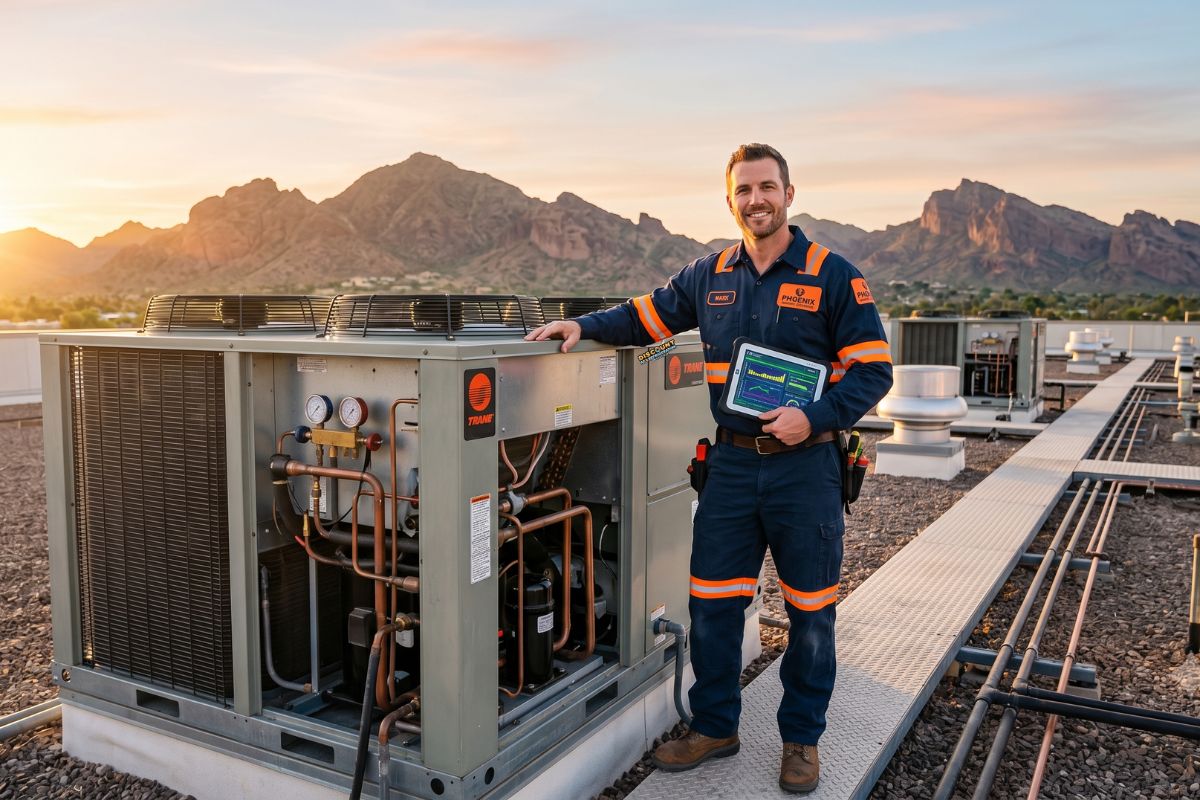
Walk-in cooler running constantly? Energy bills climbing every quarter? Compressor short-cycling and burning out faster than it should? You’re not alone — thousands of Phoenix restaurant owners and facility managers face the same losses every summer when ambient temperatures push 115°F and older single-stage units simply can’t keep up.
The answer is inverter compressor technology — a variable-speed system that adjusts cooling capacity in real time, slashes energy consumption by up to 40%, and dramatically extends equipment lifespan. This guide breaks down exactly how it works, why it matters for your bottom line, and when it’s time to upgrade.
What Is Inverter Compressor Technology?
Traditional commercial refrigeration compressors operate in a brutal on/off cycle — full blast or completely off. Every startup draws a massive inrush current, stresses internal components, and creates temperature swings inside your walk-in or display case.
Inverter compressor technology uses a variable-frequency drive (VFD) to modulate motor speed continuously between roughly 10% and 100% capacity. Instead of slamming on and off, the compressor ramps up or down to match the exact cooling demand at any given moment.
For more on how this integrates with full system design, see our commercial refrigeration services page.
Core Components of an Inverter System
- Variable-frequency drive (VFD): Controls motor RPM based on real-time temperature feedback
- DC inverter motor: Built to operate efficiently across a wide RPM range
- Electronic expansion valve (EEV): Precisely meters refrigerant flow to match compressor speed
- Smart thermostat or controller: Reads zone load and signals the VFD
Why Phoenix Businesses Are Switching to Inverter Systems
Phoenix’s climate is uniquely punishing on commercial cooling equipment. Ambient temps regularly exceed 110°F for weeks, condenser coils run hotter, and fixed-speed compressors spend most of the summer at 100% load. This is exactly where inverter technology pays for itself fastest.
According to the U.S. Department of Energy, variable-speed compressors can reduce HVAC energy consumption by 30–50% compared to single-stage units — and the savings are even larger in extreme-heat climates like ours.
Real Benefits You’ll Notice
- Lower utility bills: 25–40% reduction in compressor energy draw
- Tighter temperature control: ±1°F vs. ±5°F on traditional units — critical for food safety
- Quieter operation: No loud startup slams in dining areas
- Longer equipment life: Soft starts eliminate the #1 cause of compressor failure
- Better humidity control: Continuous low-speed running dehumidifies more effectively
- Reduced peak demand charges: APS and SRP commercial customers see major savings
If you’re already dealing with breakdowns, our emergency refrigeration repair team can assess whether your current unit is worth saving or if an inverter retrofit makes more sense.
| Feature | Traditional Single-Stage | Inverter Variable-Speed |
|---|---|---|
| Operation Mode | On/Off (100% or 0%) | Modulating (10%–100%) |
| Energy Consumption | High — full load every cycle | 25–40% lower on average |
| Temperature Stability | ±4°F to ±6°F | ±1°F to ±2°F |
| Startup Current Draw | 5–7x running amps | 1.2x running amps (soft start) |
| Average Lifespan | 8–12 years | 15–20 years |
| Noise Level | 65–75 dB | 45–55 dB |
| Ideal Ambient Temp | Up to 95°F efficiently | Performs at 115°F+ |
| Upfront Cost | Lower | 20–35% higher |
| ROI in Phoenix Climate | — | 2–4 years |
| Best For | Light-duty, low-runtime | Restaurants, 24/7 walk-ins, supermarkets |
When Should You Upgrade to Inverter Technology?
You don’t have to wait for catastrophic failure. Consider an upgrade if you’re seeing any of these warning signs:
- Your compressor is over 8 years old and short-cycling
- Energy bills have climbed more than 15% year-over-year
- Walk-in temperatures fluctuate visibly on your monitoring system
- You’ve had two or more compressor repairs in 24 months
- Your facility runs 24/7 (restaurants, convenience stores, supermarkets)
- You’re planning a kitchen remodel or refrigeration expansion
The ENERGY STAR program also offers commercial rebates on qualifying high-efficiency refrigeration equipment, which can offset 10–20% of the upgrade cost in Arizona.
Common Misconceptions About Inverter Compressors
“They’re too expensive.” Upfront yes, but Phoenix businesses typically recover the difference in 24–36 months through utility savings alone — before counting reduced repair costs.
“They don’t work well in extreme heat.” The opposite is true. Inverter systems excel in high-ambient environments because they can ramp up beyond rated capacity when needed and throttle down at night.
“Repairs are complicated.” Any qualified technician with VFD training can service them. Our HVAC and refrigeration specialists are factory-certified on all major inverter platforms including Copeland, Bitzer, and Embraco.
Maintenance Tips to Maximize Inverter System Lifespan
- Clean condenser coils every 90 days (every 60 days in Phoenix dust season)
- Verify refrigerant charge annually — inverter systems are charge-sensitive
- Check VFD cooling fans and dust filters quarterly
- Monitor superheat and subcooling at multiple load points
- Update controller firmware when manufacturer releases patches
- Schedule a full electrical inspection every 12 months
Frequently Asked Questions
Everything Phoenix businesses ask about inverter compressor technology
How much can I really save with an inverter compressor in Phoenix?
Most Phoenix commercial clients see 25–40% reduction in refrigeration energy costs. For a restaurant with $800/month in cooling bills, that’s $2,400–$3,840 in yearly savings, with full ROI in 2–4 years.
Will inverter technology work in 115°F Phoenix summers?
Absolutely — inverter systems actually outperform traditional compressors in extreme heat. They modulate capacity to handle peak loads without overheating, and their soft-start design prevents the damage common to single-stage units in Arizona’s climate.
Can I retrofit my existing walk-in cooler with an inverter compressor?
Yes, in most cases. A certified technician can replace your current compressor with an inverter unit and install a compatible VFD and electronic expansion valve. Retrofits typically cost 40–60% less than full system replacement.
How long does an inverter compressor last compared to a traditional one?
Inverter compressors typically last 15–20 years versus 8–12 years for single-stage units. The soft-start design eliminates the inrush current that destroys traditional compressors, especially in 24/7 commercial applications.
Are there APS or SRP rebates for upgrading to inverter systems?
Yes. Both APS and SRP offer commercial efficiency rebates for ENERGY STAR-certified refrigeration upgrades, often covering 10–20% of equipment cost. Our team handles the rebate paperwork as part of every commercial installation.
Do inverter compressors require special maintenance?
Maintenance is similar to standard systems but slightly more refrigerant-sensitive. You’ll need quarterly VFD inspections, 90-day condenser cleaning (60 days in dust season), and annual firmware updates. Total maintenance cost is typically lower due to fewer breakdowns.
Still Have Questions?
Talk to a certified inverter refrigeration specialist in Phoenix today.
📞 Request Free InspectionReady to Cut Your Cooling Bills in Phoenix?
If your commercial refrigeration is over 8 years old, breaking down repeatedly, or eating into your monthly profits, it’s time for an honest assessment. Discount AC & Refrigeration has been serving Phoenix restaurants, supermarkets, and commercial facilities with factory-certified inverter compressor installations, retrofits, and 24/7 emergency repair.
📞 Call now for a free inverter upgrade consultation or visit our location on the map: Discount AC & Refrigeration — Phoenix, AZ
Don’t wait for the next breakdown during a 115°F afternoon. Schedule your inspection today.