
Spa HVAC Installation Phoenix: Complete Guide for Your Business
If your Phoenix spa is dealing with condensation on treatment room walls, inconsistent temperatures across zones, or an HVAC system that runs nonstop but never quite catches up, the root cause is almost always the same: a system that wasn’t engineered for spa-specific humidity and thermal conditions. Spa HVAC installation in Phoenix requires a fundamentally different approach than a standard commercial buildout — and getting it right from the start saves spa owners years of service calls, elevated energy bills, and guest experience problems that trace directly to the mechanical system. In this guide, we cover everything your Phoenix spa needs to know: system selection, correct sizing, the installation process, code compliance, cost factors, and the maintenance practices that protect your investment through Phoenix’s extreme summers. Our team at Discount AC & Refrigeration of Phoenix handles the full scope of commercial HVAC services for spas, salons, wellness centers, and day spas throughout the Valley — and we’re ready to walk you through every step.
Why Phoenix Spas Demand Specialized HVAC Design
Spas generate moisture loads that standard commercial HVAC equipment isn’t built to manage. Treatment rooms, hydrotherapy areas, steam rooms, and wet lounges push humidity levels well above what a conventional rooftop split system can handle — and in Phoenix, where summer temperatures routinely exceed 110°F, that latent load compounds a sensible cooling burden already at the upper limit of what most commercial equipment is rated to sustain.
We’ve installed and serviced commercial HVAC systems across the Valley for years, and spa environments consistently present the most technically demanding combination of requirements we encounter. The reason comes down to a single metric that general commercial HVAC contractors frequently overlook: the Sensible Heat Ratio (SHR).
Standard commercial cooling equipment is designed with a high SHR — it prioritizes temperature reduction (sensible cooling) over moisture removal (latent cooling). That’s exactly the wrong design profile for a space generating steam, evaporated water, and body heat simultaneously. When you install generic commercial equipment in a wet spa zone, the system hits its temperature targets while humidity climbs unchecked — producing condensation on surfaces, recurring mold growth, accelerated corrosion on HVAC components, and guest complaints that seem impossible to resolve with standard service calls.
Our commercial services team approaches every spa HVAC installation in Phoenix with a full psychrometric analysis — calculating sensible and latent loads separately for each zone, then specifying equipment that addresses both. This technical foundation is what separates a correctly performing spa system from one that spends its service life fighting its environment.
If you’re experiencing any of the following in your current facility, your existing system was likely never designed for spa use:
- Condensation on walls, mirrors, or ceilings in treatment areas
- A persistent humid or musty smell despite continuous HVAC operation
- Visible mold or mildew recurring within weeks of cleaning
- Guests reporting rooms that feel cold but “clammy” or uncomfortable
- Equipment running at unusually long cycle times even in mild weather
| System Type | Best Zones | Humidity Control | Approx. Installed Cost | Energy Efficiency | Ideal For |
|---|---|---|---|---|---|
| DOAS + ERV | Pools, steam, hydrotherapy | ★★★★★ Excellent | $18,000 – $45,000 | High | Full-service spas |
| VRF Multi-Zone | Reception, retail, lounges | ★★★ Good | $12,000 – $35,000 | Very High | Multi-zone dry areas |
| High-Dehumid. Split | Small wet zones | ★★★★ Very Good | $8,000 – $20,000 | Moderate | Small day spas |
| Ductless Mini-Split | Individual treatment rooms | ★★★ Good | $3,000 – $8,000 | Very High | Boutique / solo spas |
| Chilled Water AHU | Large multi-zone facilities | ★★★★★ Excellent | $50,000 – $120,000 | High at scale | Resort / hotel spas |
| Standard Packaged RTU | Dry zones only | ★★ Poor (latent) | $5,000 – $12,000 | Moderate | Not recommended for wet areas |
| Hybrid Zoned System | Mixed wet and dry zones | ★★★★ Very Good | $20,000 – $60,000 | High | Day spas with retail |
| Geothermal Heat Pump | Full facility (long-term) | ★★★★ Very Good | $45,000 – $100,000 | Very High | Long-term investment builds |
HVAC System Types for Spa Environments in Phoenix
Most larger Phoenix spa facilities use a combination of equipment to address different zone requirements — there’s rarely a single system type that performs optimally in every area under one roof. Selecting the right equipment category for each zone is the first major engineering decision in any commercial HVAC installation.
Dedicated Outdoor Air Systems (DOAS) with Energy Recovery Ventilators
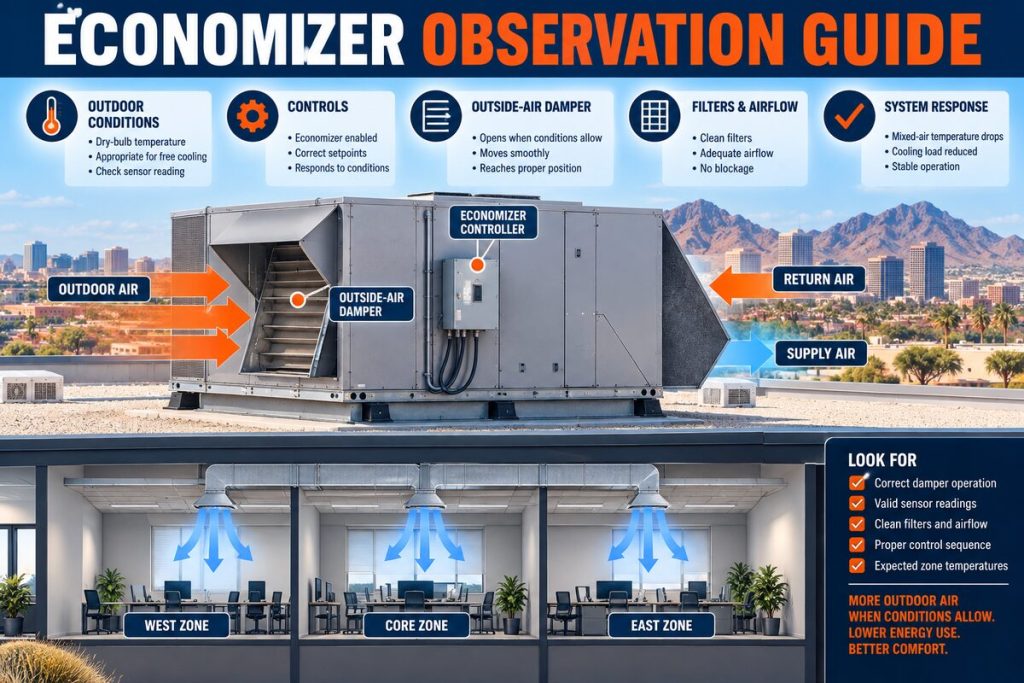
For any spa zone with a pool, steam room, wet lounge, or hydrotherapy tub, a Dedicated Outdoor Air System paired with an Energy Recovery Ventilator (ERV) is the recognized industry standard. DOAS equipment handles fresh air delivery and latent load control independently from your primary sensible cooling system — eliminating the humidity buildup that occurs when ventilation and temperature control are managed by a single piece of equipment.
In Phoenix, ERV technology carries particular value because conditioning raw outdoor air without energy recovery is expensive at our design temperatures. A high-performance ERV recovers 70–80% of the energy in exhaust air before it’s expelled — a significant gain when your outside air design condition is 113°F dry bulb. Our team at Discount AC & Refrigeration of Phoenix performs every DOAS startup and commissioning in-house, verifying airflow rates and moisture transfer efficiency against design specifications before we close out any installation.
Variable Refrigerant Flow (VRF) Systems
For the dry zones of your spa — reception, retail spaces, relaxation lounges, and consultation rooms — Variable Refrigerant Flow systems provide precise, zone-by-zone temperature control without the extensive ductwork that traditional multi-zone air handler configurations require. VRF systems allow simultaneous heating and cooling across different zones from a single outdoor condensing unit, which matters in a facility where your steam corridor needs aggressive dehumidification while your retail area needs mild cooling at the same time.
Our commercial services team sizes VRF systems using Phoenix-specific performance derate data. Outdoor condensing units lose capacity at elevated ambient temperatures, and manufacturer sizing tables are typically based on 95°F design conditions — not Phoenix’s 113°F design day. Applying proper derate factors at specification prevents undersizing that only reveals itself during the first Phoenix summer.
High-Dehumidification Split Systems
For smaller spas or those with a limited wet zone footprint, a properly selected high-dehumidification split system — equipment specifically engineered with a low SHR and elevated latent capacity — can be a cost-effective solution. Our AC installation team specifies only equipment with published latent capacity data for every project, never relying on generic SHR estimates that can conceal significant capacity shortfalls at real operating conditions.
Sizing Your Phoenix Spa HVAC System Correctly
Undersizing is the single most costly mistake in spa HVAC installation — and it’s almost always the result of using square-footage rules of thumb rather than a load calculation that accounts for spa-specific conditions. Our HVAC maintenance team regularly services spa facilities across Phoenix where prior contractors sized equipment using simplified methods, and the consequences show up as continuously running equipment, temperatures that never meet setpoint, and early compressor failures driven by sustained high discharge pressure.
For Phoenix spa installations, our engineering process begins with three parallel calculations:
Latent load analysis quantifies the moisture contribution from every source: simultaneous treatment table occupancy, pool or hydrotherapy surface area, steam equipment rated output, peak occupancy density, and the building envelope’s moisture vapor transmission under Phoenix summer conditions.
Sensible load analysis uses Phoenix’s ACCA Manual J design temperature of 113°F dry bulb, factoring in your building’s orientation, glass area and Solar Heat Gain Coefficient (SHGC) values, roof assembly R-value, shading devices, and internal heat gains from all electrical and lighting loads.
Ventilation requirement analysis determines the outside air quantities required by the 2018 International Mechanical Code as locally amended — including spa-specific requirements for areas using chemical treatments and disinfectants that exceed standard commercial occupancy ventilation rates.
Our service areas span the entire Phoenix metro — Scottsdale, Tempe, Mesa, Chandler, Gilbert, and Queen Creek included — and wherever your spa operates in the Valley, we perform on-site load calculations as part of the installation design process, not as an afterthought.
The Installation Process: What Phoenix Spa Owners Should Expect
A spa HVAC installation in Phoenix is a multi-phase project with distinct steps that must align with your general contractor’s construction schedule on new builds, or sequence carefully around guest operations on renovation projects.
Phase 1 — Design and Permitting. All commercial HVAC work in the City of Phoenix requires a mechanical permit issued by the Phoenix Development Services Department. We prepare and submit the complete permit package on your behalf: load calculations, equipment schedules, duct design drawings, and IECC energy compliance documentation. Current Phoenix commercial mechanical permit timelines run approximately 3–6 weeks, with an expedited review pathway available for qualifying projects.
Phase 2 — Equipment Procurement. Lead times for commercial HVAC equipment range from 4–10 weeks depending on system type. DOAS units, ERVs, and VRF systems typically require longer lead times than conventional split systems. We lock in equipment procurement after permit approval so delivery aligns with your construction schedule.
Phase 3 — Rough-In and Ductwork. Our commercial HVAC team coordinates structural penetrations, duct rough-in, and electrical rough-in with your GC’s schedule. In spa applications, we specify moisture-resistant duct lining throughout every zone subject to elevated humidity. Standard fiberglass duct board deteriorates in high-humidity environments and can become a mold growth substrate within its first operating season — a problem we’ve remediated at multiple spa facilities that used it in wet areas.
Phase 4 — Equipment Installation and Commissioning. Equipment is set, connected, and commissioned per manufacturer specifications. Commissioning includes refrigerant charge verification, airflow measurement and TAB (Testing, Adjusting, and Balancing), controls programming, and a full operational performance test across all modes. We provide written commissioning reports for every commercial installation we complete.
Phase 5 — Training and Handoff. Before project closeout, we walk your facilities team through every piece of equipment: controls operation, filter locations, maintenance intervals, and the early warning signs that warrant a service call. Our preventive maintenance programs are designed to extend equipment service life and prevent the operational interruptions that directly affect guest experience.
Phoenix Building Codes and Compliance for Spa HVAC
Commercial HVAC installations in Phoenix must comply with the 2018 International Mechanical Code (IMC) as locally amended, the 2021 International Energy Conservation Code (IECC), and ASHRAE Standard 62.1 for ventilation. Spa environments carry specific ventilation requirements — particularly for areas containing pools, steam equipment, and chemical treatment systems — that exceed standard commercial occupancy provisions in the code.
Our commercial HVAC services team manages every aspect of code compliance from permit submittal through final city inspection, including coordination with Phoenix’s mechanical plan review office and field inspectors. We’ve navigated Phoenix commercial HVAC permitting on many spa projects, and we know which plan review items arise most frequently for spa facility types.
One detail that frequently surprises spa operators: Maricopa County Environmental Services has regulatory jurisdiction over certain facility categories, with ventilation requirements that extend beyond the standard building code. We review applicable county requirements during the design phase and address them in our permit submittal package — so there are no compliance surprises at final inspection. For additional background on commercial HVAC standards and regulations, our HVAC blog covers relevant code topics in detail.
Cost Factors in Spa HVAC Installation Phoenix
Understanding the cost drivers in spa HVAC installation helps Phoenix spa owners budget realistically and evaluate contractor proposals on equal terms.
The most significant variable is system type. A high-dehumidification split system for a small spa with a single wet zone typically runs $8,000–$20,000 installed. A mid-size day spa requiring VRF zoning in dry areas plus a DOAS system for treatment rooms generally falls in the $25,000–$55,000 range. A full-service spa with pool, steam rooms, multiple treatment zones, and retail typically requires a custom-engineered system in the $60,000–$120,000 range or higher, depending on facility square footage and equipment selection.
Beyond equipment, the cost factors that vary most between projects are structural modifications required for ductwork routing, electrical service upgrades (commercial HVAC draws significant amperage, and older spa buildings frequently require panel upgrades), permit and inspection fees, and the scope of TAB commissioning. Our AC repair team also advises that investing in proper commissioning upfront reduces service call frequency over the system’s service life by a meaningful margin — so it’s a cost that pays for itself.
We publish transparent project estimates through our contact page, where you can submit your facility details and receive a preliminary scoping response from our team before committing to an on-site assessment.
Maintaining Your Spa HVAC System Through Phoenix Seasons
Spa HVAC equipment operates under higher sustained stress than standard commercial systems — elevated humidity, continuous operating hours, and Phoenix’s extreme summers combine to accelerate wear on key components. We recommend maintenance intervals for spa clients that are more frequent than our standard commercial schedule.
For air conditioning and HVAC equipment in spa applications, our recommended schedule includes:
- Monthly: Drain pan and condensate line inspection and flush; filter inspection and replacement as needed
- Quarterly: Full coil cleaning; belt and drive system inspection; electrical connection torque verification
- Semi-annually: Refrigerant system inspection; ERV filter media inspection; actuator and damper operation test
- Annually: Comprehensive system performance benchmarking against the original commissioning baseline; duct inspection in humid zones; controls calibration verification
A blocked condensate drain in a spa ceiling space can release several gallons of water before staff notices — the structural damage routinely exceeds the cost of an annual maintenance contract. Our emergency service team has responded to multiple spa water damage events originating from neglected condensate systems, and the repair invoices are never a pleasant conversation. A consistent preventive maintenance schedule eliminates this risk almost entirely.
For spas operating commercial refrigeration equipment — beverage coolers, product storage refrigerators, or skin care product refrigeration — our refrigeration team handles that equipment on the same maintenance visit, simplifying your facilities management and ensuring no system falls through the cracks between service providers. Our Phoenix-area service covers same-day scheduling for maintenance and urgent calls throughout the metro.
Frequently Asked Questions — Spa HVAC Installation Phoenix
How long does spa HVAC installation take in Phoenix? +
A complete spa HVAC installation in Phoenix typically spans 8–16 weeks from initial design through commissioning — permitting alone runs 3–6 weeks with the City of Phoenix, equipment procurement adds 4–10 weeks depending on system type, and the physical installation phase runs 1–3 weeks. Renovation projects in occupied facilities often require additional scheduling to minimize disruption during guest hours. We coordinate the full project timeline and keep you updated at every phase.
Do I need a permit for HVAC installation at my Phoenix spa? +
Yes — all commercial HVAC installations in Phoenix require a mechanical permit issued by the City of Phoenix Development Services Department. Spa facilities may also require coordination with Maricopa County Environmental Services depending on the facility type and services offered. We handle permit preparation and submittal on your behalf, including all supporting documentation required for plan review approval.
How do I know if my current spa HVAC is undersized? +
Key indicators of undersized spa HVAC equipment include: equipment running continuously without maintaining setpoint temperatures, humidity complaints from guests and staff despite continuous operation, condensation forming on surfaces in wet zones, early compressor failures (within 5–7 years in a well-maintained system), and elevated energy bills that track with increased operating hours rather than seasonal load. If you’re observing two or more of these, we recommend an on-site diagnostic assessment before investing in another repair cycle on an undersized system.
What HVAC system works best for steam rooms and wet areas? +
For steam rooms, hydrotherapy areas, and wet lounges, a Dedicated Outdoor Air System (DOAS) paired with an Energy Recovery Ventilator is the industry-recommended solution. DOAS equipment handles latent (moisture) load independently from sensible cooling — the only reliable way to maintain both temperature and humidity targets simultaneously in a high-moisture environment. For Phoenix applications, selecting a DOAS unit rated for outdoor air temperatures above 110°F is essential; standard equipment may derate significantly at Phoenix design conditions.
How often should spa HVAC be serviced in Phoenix? +
Spa HVAC equipment in Phoenix requires more frequent servicing than standard commercial installations. We recommend monthly drain pan and condensate line inspections (critical in high-humidity spa environments), quarterly coil cleaning and electrical connection checks, semi-annual refrigerant system and ERV inspections, and an annual full-system commissioning benchmark. Phoenix’s summer heat substantially accelerates condenser coil fouling and refrigerant system stress — the interval between coil cleanings that’s acceptable in other climates is typically insufficient here.
Can Discount AC & Refrigeration handle both HVAC and refrigeration for my spa? +
Yes — we provide both commercial HVAC installation and commercial refrigeration services for spa clients from a single point of contact. This matters because spa facilities often operate beverage coolers, product storage refrigerators, and skin care product refrigeration alongside their HVAC systems, and coordinating those systems under one service provider reduces the scheduling complexity and eliminates the accountability gaps that arise when two separate contractors are managing connected systems.
Schedule Your Spa HVAC Installation Consultation in Phoenix Today
Spa HVAC installation in Phoenix is one of the most technically demanding commercial HVAC projects we take on — and one of the most consequential when it’s done correctly. A properly designed and installed system gives your guests a consistent, comfortable experience in every zone of your facility, protects your building envelope from the moisture damage that inadequate dehumidification causes over time, and keeps your energy costs predictable through Phoenix’s most extreme months. Whether you’re planning a new spa buildout, expanding an existing location, or replacing aging equipment that has never performed to spec, our NATE-certified, EPA Section 608-certified technicians have the engineering depth and hands-on Phoenix experience to design and install a system that matches your actual requirements.
If you’re also evaluating efficiency options during this process, our guide to energy-efficient AC systems covers the current SEER2 rating landscape in detail — a useful companion resource as you consider equipment specifications for your spa’s dry zones.
You can read firsthand accounts from Phoenix-area business owners who’ve trusted our team with their commercial HVAC installations at our Google Maps listing. We’ve built our reputation in this market one correctly sized, properly installed system at a time, and we stand behind every project with responsive, long-term service support.
📞 Call us at (602) 889-1367 or contact Discount AC & Refrigeration of Phoenix online to schedule your spa HVAC installation consultation. Visit our Google Maps listing to confirm we serve your area and to see the reviews from Valley business owners who depend on our team. Our about us page has full detail on our certifications, training, and service history. We’re ready to design and install the right system for your Phoenix spa — from load calculation through final commissioning and beyond.