
If your Phoenix spa is fighting foggy mirrors, treatment rooms that swing from cold to clammy, or an energy bill that climbs every summer, the problem usually isn’t your equipment — it’s a maintenance routine that was never built for spa-specific humidity and our extreme desert heat. A consistent spa HVAC maintenance checklist in Phoenix is the single most reliable way to keep guests comfortable, protect your investment, and avoid the emergency calls that always seem to land on your busiest weekend. In this guide, we walk you through exactly what to inspect each month, why each task matters in our climate, and when to bring in a professional. Our team at Discount AC & Refrigeration of Phoenix services spas, salons, and wellness centers across Phoenix and the wider Valley, and you can find us anytime on our Google Maps listing. Let’s keep your spa running clean, quiet, and efficient — month after month.
Why a Monthly Spa HVAC Maintenance Checklist Matters in Phoenix
Phoenix puts a heavier load on spa HVAC equipment than almost any climate in the country. Summer temperatures routinely top 110°F, our water is famously hard, and spa environments add steam, evaporated water, and body heat to a cooling burden that’s already at the upper limit of what most commercial systems are rated to sustain. When maintenance slips, those pressures compound quickly — a slightly clogged coil in March becomes a midsummer breakdown in July.
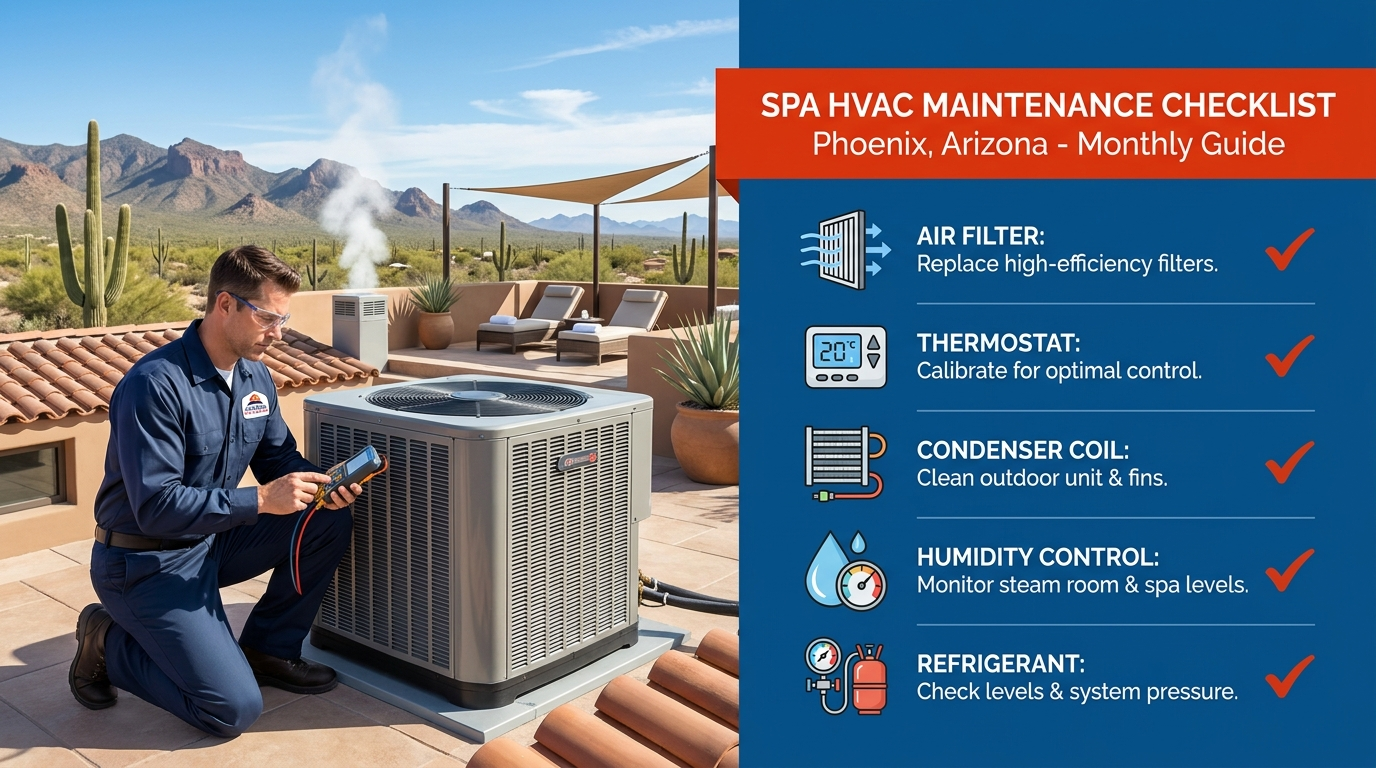
A documented commercial HVAC maintenance routine protects three things at once: guest comfort, equipment lifespan, and your operating budget. Spas that follow a monthly checklist consistently see fewer mid-season failures, lower humidity complaints, and meaningfully smaller power bills than spas that only call when something breaks. The table below is the at-a-glance version of the routine we recommend for most Phoenix spa facilities — keep it posted near your mechanical room and check off each item as your staff or service partner completes it.
| Maintenance Task | Frequency | Why It Matters in Phoenix | DIY or Pro |
|---|---|---|---|
| Inspect & replace air filters | Every 30 days | Dust and high run-times clog filters fast, choking airflow | DIY |
| Check evaporator & condenser coils | Monthly visual / quarterly deep clean | Hard-water scale and dust cut heat transfer | Pro |
| Flush & treat condensate drain line | Every 30 days | Standing water breeds mold and overflows in humid rooms | DIY / Pro |
| Verify humidity (40%–55% RH) | Monthly | Steam and hydrotherapy push moisture out of range | DIY |
| Test thermostats & zone controls | Monthly | Drift causes overcooling and uneven rooms | DIY / Pro |
| Inspect refrigerant pressures & lines | Quarterly | Low charge cripples cooling in 110°F heat | Pro |
| Tighten & test electrical connections | Quarterly | Heat loosens lugs and degrades capacitors | Pro |
| Clean & clear outdoor condenser unit | Monthly | Desert dust and debris smother airflow | DIY |
| Check belts, motors & lubrication | Quarterly | Worn belts cause airflow loss and breakdowns | Pro |
| Review energy use & run-time logs | Monthly | Rising kWh is an early warning of trouble | DIY / Pro |
Your Monthly Spa HVAC Maintenance Checklist, Task by Task
The table gives you the schedule; this section gives you the reasoning behind each task and the technique that makes it worthwhile. We’ve refined this routine over years of hands-on commercial HVAC service across Phoenix spas, and the order below reflects how we actually move through a facility on a maintenance visit.
Air Filters: The 30-Day Non-Negotiable
Filters are the cheapest insurance in your entire mechanical system, and in a spa they load up faster than almost anywhere else. Skin cells, lint from towels, product mist, and Phoenix dust all collect in the media, and once a filter is dirty your blower works harder, your air conditioning system loses capacity, and humidity creeps upward because airflow has dropped. Check filters every 30 days without exception, and replace them the moment they look gray or loaded.
For wet zones, we often recommend a slightly higher MERV rating to capture finer particles, paired with more frequent changes. If you’ve noticed weak airflow even with a fresh filter, that’s a sign the issue has moved downstream to the coils or ductwork — a good moment to schedule professional HVAC repair and diagnostics before it worsens.
Coils and the Phoenix Hard-Water Problem
Evaporator and condenser coils are where heat actually moves into and out of your system, so anything coating them directly steals capacity. In Phoenix, the twin enemies are desert dust on the outdoor coil — especially on roof-mounted equipment that needs regular rooftop unit service — and hard-water mineral scale on anything touched by humidity or condensate. A visual check belongs on your monthly list; a thorough chemical cleaning is a quarterly job for a technician who can do it without bending fins or damaging the coating.
When coils stay clean, your system reaches its target temperature faster and runs shorter cycles — which is exactly what protects both comfort and your power bill. This is also where energy-efficient operation is won or lost. A neglected coil can quietly add 20% or more to cooling costs long before it ever triggers an obvious failure.
Condensate Drains and Humidity Control
Spas generate moisture all day, and your system pulls that moisture out of the air as condensate. If the drain line clogs with algae or mineral buildup, water backs up into the pan, then overflows — and the standing water becomes a breeding ground for mold that the blower spreads through your treatment rooms. Flush the drain line monthly and treat it to keep it clear.
Pair that with a humidity reading in each zone. We aim for a relative humidity band of 40% to 55%; above that, you’ll see condensation on mirrors and that “cold but clammy” feeling guests dislike. When a single wet room runs hot and humid no matter what the thermostat says, the fix is often a dedicated ductless mini-split zone and recalibrated humidity sensors so the system reacts to real moisture rather than a misread. Stronger indoor air quality always starts with controlled water.
Thermostats, Controls, and Zoning
A spa lives and dies by even temperatures from suite to suite, and that depends on accurate controls. Each month, verify that every thermostat reads true and that zone dampers respond as they should. Drift of even a few degrees causes one room to overcool while another never catches up, and it quietly drives up run-time. If your controls are aging or you’re still juggling manual setpoints, upgraded zoning and thermostat controls with programmable scheduling pays for itself quickly in a facility with predictable hours.
While you’re in the controls, confirm that conditioned air is actually reaching each room. Leaky ducts can dump 20% to 30% of your cooling into ceiling cavities, so professional duct sealing is one of the highest-return upgrades we recommend for older spa buildings.
Refrigerant, Electrical, and the Quarterly Deep Check
Some tasks shouldn’t wait for an annual visit but also can’t be done safely by in-house staff. Refrigerant pressures, line-set condition, electrical connections, capacitors, and motor lubrication all fall here. Low refrigerant charge is especially punishing in our climate — a system that’s even slightly undercharged simply can’t keep up when the outdoor temperature crosses 110°F, and small leaks only grow. Professional refrigerant leak detection on a quarterly cadence catches these before they cascade into a compressor failure.
Heat also loosens electrical lugs and ages capacitors faster than in milder regions, which is why our technicians tighten and test connections every visit. Catching a weak capacitor in spring is a five-minute swap; catching it after it fails in July is an emergency AC repair during your peak season.
Seasonal Adjustments for Phoenix’s Climate
The monthly checklist stays constant, but smart spas shift their emphasis with the calendar. A little seasonal planning keeps you ahead of the two stretches that cause the most trouble here: the brutal summer cooling season and the dusty monsoon weeks that follow.
- Spring (Mar–May): This is your pre-summer tune-up window. Schedule a full professional inspection now — coils, refrigerant, electrical, and capacitor health — so the system enters June at full capacity. It’s the cheapest month to fix anything.
- Summer (Jun–Aug): Run-times spike, so tighten the filter routine to every two to three weeks and keep the outdoor condenser clear of debris. Watch your energy logs closely; a sudden jump is the earliest sign of a developing fault.
- Monsoon (Jul–Sep): Blowing dust and storms load coils and filters fast. Inspect the outdoor unit after major dust events, and confirm condensate drains handle the added humidity without backing up.
- Fall & Winter (Oct–Feb): The slower season is ideal for bigger projects — duct sealing, control upgrades, or a full AC installation if your current system is past its prime. If you operate steam rooms or heated treatments, verify heat pump and heating performance before the cooler weeks arrive.
Many spas also run ice machines, beverage coolers, or other refrigeration in their relaxation lounges, and that equipment adds both heat and humidity to the same space your HVAC has to manage. Folding refrigeration maintenance and ice machine service into the same seasonal plan keeps every moisture source in check rather than letting one undo the others.
Want a quick visual walkthrough? Watch our short below for a fast look at the maintenance habits that keep Phoenix systems running through the heat.
Troubleshooting Common Spa HVAC Issues
Even with a disciplined checklist, problems surface — and knowing what an early symptom means helps you decide whether it’s a quick fix or a service call. Here are the patterns we see most often in Phoenix spas:
- Foggy mirrors or condensation: Humidity is above range. Check the condensate drain and filter first, then have a tech verify the system is removing latent load, not just lowering temperature.
- One room never cools: Usually a zoning, damper, or duct-leak issue rather than a failing system. A controls check and duct inspection typically pinpoints it.
- System runs constantly but won’t catch up: Often low refrigerant charge or a fouled coil — both jobs for a licensed technician, and both worse the longer they wait.
- Musty smell despite cleaning: Moisture is sitting somewhere it shouldn’t, commonly a slow drain or a damp filter.
- Rising power bills with no weather change: A reliable early warning — compare your run-time logs and book an inspection before the fault grows.
When a symptom points to refrigerant, electrical, or sealed-system work, that’s the line where a professional should take over. Our 24/7 emergency service exists because spa breakdowns rarely keep business hours — but a faithful maintenance checklist is what keeps those calls rare in the first place.
When to Call a Professional for Your Spa HVAC
A trained in-house team can confidently handle filters, drain flushing, humidity readings, and keeping the outdoor unit clear. Everything touching refrigerant, the electrical system, or the sealed mechanical loop should go to a licensed, insured technician — both for safety and to keep your equipment warranty intact. That’s not a sales pitch; it’s the practical line between routine upkeep and specialized work.
Experience matters here more than most owners expect. Spa HVAC sits at the intersection of high humidity, hard water, and health-sensitive guests, and our technicians are trained for that exact combination rather than treating a spa like a generic office buildout. For larger facilities, that same expertise extends to chiller systems and other central equipment. You can read about our background, certifications, and years serving the Valley on our about page, and review what we cover under our commercial services. We document every visit so you have a clear maintenance history for warranty claims and health inspections.
If you’re weighing a maintenance agreement, the math is straightforward: scheduled preventive maintenance costs a fraction of a single peak-season emergency repair and extends equipment life by years. We build plans around your hours, confirm your facility falls within our service areas — including Scottsdale, Tempe, and Mesa — and can walk through upgrade options whenever you reach out to our team. For owners researching efficiency, more practical guidance lives on our blog.
Frequently Asked Questions — Spa HVAC Maintenance in Phoenix
How often should a Phoenix spa service its HVAC system? +
We recommend monthly in-house checks (filters, drains, humidity, outdoor unit) plus a professional inspection every quarter. In Phoenix’s heat and hard water, that cadence catches coil scale, refrigerant issues, and electrical wear before they become peak-season breakdowns.
What humidity level should a spa maintain? +
Aim for 40% to 55% relative humidity. Staying in that band keeps treatment rooms comfortable, prevents condensation on mirrors and surfaces, and stops the mold growth that thrives when moisture climbs higher. We measure each zone separately because wet rooms run very differently from reception areas.
Which maintenance tasks can my staff do versus a technician? +
Your team can handle filter changes, condensate drain flushing, humidity readings, and clearing the outdoor condenser. Anything involving refrigerant, electrical connections, capacitors, or the sealed system should go to a licensed technician — both for safety and to keep your warranty valid.
Why does Phoenix hard water affect my spa HVAC? +
Every time hard water evaporates, it leaves mineral scale on coils, humidifier parts, and condensate drains. That scale reduces heat transfer, clogs drainage, and forces your system to work harder for worse results. Regular descaling and drain treatment are core parts of a Phoenix spa maintenance plan.
Does preventive maintenance really lower energy bills? +
Yes, measurably. Clean coils, correct refrigerant charge, sealed ducts, and fresh filters let the system reach temperature faster and run shorter cycles. A neglected system can add 20% or more to cooling costs, so consistent maintenance often pays for itself during a single Phoenix summer.
Do you serve spas throughout the Phoenix metro? +
We serve spas, salons, and wellness facilities across the Valley. You can confirm your location on our service areas page or call us at (602) 889-1367, and you’ll find us on our Google Maps listing for directions and reviews.
Keep Your Spa Comfortable Through Every Phoenix Season
The spas that sail through summer aren’t the ones with the newest equipment — they’re the ones that treat maintenance as a monthly habit rather than an emergency response. A clear-mirror treatment room, steady temperatures from suite to suite, and air that smells clean the moment a guest walks in aren’t luxuries; they’re the natural result of a system that’s checked, cleaned, and calibrated on a schedule built for our climate. Post the checklist above near your mechanical room, hand the professional tasks to a technician you trust, and you’ll trade unpredictable breakdowns for predictable, manageable upkeep.
If you’re also planning a buildout or expansion, our guide to commercial AC installation in Phoenix walks through sizing and system selection in depth, and you’ll find more practical advice on our blog. When you’re ready for a hands-on assessment, our team is a short drive from spas across the Valley — get directions and save us through our Google Maps location so we’re one tap away the moment you need us.
Ready to put your spa HVAC maintenance checklist on autopilot? Call Discount AC & Refrigeration of Phoenix today at (602) 889-1367 to schedule a maintenance visit or set up a preventive plan, or reach us through our contact page and stop by our local Google listing to see why Phoenix spas trust us with the systems their guests depend on. Let’s keep your spa comfortable, efficient, and running clean — season after season.