
Water Quality and Med Spa HVAC in Phoenix: Why It Matters for Your Facility
If your med spa keeps fighting white scale on equipment, foggy mirrors in treatment rooms, or an HVAC system that struggles to hold a steady temperature, the culprit is often something most owners never connect to their air conditioning: the water itself. The relationship between water quality and med spa HVAC in Phoenix is direct, measurable, and expensive to ignore — our city’s notoriously hard water leaves mineral deposits that quietly degrade coils, humidifiers, and condensate systems while pushing humidity and indoor air quality in the wrong direction. In this guide, we explain exactly how the two systems interact, what it costs you when they fall out of balance, and how to protect both. Read on to save yourself the recurring service calls and premature equipment replacements we see across the Valley every season.
At Discount AC & Refrigeration of Phoenix, we’ve spent years servicing wellness facilities, salons, and clinical spaces across the metro, and the water-and-air connection is one of the most overlooked maintenance gaps we encounter. Our commercial HVAC team approaches every med spa as a combined moisture, mineral, and air-quality problem — not just a thermostat setting — and that difference is what keeps your equipment running and your clients comfortable.
Why Water Quality and HVAC Are Connected in a Med Spa
A med spa is a uniquely water-intensive commercial environment. Hydrafacials, steam treatments, towel warmers, autoclaves and sterilizers, laundry, and hydrotherapy stations all introduce moisture and minerals into the building at a volume a typical office or retail space never sees. That moisture doesn’t stay in the equipment — it migrates into the air, where your HVAC system has to remove it. And the minerals dissolved in Phoenix tap water don’t disappear either; they precipitate out as scale on every warm or wet surface the air handler touches.
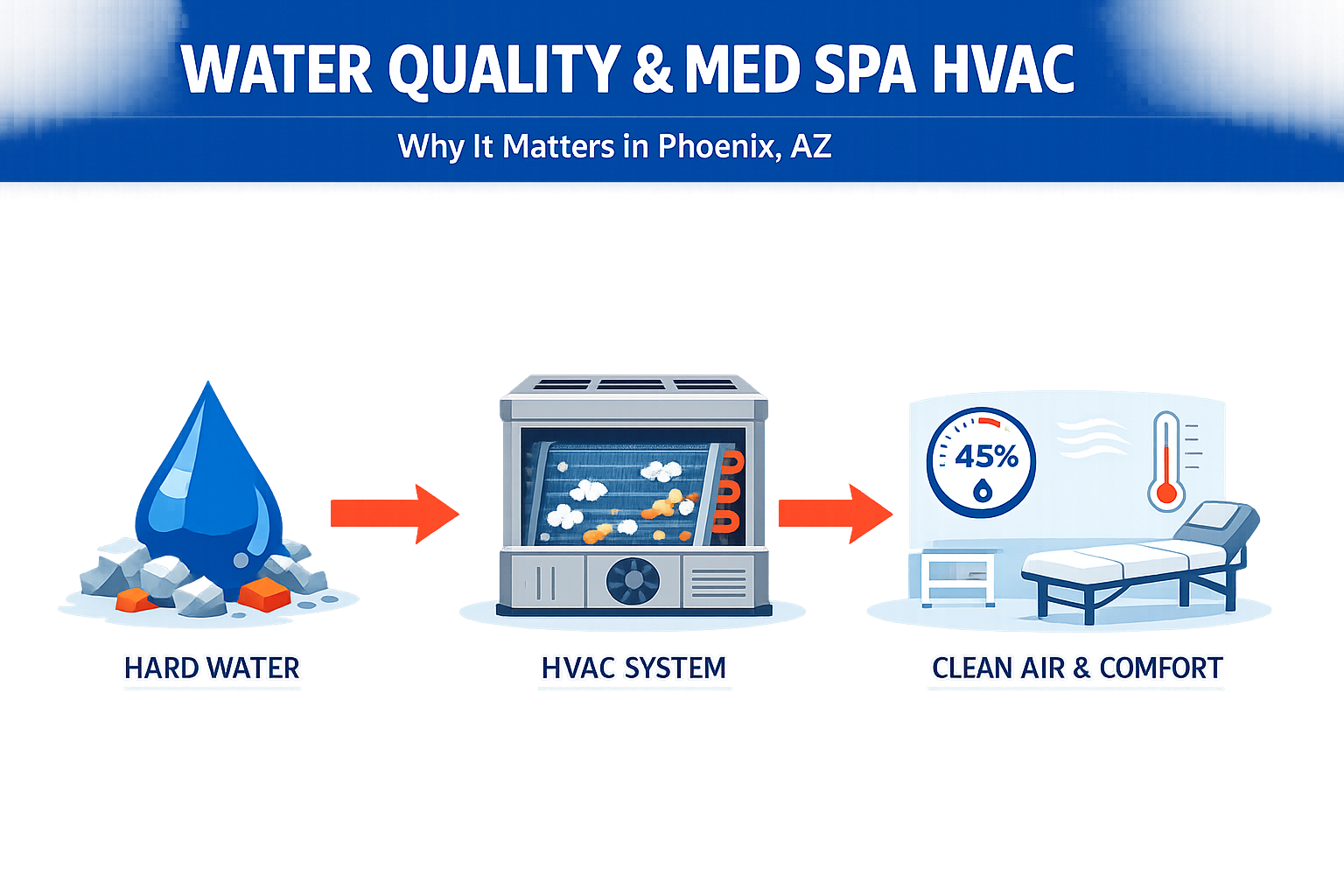
This is why we treat indoor air quality and water chemistry as a single engineering problem in spa settings. When water quality is poor, three things happen at once: humidity becomes harder to control, equipment efficiency drops as scale insulates heat-transfer surfaces, and the moist, mineral-rich environment becomes friendlier to microbial growth. Each of those individually creates client complaints. Together, they shorten the service life of the whole system.
Phoenix sits in one of the hardest water regions in the country, with mineral content frequently measured between 12 and 17 grains per gallon. For comparison, water above 7 grains per gallon is already considered hard. That mineral load is the single biggest variable separating a med spa HVAC system that lasts from one that needs constant attention. The table below summarizes how that water quality shows up across the components our technicians inspect most often.
| Component | How Hard Water Affects It | Warning Sign | Phoenix Risk | Service Interval |
|---|---|---|---|---|
| Evaporator Coil | Scale insulates fins, cutting heat transfer | Weak cooling, longer run times | High | Every 6 months |
| Steam Humidifier | Mineral crust clogs nozzles and cylinders | Inconsistent output, white dust | Very High | Quarterly |
| Condensate Drain | Scale plus biofilm blocks the line | Water leaks, musty odor | High | Every 3 months |
| Drain Pan | Standing mineral water breeds mold | Slime, discoloration | Moderate | Every 6 months |
| Blower & Ductwork | Mineral dust coats blades and liners | Reduced airflow, dust film | Moderate | Annually |
| Air Filtration | High humidity loads filters faster | Frequent clogging, pressure drop | High | Every 1–2 months |
| Thermostat Sensors | Humidity drift causes misreads | Temperature swings room to room | Moderate | Annually |
| Towel Warmer / Autoclave | Scale shortens heating-element life | Slow heat-up, element failure | Very High | Monthly descale |
How Phoenix’s Hard Water Affects Med Spa HVAC Systems
Hard water damages an HVAC system in slow, compounding ways that rarely trigger an obvious failure until the bill arrives. Understanding the mechanism helps owners see why our HVAC maintenance program for spas looks different from a standard commercial plan.
Scale Buildup on Coils and Humidifier Components
When mineral-rich water evaporates — whether from a steam humidifier, a hydrotherapy room, or condensation on a cold evaporator coil — the calcium and magnesium it carried stay behind as scale. A coating just 1/32 of an inch thick on a coil can reduce heat-transfer efficiency by double digits, forcing the compressor to run longer to hit the same setpoint. That extra runtime raises energy bills and accelerates wear, which is exactly the kind of problem our energy-efficient AC solutions are designed to prevent. Steam humidifiers suffer even faster, since they boil water continuously and concentrate minerals into a hard crust that clogs cylinders and nozzles within weeks if left untreated.
We see this most often in spas that added humidification or steam treatments after the original buildout without revisiting the mechanical system. If your facility is in that position, it may be worth reviewing your equipment alongside our spa HVAC installation guidance, because retrofitting moisture control onto an undersized system rarely ends well.
Condensate Drains, Drain Pans, and Microbial Growth
Every cooling system pulls moisture out of the air and routes it through a condensate drain. In a med spa, that drain handles far more water than usual because the latent load is so high. When Phoenix minerals combine with the organic film that naturally forms in a wet drain line, you get a sticky scale-and-biofilm blockage that backs water into the drain pan. Standing water in a warm pan is the ideal breeding ground for mold and bacteria — which then gets distributed through the airstream the moment the blower turns on.
This is the point where a water problem becomes an air problem, and where a clogged drain becomes a health concern in a clinical setting. Quick AC repair on a flooded pan only treats the symptom; correcting the water chemistry and drainage design is what actually fixes it. Our technicians flush, treat, and re-pitch drain lines as part of every preventive maintenance visit so a slow blockage never becomes a ceiling stain or a mold remediation invoice.
Humidity, Indoor Air Quality, and Client Safety
The most visible consequence of poor water-and-air balance is humidity that won’t sit where it should. Med spas need tighter humidity control than almost any other commercial space — typically a relative humidity band between 40% and 55%. Below that range, treatment rooms feel dry and clients are uncomfortable; above it, you invite condensation, mold, and that unmistakable “clammy” feeling no air freshener can mask.
When humidity drifts high, the problems cluster quickly:
- Condensation on mirrors, windows, and cold supply registers in treatment rooms
- Mold and mildew recurring on grout, baseboards, and ceiling tiles within weeks of cleaning
- Musty odors that persist even with the HVAC running constantly
- Compromised sterilization, since damp environments undercut clinical hygiene standards
- Client and staff discomfort, with rooms that feel cold yet sticky at the same time
Solving this isn’t about turning the thermostat colder — it’s about removing moisture independently of temperature. That often means a properly sized dehumidification stage, smarter controls, or in some layouts a ductless mini-split zone that conditions a wet room separately from your reception and retail areas. We also calibrate thermostat and humidity sensors so the system reacts to the real moisture load rather than a misread caused by mineral drift. Cleaner air starts with controlled water, and we pair these adjustments with upgraded duct sealing so conditioned air actually reaches the rooms that need it instead of leaking into ceiling cavities.
The Equipment That Ties Water and Air Together
It helps to think of a med spa’s mechanical systems as one connected loop rather than separate machines. Several pieces of equipment sit directly at the intersection of water quality and air performance, and a failure in one almost always shows up in another.
Steam generators and humidifiers convert water into air moisture, so their scale problems become humidity problems. Towel warmers, autoclaves, and sterilizers concentrate minerals as they heat, and the steam they release adds to the latent load your air conditioning system must remove. Even your refrigeration matters: a poorly maintained ice machine or beverage cooler in the relaxation lounge contributes heat and humidity, which is why our commercial refrigeration and ice machine repair services overlap so often with our spa HVAC work. When a facility manager calls us about “the AC not keeping up,” the root cause is frequently a piece of water-handling equipment that nobody thought of as part of the HVAC system at all.
For owners weighing a larger upgrade, efficiency ratings matter here too. A high-performing system handles latent load more gracefully, and understanding what a SEER2 rating means helps you compare equipment that can actually manage a humid spa environment. Whether the right answer is targeted HVAC repair, a heat pump installation, or a full AC installation, the decision should account for your water profile, not just square footage.
Our Maintenance Approach for Water-and-Air Systems
Experience in clinical and wellness spaces has taught us that med spa HVAC can’t be handled with a generic filter-and-go service call. The combination of high moisture, hard water, and health-sensitive clients raises the stakes — and our process reflects years of hands-on work across Phoenix facilities. You can read more about our background and credentials on our about page, and review the full scope of what we cover under our services.
On a water-and-air maintenance visit, our trained, certified technicians:
- Inspect and descale evaporator coils, humidifier cylinders, and heating elements
- Flush and treat condensate drains, then verify drain-pan pitch and cleanliness
- Measure relative humidity in each zone and compare it to clinical targets
- Test airflow and replace filtration sized for high-moisture loads
- Recommend water-treatment or scale-mitigation steps where the system needs them
We document each visit so you have a clear maintenance history — useful for warranty claims, health inspections, and planning future upgrades. Many of our spa clients fold these visits into a year-round refrigeration and HVAC maintenance agreement so nothing slips through the cracks during peak season. We serve med spas throughout the metro, and you can confirm whether your facility falls within our coverage on our service areas page. For larger investments, we also offer financing options that make a properly engineered system attainable without straining cash flow.
Frequently Asked Questions — Water Quality & Med Spa HVAC
Does water quality really affect my med spa’s air conditioning? +
Yes. Phoenix’s hard water deposits mineral scale on coils, humidifiers, and drains every time it evaporates. That scale reduces heat transfer, clogs drainage, and raises humidity — all of which force your HVAC system to work harder while delivering worse comfort and air quality.
What humidity level should a med spa maintain? +
Most med spas aim for a relative humidity band of 40% to 55%. Staying in that range keeps treatment rooms comfortable, protects equipment, and prevents the condensation and mold growth that thrive when moisture climbs higher.
How often should med spa HVAC equipment be serviced in Phoenix? +
Because of our hard water and high moisture loads, we recommend coil and drain service every three to six months, humidifier descaling quarterly, and filtration checks every one to two months. We set an exact schedule based on your treatment menu after an on-site inspection.
Can hard water cause mold in my HVAC system? +
Indirectly, yes. Mineral scale blocks condensate drains, which causes water to stand in the drain pan. That warm, still water becomes a breeding ground for mold and bacteria that the blower can then spread through your treatment rooms. Keeping drains clear is one of the most important steps we take.
Should each wet treatment room have its own HVAC zone? +
Often, yes. Steam and hydrotherapy rooms generate far more moisture than reception or retail areas, so conditioning them on a separate zone — frequently with a ductless mini-split — lets you control humidity precisely without overcooling the rest of the spa. We assess this during an on-site visit.
Do you serve med spas throughout the Phoenix metro? +
We serve med spas, salons, and wellness facilities across the Valley. You can confirm your location on our service areas page or call us directly at (602) 889-1367, and you’ll find us on our Google Maps listing as well.
Protect Your Med Spa Before the Next Phoenix Summer Hits
The spas that avoid emergency calls aren’t the ones with the newest equipment — they’re the ones that recognized early how tightly water quality and med spa HVAC in Phoenix are linked, and acted before scale, humidity, and mold compounded into a major repair. A clear-mirror treatment room, a steady temperature from suite to suite, and air that smells clean the moment a client walks in: those aren’t luxuries, they’re the natural result of a system engineered around our local water and climate. If your facility is showing any of the warning signs in the table above, the time to address them is now, while it’s still a tune-up and not a replacement.
If you’re also planning a buildout or expansion, our companion guide on spa HVAC installation in Phoenix walks through sizing and system selection in depth, and you can browse more practical advice on our blog. When you’re ready for a hands-on assessment, our team is a short drive from spas across the Valley — find us and get directions through our Google Maps location, and stop by or save the listing for your records.
Ready to protect your equipment, your air quality, and your clients? Call Discount AC & Refrigeration of Phoenix today at (602) 889-1367 to schedule a med spa water-and-air inspection, or reach us through our contact page and visit our local Google listing to see why Phoenix wellness businesses trust us with the systems their clients depend on. Let’s keep your spa comfortable, compliant, and running clean — season after season.