
AC leak repair should locate and seal the refrigerant loss before the system receives a measured recharge. Adding refrigerant without finding the leak is not a lasting repair. If your Phoenix AC is blowing warm air, icing over, or running longer than usual, call (602) 889-1367 or find Discount AC & Refrigeration of Phoenix on Google Maps.
Low refrigerant can reduce capacity and raise compressor stress, but those symptoms can also come from restricted airflow, a faulty expansion device, or dirty coils. We begin with measurements instead of assumptions, then explain what failed and what the repair requires.
Signs That Point to the Need for AC Leak Repair
| Symptom | Possible explanation | Recommended response |
|---|---|---|
| Warm air and long cycles | Low charge may reduce heat transfer | Schedule full diagnostics |
| Ice on coil or suction line | Low charge or restricted airflow | Turn cooling off; keep fan on |
| Oil stain at a fitting | Refrigerant oil may mark a leak point | Do not disturb the connection |
| Hissing near line set | Possible active pressure leak | Shut system off and call |
| Repeated need for refrigerant | The sealed circuit is losing charge | Request leak detection |
Low Refrigerant Is Not Normal Consumption
A properly sealed air conditioner does not use refrigerant like fuel. The refrigerant circulates between the evaporator and condenser. If the charge is low, the system was undercharged during prior service or refrigerant escaped through a defect.
A homeowner can safely check the thermostat, filter, supply airflow, and visible ice. Do not loosen service caps, attach gauges, or try a store-bought recharge. Professional AC leak repair involves regulated sealed-system work. The EPA requires appropriate Section 608 certification for technicians who service equipment in ways that could release regulated refrigerant. The agency also prohibits intentional venting during service. Read the EPA Section 608 certification guidance and refrigerant management rules.
Why Phoenix Heat Can Expose a Weak Point
Phoenix summer operation creates long run times and elevated condensing pressure. A worn Schrader core, weakened braze, rubbed copper line, or corroded evaporator coil may begin leaking under that stress. Dust can also coat the outdoor coil. That raises operating pressure and can make an existing weakness more apparent.
A frozen coil does not automatically prove a leak. A dirty filter, failed blower, collapsed duct, or blocked evaporator can lower airflow and create similar icing. Our HVAC troubleshooting library explains common comfort problems, while our AC repair and diagnostics service covers professional testing.
How Professional AC Leak Repair Works
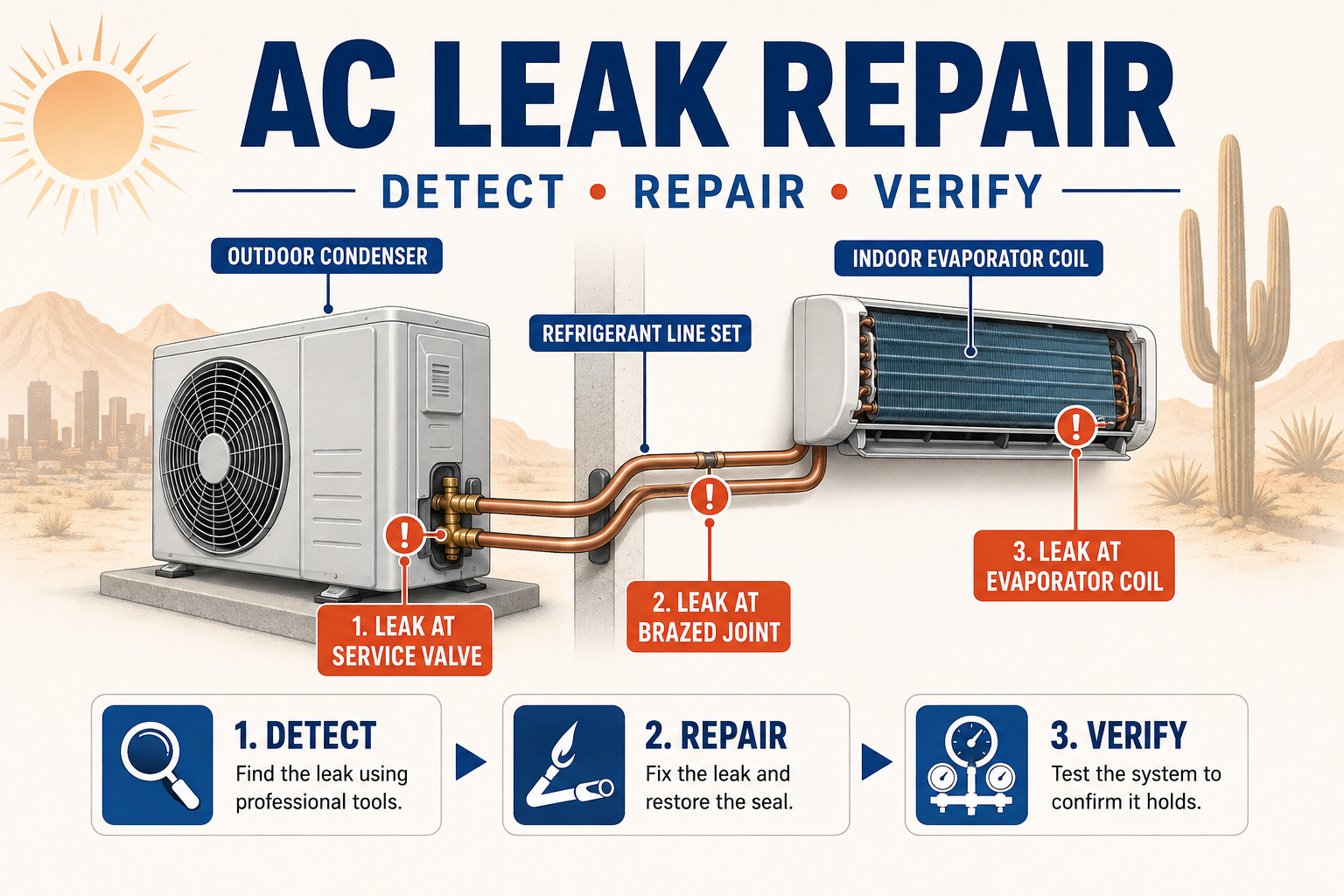
A complete AC leak repair has three goals: identify the exact leak, restore the sealed circuit, and prove that the system holds pressure and operates with the correct charge.
- Confirm the complaint. We record indoor and outdoor conditions, thermostat settings, supply and return temperatures, airflow clues, and equipment history.
- Measure system operation. Pressure alone is not enough. Depending on the metering device and system, the technician evaluates superheat, subcooling, saturation temperatures, delta-T, amp draw, and coil condition.
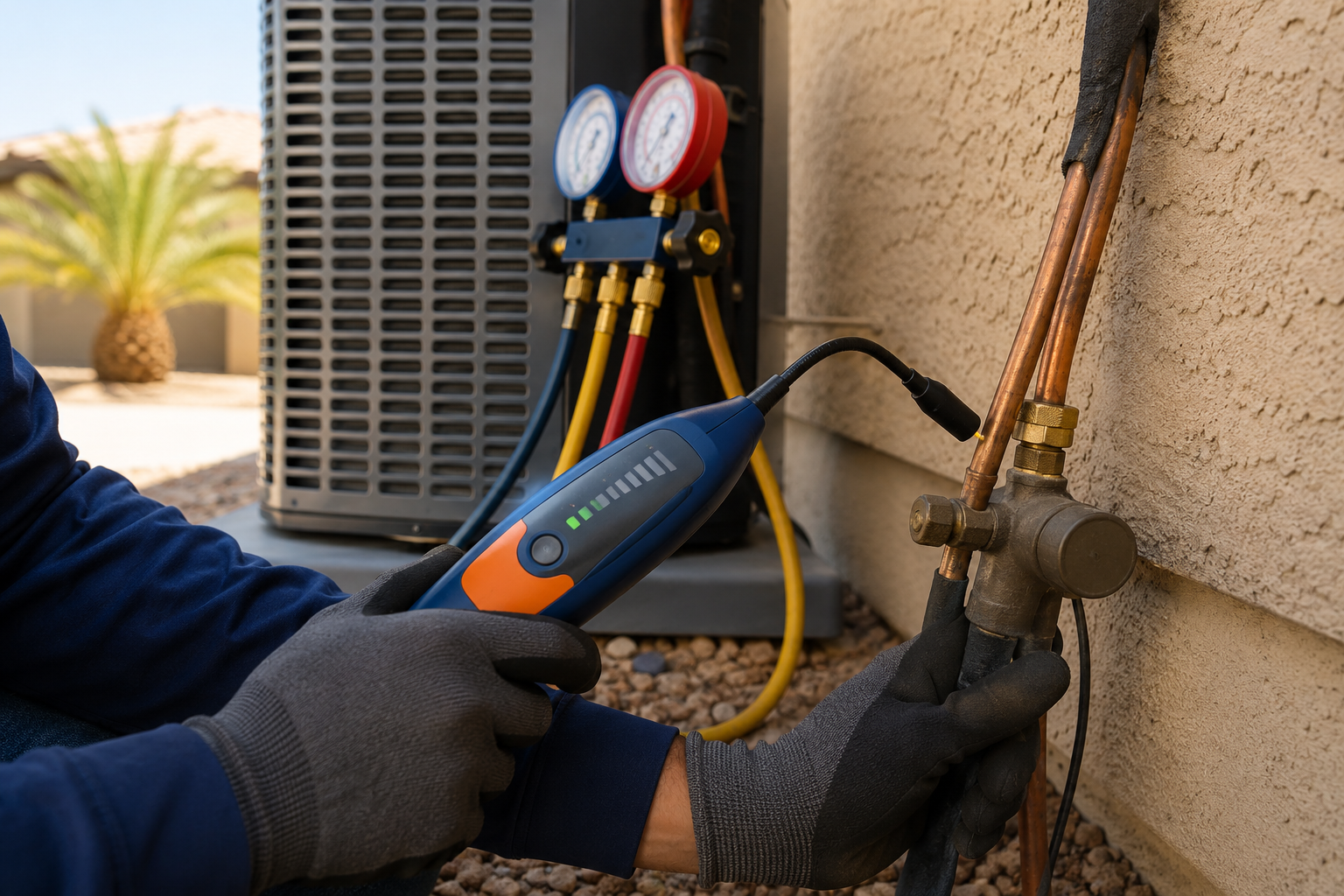
- Search for the source. An electronic detector can identify refrigerant near service valves, coils, fittings, and line-set routes. Soap solution can confirm accessible points. Nitrogen pressure testing helps isolate difficult or intermittent leaks.
- Recover refrigerant when required. Refrigerant must be handled with approved recovery procedures. It should not be released into the air.
- Repair or replace the failed part. The solution may be a valve core, brazed joint, damaged line section, evaporator coil, condenser coil, or another sealed-system component.
- Pressure-test and evacuate. The repaired circuit is tested, then evacuated with a vacuum pump to remove air and moisture. A decay test helps verify system integrity.
- Recharge and commission. Refrigerant is weighed in or adjusted according to manufacturer procedures. Final readings confirm airflow, charge, temperature performance, and electrical operation.
Why “Top It Off” Is an Incomplete Solution
A recharge may temporarily restore cooling, but it does not correct the opening that allowed refrigerant to escape. The new charge can leave through the same defect. Repeated undercharge also changes system pressures, reduces evaporator performance, and can deprive the compressor of normal cooling and oil return.
We treat leak detection as part of the AC leak repair, not as an optional extra after several recharges. For residential equipment, review our residential HVAC services. Businesses with walk-ins, reach-ins, RTUs, or ice machines should use our commercial refrigerant leak detection service.
Different Refrigerants Require Different Procedures
Older systems may use R-22, many current systems use R-410A, and newer equipment may use lower-global-warming-potential refrigerants such as R-454B. Refrigerants are not interchangeable. The equipment rating plate, manufacturer data, approved tools, ventilation needs, and safety classification determine the service method.
R-454B is mildly flammable and requires tools and procedures appropriate to A2L refrigerants. This is another reason sealed-system work is not a DIY task. If replacement becomes the better path, our team can explain AC installation and replacement options, including system compatibility and load requirements.
Common AC Leak Repair Locations in Phoenix Systems
The most likely AC leak repair point depends on equipment age, installation quality, vibration, corrosion, service history, and where the copper line runs.
Service Valves, Caps, and Brazed Connections
The outdoor unit has several accessible joints where vibration and repeated service can affect sealing. Valve cores can leak. Caps can lose sealing surfaces. A braze may fail if the joint was contaminated or poorly supported. Oil residue often helps direct the inspection, but the location still needs confirmation.
Evaporator Coils and Condensate Environments
The indoor evaporator coil operates around moisture. Formicary corrosion can create tiny passages in copper tubing. Access may require opening the air handler or coil cabinet. If the coil is inaccessible or has multiple leaks, replacement may be more reliable than repairing one visible point.
Line Sets Exposed to Vibration or Abrasion
Copper can rub against sheet metal, masonry, or another pipe. Attic heat, poor support, and compressor vibration can worsen that contact over time. We inspect the accessible path, penetrations, insulation condition, and connections at both coils. Related airflow or insulation problems may also justify an evaluation of ductwork services.
Commercial Refrigeration Examples
In a representative Tempe restaurant scenario, a walk-in cooler that gradually warms and needs repeated recharge may have a leak at a valve stem or evaporator connection. The correct sequence is to protect product, identify the leak, repair it, test it, and verify the final charge—not assume compressor failure.
In a representative Mesa rooftop-unit scenario, a dusty condenser can drive high head pressure while a small joint leak reduces charge. Cleaning alone cannot restore lost refrigerant, and refrigerant alone cannot correct the heat-rejection problem. Both conditions need attention. See our rooftop unit service, commercial preventive maintenance, and commercial refrigeration capabilities.
AC Leak Repair or System Replacement?
AC leak repair usually makes sense when the leak is accessible, the failed component is available, the rest of the system is in sound condition, and the repair has a reasonable expected service life.
When Repair Is Often Reasonable
- The leak is at a service valve, accessible fitting, or isolated line-set section.
- The compressor and major coils test well.
- The system is compatible with an available refrigerant and approved components.
- The equipment has not developed repeated sealed-system failures.
- The repair can be pressure-tested and verified without major reconstruction.
When Replacement Deserves a Serious Comparison
Replacement may be more practical when an older coil has widespread corrosion, a discontinued component is unavailable, the compressor has been damaged, or several expensive failures are accumulating. R-22 equipment deserves special review because refrigerant and compatible parts can complicate long-term ownership.
We compare the confirmed repair scope with equipment condition, efficiency, expected use, and warranty status. Age alone does not decide the answer. A well-maintained older system with an accessible valve leak is different from a neglected unit with a leaking coil and failing compressor. If the compressor is involved, review our compressor replacement service. Heat-pump owners can also see our heat pump service.
What Affects the Repair Scope
AC leak repair pricing cannot be accurate until the leak location and equipment are known. Access, refrigerant type, remaining charge, required recovery, component availability, nitrogen testing, evacuation time, and the amount of refrigerant all affect the work. A written estimate should distinguish diagnosis, leak repair, parts, refrigerant, and any recommended follow-up.
For urgent loss of cooling, use our emergency residential AC repair. Commercial facilities can request emergency HVAC service or emergency refrigeration support.
What to Do Before the Technician Arrives
Protect the equipment and collect useful observations without opening the refrigerant circuit.
- Turn cooling off if the indoor coil or copper line is covered in ice.
- Set the thermostat fan to ON to help thaw the coil, if airflow is normal.
- Replace a visibly clogged filter with the correct size.
- Keep children and pets away from the outdoor unit and suspected leak area.
- Note when the problem began, any hissing, prior recharge dates, and recent repairs.
- Do not chip ice, heat the coil, open valves, or add refrigerant.
- Clear reasonable access to the thermostat, air handler, condenser, and electrical panel.
Routine inspections can catch oil staining, vibration, loose supports, dirty coils, and abnormal operating readings before comfort drops sharply. Explore our residential maintenance programs or schedule service through our contact page. Our Phoenix metro service-area directory lists the communities we cover. If cooling concerns also involve odors, dust, or filtration, review our indoor air quality services. Owners of zoned additions can compare ductless mini-split systems.
Frequently Asked Questions — AC Leak Repair
Schedule AC Leak Repair in Phoenix
AC leak repair is most effective when the technician fixes the source and verifies the sealed system before charging it. If your home or business is losing cooling, schedule a measured diagnosis instead of another unverified refill. Call Discount AC & Refrigeration of Phoenix at (602) 889-1367, request service through our online contact page, or get directions from our Google Business Profile.