
When your cooling quits on a 115°F afternoon, emergency AC repair isn’t a luxury — it’s a safety need. In this guide we explain exactly what to expect: what qualifies as a true AC emergency, why extreme heat in Arizona raises the stakes, what you can safely do while help is on the way, and how our team responds around the clock across the Phoenix metro. We’ve spent years cooling homes and businesses in the desert, so we’ll keep this practical and honest. Here’s what happens from the moment you call to the moment your air turns cold again.
What Counts as an AC Emergency?
Not every cooling problem needs a technician at your door within the hour. Part of our job is helping you tell the difference so you can make a calm, informed decision. In simple terms, an AC emergency is any failure that threatens the health and safety of the people inside — or one that will cause fast, expensive damage if it isn’t addressed right away. A warm bedroom overnight in spring is uncomfortable; a dead system during a July heat advisory with an infant or an elderly parent at home is a different situation entirely.
Over the years handling AC repair and diagnostics throughout the Valley, we’ve learned that most “emergencies” fall into a handful of clear categories: a complete loss of cooling during dangerous heat, burning or electrical smells, a tripping breaker that won’t reset, water pouring from the indoor unit, or ice building on the lines. Each of these has a reason behind it, and each deserves a fast, professional response through our 24/7 emergency AC repair service rather than a wait-and-see approach.
| What You’re Seeing | Emergency? | What We Recommend |
|---|---|---|
| No cooling during a heat warning (indoors 90°F+) | Yes | Call for same-day emergency service immediately |
| Burning smell or electrical odor from the unit | Yes | Shut it off at the breaker and call right away |
| Water leaking heavily near the indoor air handler | Yes | Power down to prevent damage, then schedule urgent repair |
| Breaker trips repeatedly when the AC starts | Yes | Stop resetting it — this signals an electrical fault |
| Weak airflow or slightly warm air, mild weather | Usually not | Book a standard diagnostic visit soon |
| Higher bills or uneven cooling room to room | Not urgent | Consider a tune-up or airflow assessment |
If your system is older and failing repeatedly, an emergency visit is also the right moment to talk honestly about whether continued fixes make sense or whether AC installation and replacement would serve you better long term. And if you rely on a heat pump for both heating and cooling, our heat pump service team handles those emergencies too, since a single failed component can knock out comfort in either season.
The Real Risks of Extreme Heat in Arizona
Phoenix summers are not like summers almost anywhere else in the country. When outdoor temperatures push past 110°F, an unconditioned home can climb well past 90°F indoors within a couple of hours — and it keeps climbing. That’s why we treat a broken air conditioner here as a genuine health matter, not just an inconvenience. Heat-related illness moves quickly, and the people most at risk are often the ones least able to say something is wrong.
Infants and young children, adults over 65, people with heart or respiratory conditions, and anyone taking certain medications all lose the ability to regulate body temperature efficiently in extreme heat. Pets are vulnerable too. According to public-health guidance, the warning signs of heat exhaustion — heavy sweating, dizziness, nausea, a rapid pulse — can tip into heat stroke, which is a medical emergency. This is the honest reason we keep a crew available at all hours across our service areas, from central Phoenix out to Scottsdale and Mesa.
Heat is hard on equipment as well. The same conditions that make a failure dangerous also make it more likely, because your system is running long, punishing cycles just to hold a comfortable temperature. Undersized ductwork, low refrigerant, a tired capacitor, or a clogged filter all force the unit to work harder in the exact moment it can least afford to. Regular attention through our maintenance programs is the single best way to avoid a mid-July breakdown, and pairing it with healthy indoor air quality habits keeps the whole system breathing easier.
What to Do While the Technician Is on the Way
Once you’ve called and help is confirmed, a few smart steps can keep everyone safer and even protect your equipment before we arrive. None of these replace a professional repair — they simply buy time and reduce risk:
- Move to the coolest part of the home. Interior rooms and lower floors hold heat less than sun-facing spaces. Close blinds on the sunny side.
- Hydrate and check on the vulnerable. Offer water to children, older adults, and pets, and never leave anyone in a parked vehicle, even briefly.
- Turn the system off if you smell burning or see water. Shut it down at the breaker rather than the thermostat when you suspect an electrical or leak issue.
- Stop resetting a tripping breaker. Repeated resets can worsen an electrical fault and create a fire risk.
- Use fans and damp cloths. Moving air and evaporative cooling help the body shed heat while you wait.
- Keep the fridge and freezer closed. They’ll hold temperature longer and give you cold water on hand.
If you’re unsure about any of this, call us and stay on the line — our dispatchers will walk you through it, or you can reach our office through the contact page at any time. You can also find us and get directions on our Google Maps listing if you’d like to see where our Queen Creek base sits relative to your neighborhood.
What to Expect During Our Emergency AC Repair Visit
Uncertainty is stressful, especially when it’s hot and you’re worried about your family. So here’s the plain version of how an emergency AC repair unfolds with us, step by step, from the first ring to the final temperature check.
The call and dispatch. When you reach us, we ask a few focused questions — what the system is doing, how hot it is inside, and who’s home — so we can prioritize correctly and bring the right parts. Homes with infants, seniors, or medical needs move up the queue. You’ll get a realistic arrival window, not a vague promise.
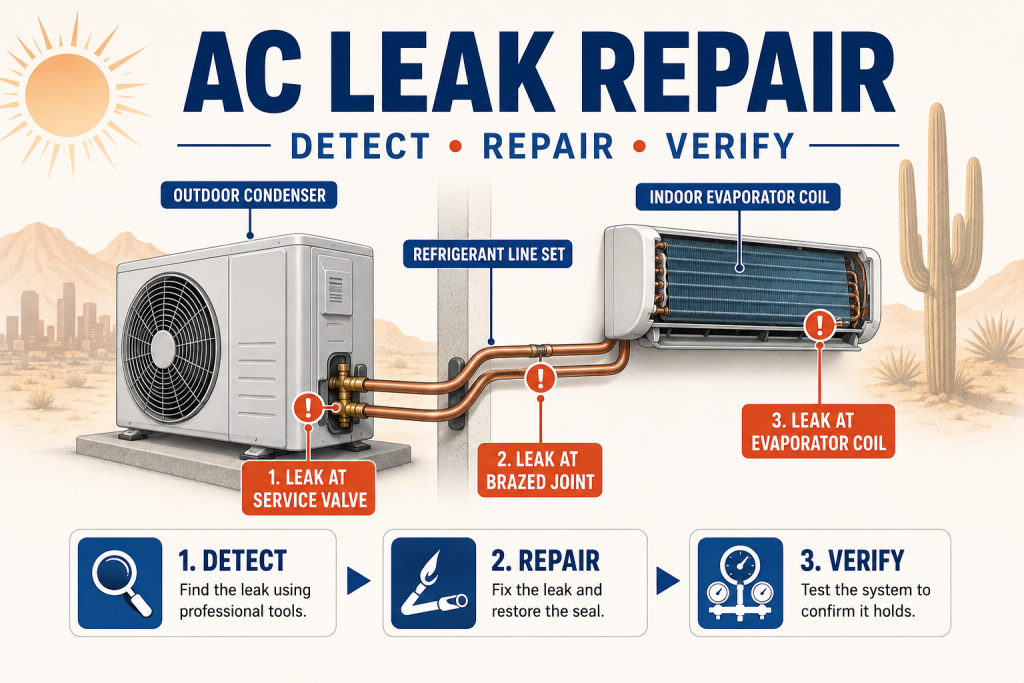
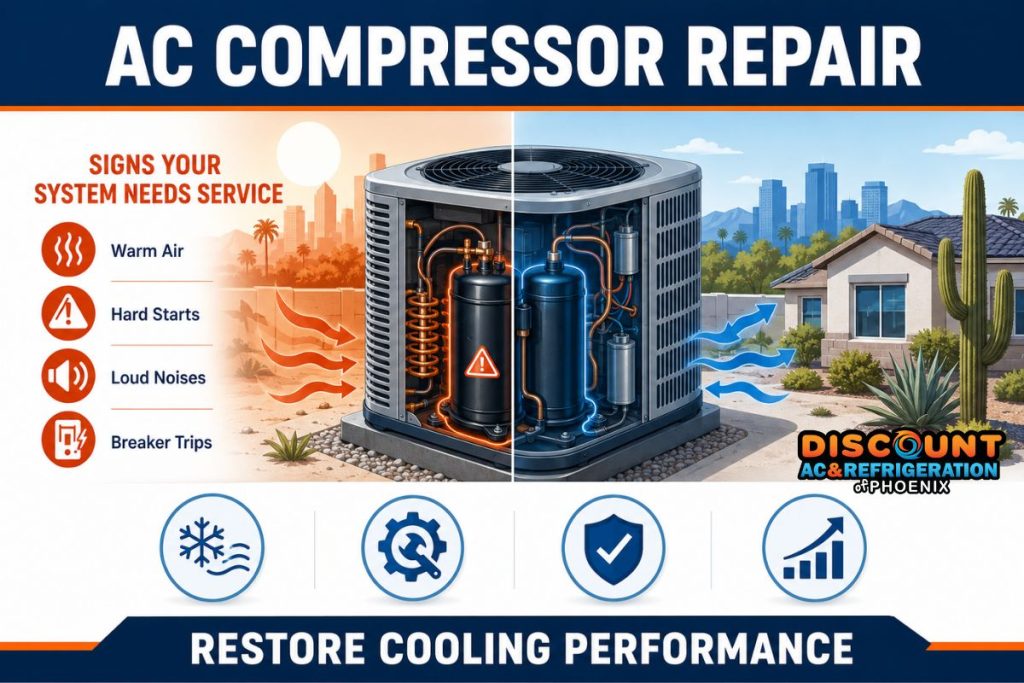
The diagnosis. On site, our technician starts with a genuine inspection rather than a guess. We check the thermostat, electrical connections, capacitor, contactor, refrigerant charge, coils, and airflow. Many “dead” systems come back to life with a failed capacitor or a tripped safety, while others need deeper attention such as refrigerant leak detection or compressor replacement. We show you what we find.
Transparent options and pricing. Before any work begins, we explain the problem in language that makes sense and give you clear pricing. If there’s more than one reasonable path — a quick fix now versus a more durable repair — we lay out both so the choice stays yours. We don’t upsell repairs you don’t need, and we’re upfront when a system is near the end of its life.
The repair and testing. Once you approve, we complete the work and then verify it, measuring the temperature split and confirming the system holds a safe, steady cool. If the root cause traces back to airflow or leaky runs, we’ll flag whether ductwork services would prevent a repeat. For homes with add-on rooms or no ducts at all, we may discuss ductless mini-split systems as a targeted fix, and in the cooler months our furnace service and repair team covers the heating side of the same equipment.
Behind all of this is experience that we take seriously. Our technicians are trained and certified, carry the EPA and industry credentials the trade requires, and work to strict safety standards on every call. You can read more about our team and the ongoing training we invest in, because the quality of an emergency repair comes down to the person holding the gauge. That hands-on expertise, paired with a strong local reputation, is what lets us solve problems quickly instead of trading parts until something works.
Our 24/7 Emergency Service Across the Valley
Cooling doesn’t fail on a schedule, and neither does our response. Our round-the-clock emergency service covers both homes and businesses, because a restaurant, clinic, or warehouse can’t simply close because the air went out. For households, our full range of residential services backs up every emergency call with the parts, tools, and know-how to finish the job right the first time.
On the commercial side, downtime is expensive and sometimes hazardous, so we keep the same urgency for commercial HVAC and commercial refrigeration. That includes rooftop unit service, urgent walk-in cooler and freezer repair, and after-hours emergency refrigeration that protects perishable inventory before it’s lost. Our 24/7 commercial emergency service is built so a manager never has to choose between safety and revenue.
We also believe the best emergency is the one that never happens. Scheduling preventive maintenance catches worn capacitors, low charge, and dirty coils before a heat wave turns them into a 2 a.m. phone call. It’s the quiet work that keeps you off this page next summer, and you’ll find more seasonal tips on our blog.
Call Now — Reach Our Phoenix Team Anytime
If your air conditioner has stopped and the house is heating up, don’t wait it out. Call (602) 889-1367 and speak with a real person who can dispatch help fast. You can also pin our location on Google Maps for directions or to leave a review after we’ve made things right. The sooner we hear from you, the sooner your home is safe and cool again.
Frequently Asked Questions — Emergency AC Repair
How fast can you arrive for an emergency AC repair in Phoenix? +
Response times depend on the day and demand, but emergency calls are prioritized above routine visits, and homes with vulnerable residents move to the front of the line. When you call, we give you a realistic arrival window rather than a vague promise, and we dispatch the nearest available technician with the right parts on board.
Is it worth paying for emergency service instead of waiting? +
During extreme Arizona heat, yes. Indoor temperatures can reach unsafe levels within hours, which is a real health risk for children, older adults, and pets. Prompt repair also prevents a small fault from cascading into a costlier failure. If the weather is mild and the issue is minor, a standard next-available visit is usually fine.
What should I do the moment my AC stops working? +
Move to the coolest room, hydrate, and check on anyone at risk. If you smell burning or see water near the indoor unit, switch the system off at the breaker and call us. Avoid resetting a breaker that keeps tripping, since that can signal an electrical fault. Then call for emergency AC repair so we can get you cooling again quickly.
Do you handle commercial and refrigeration emergencies too? +
We do. Alongside residential AC, our team responds to commercial HVAC, rooftop units, walk-in coolers and freezers, and after-hours refrigeration emergencies that put inventory at risk. The same 24/7 urgency applies, because a business can’t afford to lose product or close its doors during a breakdown.
How can I avoid needing emergency AC repair next summer? +
Routine maintenance is the most reliable prevention. A seasonal tune-up checks the capacitor, refrigerant charge, coils, and airflow before summer stress exposes a weak point. Joining a maintenance program keeps that on a schedule so small issues are caught early, long before they become a hot-night breakdown.
Cool, Safe, and Back to Normal — Sooner Than You Think
A failed air conditioner in the Arizona heat can feel like a crisis, but it doesn’t have to become one. Knowing what counts as a true emergency, understanding how fast indoor heat becomes dangerous, and having a clear picture of what a professional visit looks like all put you back in control of the situation. That’s the whole point of emergency AC repair done right: less panic, faster relief, and honest guidance from people who do this every day. If you’re weighing whether to repair or upgrade after this call, our overview of AC installation and replacement is a useful next read once the immediate heat is handled.
Whenever the moment comes — day, night, weekend, or holiday — we’re ready. Call our Phoenix team now at (602) 889-1367, reach out through our contact page, and find or review us on our Google Maps listing. Let’s get your home cool, safe, and comfortable again, starting the minute you pick up the phone.