
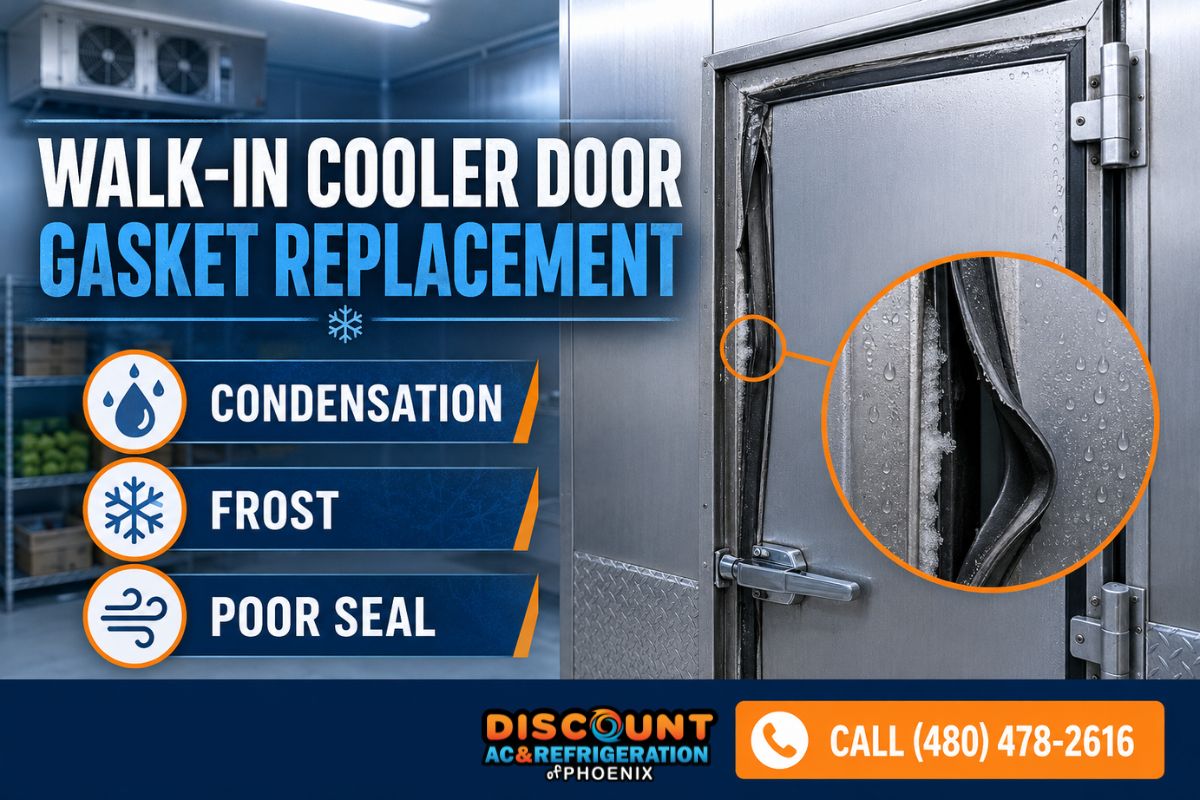
A walk-in cooler door gasket creates the flexible seal between the door and its frame. When that seal becomes loose, torn, hardened, or incorrectly fitted, warm air and moisture can enter the refrigerated space every time the system operates. The result may be condensation, frost, longer cooling cycles, uneven temperatures, and unnecessary stress on refrigeration components.
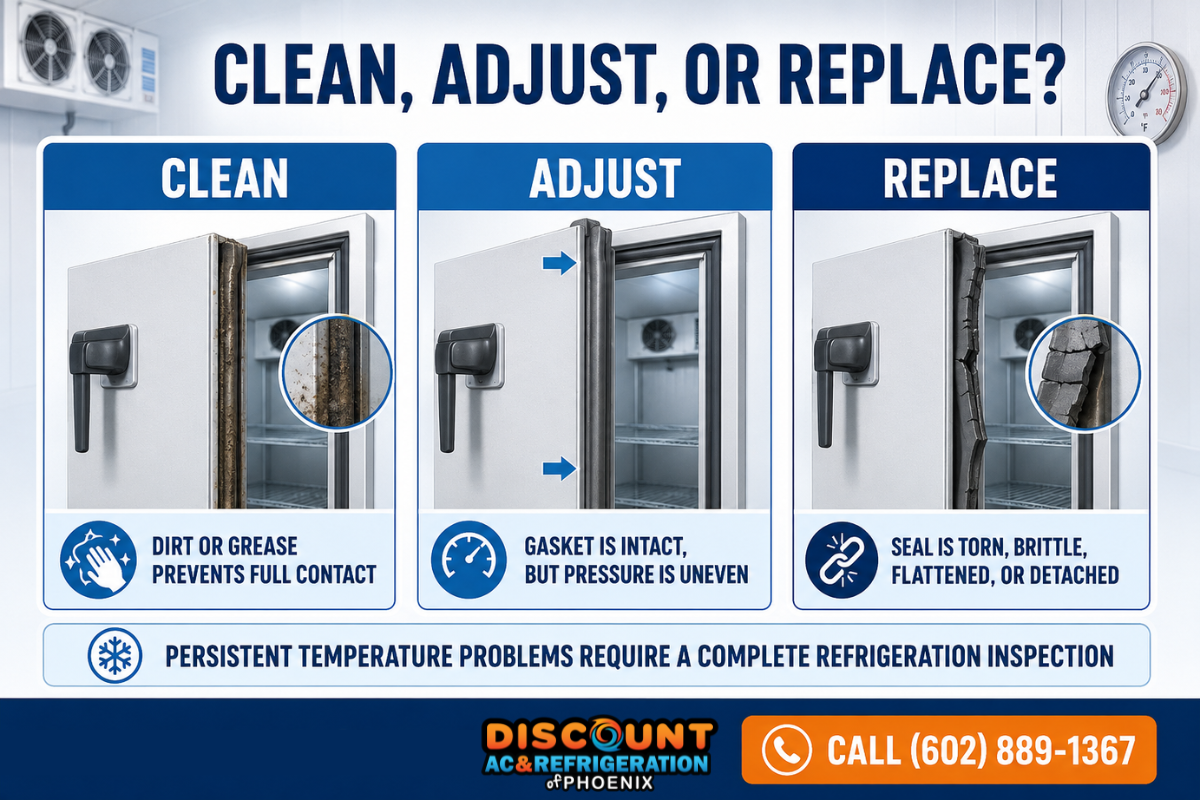
Some sealing problems can be corrected with careful cleaning or a door adjustment. Others require professional walk in cooler door gasket replacement. Knowing how to distinguish between these conditions helps Phoenix businesses address the actual problem without replacing parts unnecessarily.
Door seals are only one part of a complete commercial refrigeration system. Businesses experiencing persistent cooling problems should schedule a broader walk-in cooler and freezer inspection to determine whether air infiltration, airflow, controls, defrost operation, or mechanical conditions are contributing to the symptoms.
What Does a Walk-In Cooler Door Gasket Do?
The gasket compresses against the door frame when the door closes. This contact limits the exchange of air between the conditioned interior and the surrounding kitchen, warehouse, or storage area.
A proper seal supports stable refrigeration operation by helping to:
- Keep warm ambient air from entering the cooler.
- Reduce moisture infiltration around the doorway.
- Limit condensation and localized frost formation.
- Help the refrigeration system maintain its temperature setpoint.
- Reduce avoidable compressor and evaporator runtime.
- Protect the doorway, floor, panels, and stored inventory from excess moisture.
Phoenix conditions can make gasket problems especially noticeable. A door may separate the cooler from a hot receiving area, kitchen, or exterior-facing storage space. The greater the temperature difference, the more quickly a small opening can introduce heat and moisture.
Signs a Walk-In Cooler Door Gasket May Need Replacement
A damaged seal does not always cause an immediate loss of refrigeration. Early symptoms often appear around the doorway before the cooler develops a noticeable temperature problem.
| Observed sign | What it may indicate | Recommended response |
|---|---|---|
| Visible tears, splits, or missing sections | The gasket can no longer form a continuous barrier. | Confirm the gasket profile and replace the damaged seal. |
| Condensation around the door or frame | Warm, moisture-bearing air may be entering through a gap. | Clean, dry, and test the entire perimeter. |
| Frost concentrated near one door edge | A localized air leak, weak gasket contact, or alignment problem. | Inspect the gasket, hinges, latch, and door position. |
| Gasket is hard, brittle, or permanently flattened | The material has lost the flexibility needed to compress. | Replacement is usually more appropriate than adjustment. |
| Door does not close or latch evenly | Hinge wear, a weak closer, latch position, or door misalignment. | Correct the hardware or alignment before evaluating the seal again. |
| Gasket pulls away from its mounting channel | Incorrect fit, damaged mounting material, or a deteriorated gasket. | Identify the mounting style and inspect the channel before replacement. |
Condensation has several possible causes, so moisture alone does not prove that the gasket is defective. Door traffic, warm product loads, humidity, damaged panels, heater problems, and operating conditions may also contribute. Our guide to condensation in commercial refrigeration explains how moisture patterns can help narrow down the source.
How to Perform the Paper Test
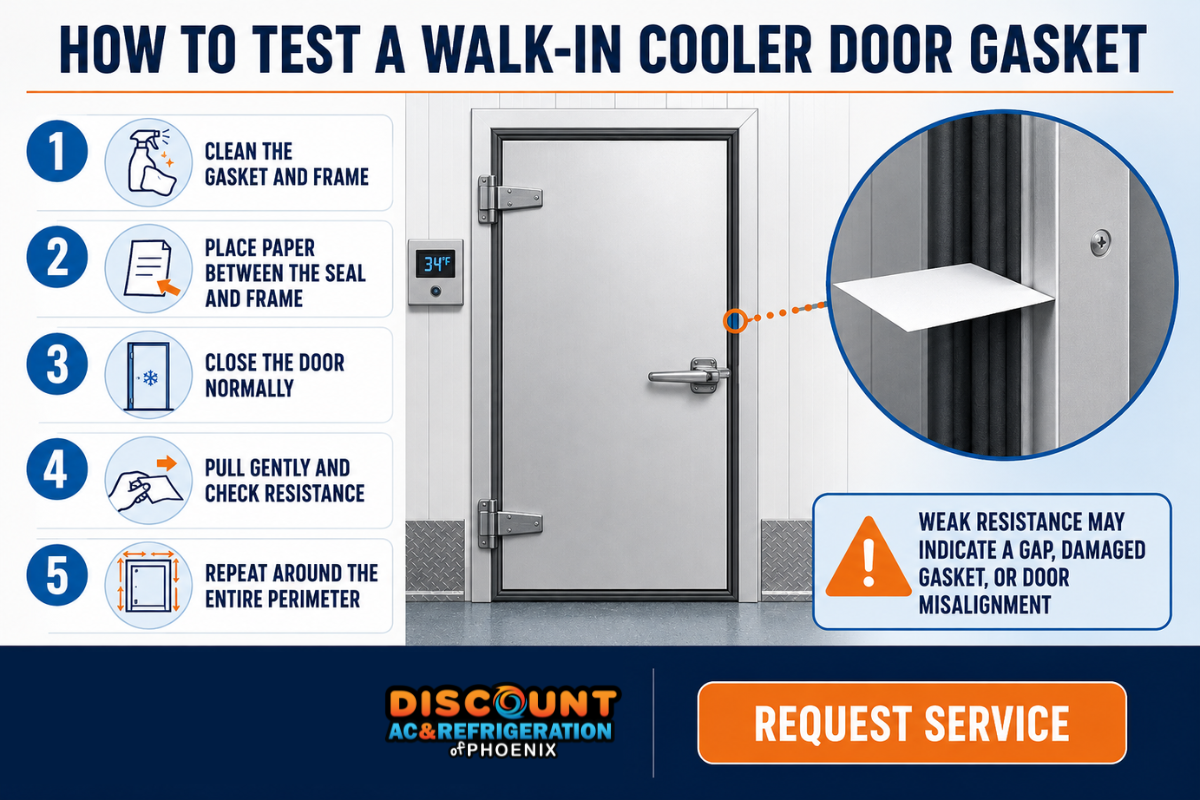
The paper test is a simple observational check for inconsistent gasket pressure. It can identify areas that deserve closer inspection, but it does not diagnose every possible door or refrigeration problem.
- Inspect the doorway first. Remove boxes, packaging, or debris that could prevent the door from closing normally.
- Use a clean sheet of paper. Place part of the paper between the gasket and frame.
- Close the door normally. Do not push, lift, or force the door into position.
- Pull the paper gently. A sealing area should produce noticeable, consistent resistance.
- Repeat around the perimeter. Test the top, bottom, both sides, and each corner.
- Compare the results. A section where the paper slides out freely may have weak contact.
What the paper test cannot tell you
Weak resistance does not automatically mean the gasket must be replaced. The door may be sagging, the latch may be incorrectly positioned, the hinges may be worn, or the frame may be uneven. Replacing a gasket without correcting these conditions can leave the original air gap in place.
Condensation and Frost Around the Door
Condensation forms when a cold surface contacts warmer air containing enough moisture. If warm air enters continuously through a gasket gap, water droplets may develop on the frame, door edge, nearby panels, or floor.
In a freezer, the same infiltration may appear as frost or ice. A pattern concentrated near one section of the door is more suggestive of a local seal problem than frost distributed across the evaporator or interior.
Look for the location and pattern of the moisture:
- Moisture along one edge: Possible gasket gap or door alignment issue.
- Frost in one corner: Possible damaged, folded, or poorly fitted gasket material.
- Water around the threshold: Possible air leak, drain problem, door traffic, or heater issue.
- Frost throughout the box: The defrost system, airflow, controls, or operating practices may need evaluation.
- Condensation despite an even paper test: Inspect ambient humidity, door usage, frame heaters, panels, and other infiltration points.
If the box is also failing to hold temperature, review the broader causes covered in our walk-in cooler repair guide. A door leak can contribute to the problem, but it should not be assumed to be the only cause.
Can Cleaning Restore the Seal?
Yes, cleaning can improve gasket contact when grease, food residue, dust, or hardened debris prevents the gasket from sitting flat. Cleaning will not repair torn material, restore a hardened gasket, or correct a misaligned door.
Safe basic cleaning steps
- Follow the cooler and gasket manufacturer’s care instructions.
- Use a soft cloth with mild soap and warm water.
- Clean inside the folds without pulling aggressively on the gasket.
- Clean the mating surface on the door frame.
- Dry the gasket and frame thoroughly.
- Close the door and repeat the paper test after the material settles.
Avoid sharp tools, abrasive pads, harsh solvents, and chemicals that may weaken the gasket material. Do not attempt to remove thick ice with a knife or screwdriver. This can puncture the gasket, damage the frame, or create a safety hazard.
Replacement or Adjustment: Which Does the Door Need?
Successful walk in cooler door gasket replacement depends on identifying whether the seal itself is defective or another door component is preventing proper contact.
Replacement is more likely needed when:
- The gasket has visible cuts, tears, or missing sections.
- The material is brittle, hardened, or permanently compressed.
- The magnetic portion no longer holds consistently.
- The gasket repeatedly separates from its mounting channel.
- Cleaning does not restore contact and the door is correctly aligned.
Adjustment is more likely needed when:
- The gap appears only at the top or bottom of one side.
- The door visibly sags or rubs against the frame.
- The latch must be forced to keep the door closed.
- The gasket is flexible and undamaged but pressure is uneven.
- The door closer, hinge, sweep, or threshold is out of position.
In some cases, both services are needed. A damaged gasket may require replacement while worn hinges or an incorrectly positioned latch require adjustment. Addressing only one condition can result in continued leakage or premature wear on the new gasket.
Why Correct Gasket Fit Matters
Walk-in door gaskets are not universally interchangeable. The replacement must match the door dimensions, gasket profile, mounting method, corner construction, and intended temperature application.
A technician may need to identify:
- The walk-in manufacturer and door model.
- The exact width and height of the gasket.
- Whether dimensions are measured from the dart, outside edge, or mounting points.
- The gasket’s cross-sectional profile.
- The mounting style, such as push-in, screw-in, or retainer-mounted.
- Whether the application is a cooler or freezer.
- The condition of the door, frame, hinges, latch, sweep, and threshold.
An incorrectly sized gasket may stretch at the corners, buckle along an edge, pull away from its channel, or fail to contact the frame. Ordering by appearance alone can lead to poor fit even when two seals look similar.
What Professional Gasket Service Should Include
A professional visit should involve more than removing the old seal and installing a new one. The door system must be evaluated as a complete assembly.
A thorough service may include:
- Visual inspection of the full gasket perimeter.
- Paper testing at multiple points.
- Inspection of hinges, latch, closer, sweep, and threshold.
- Confirmation of door alignment and frame contact.
- Identification of the correct replacement gasket profile.
- Cleaning of the mounting channel and mating surface.
- Installation without overstretching or distorting the corners.
- Final closing, latching, and perimeter-contact tests.
- Review of condensation, frost, or temperature conditions after service.
Businesses that need a complete system evaluation can request professional commercial refrigeration service. Preventive inspections can also identify door wear before it contributes to a larger operational problem.
When a New Gasket Does Not Solve the Problem
If condensation, frost, or temperature instability continues after gasket service, another condition may be present. Possible causes include:
- Worn hinges or a sagging door.
- An incorrectly adjusted latch or door closer.
- A damaged frame, threshold, sweep, or insulation panel.
- Failed or disconnected frame heaters on applicable equipment.
- Excessive door traffic or a door frequently left open.
- Blocked evaporator airflow.
- A defrost-system malfunction.
- Dirty condenser components or inadequate equipment ventilation.
- Refrigerant loss or another mechanical problem.
A door-seal repair should not replace full refrigeration diagnostics when the cooler cannot maintain its required operating range. Learn how to separate different causes in our guide to walk-in cooler temperature settings and problems.
Oil residue, unexplained cooling loss, or suspected refrigerant loss requires specialized testing. Our commercial refrigerant leak detection service addresses those conditions without relying on the gasket as the assumed cause.
When to Schedule Walk-In Cooler Door Gasket Replacement
Schedule service when the gasket has physical damage, repeatedly fails the paper test after cleaning, or allows visible air and moisture infiltration. Professional inspection is also appropriate when the door does not sit squarely or when you are uncertain which gasket profile fits the equipment.
Prompt evaluation is especially important when you observe:
- Rising or unstable product temperatures.
- Rapid frost accumulation near the doorway.
- Water creating a slip hazard around the entrance.
- A door that will not close or remain latched.
- Continuous equipment operation without adequate cooling.
- Signs that stored inventory may be outside required conditions.
Protect temperature-sensitive inventory
If the cooler cannot maintain safe storage conditions, follow your organization’s food-safety or product-handling procedures. Do not rely on the thermostat display alone. Verify temperatures with appropriate monitoring equipment and move inventory when required by your established safety plan.
For critical refrigeration failures affecting operations or inventory, visit our emergency commercial refrigeration service page. Service options for other refrigerated cabinets are available through our reach-in cooler and display case service.
Frequently Asked Questions
How do I know if my walk-in cooler gasket needs replacement?
Replacement is usually appropriate when the gasket is torn, brittle, permanently flattened, detached, or unable to maintain contact after cleaning. Uneven contact with an undamaged gasket may point to hinges, latch position, door alignment, or frame conditions instead.
How do I perform the paper test on a cooler door?
Place a sheet of paper between the gasket and frame, close the door normally, and pull the paper gently. Repeat the test around the entire perimeter. Areas with significantly less resistance should be inspected for gasket damage or alignment problems.
Can a dirty gasket cause the walk-in cooler door to leak air?
Yes. Grease, dust, and food residue can prevent the gasket from lying flat against the frame. Clean it with mild soap and warm water according to the manufacturer’s instructions, dry it completely, and test the seal again.
Does condensation around the door always mean the gasket is bad?
No. Condensation may also result from humidity, frequent door openings, a misaligned door, failed frame heaters, damaged panels, or other sources of air infiltration. The location of the moisture and a complete door inspection help determine the cause.
Why is frost forming around one corner of the walk-in door?
Localized frost may indicate that warm air is entering through a gap in that corner. The gasket may be folded, damaged, incorrectly fitted, or receiving insufficient pressure because the door is out of alignment.
Can I replace a walk-in cooler gasket myself?
Some gasket styles can be removed and installed without complex tools, but correct identification and fit are essential. Professional service is recommended when the door sags, the mounting channel is damaged, the gasket profile is uncertain, or adjustment is required.
Why does the new gasket still have gaps?
The replacement may be the wrong size or profile, may have been stretched during installation, or may not be fully seated. Gaps may also remain when hinges, latch hardware, the frame, or the door itself require adjustment or repair.
Should the entire refrigeration system be checked during gasket service?
A broader inspection is advisable when the cooler has unstable temperatures, excessive frost, long operating cycles, or other performance symptoms. A gasket can contribute to these problems, but airflow, defrost, controls, refrigerant conditions, and mechanical components may also be involved.
Schedule Walk-In Cooler Door Service in Phoenix
If cleaning does not restore the seal or the door shows signs of damage or misalignment, Discount AC & Refrigeration of Phoenix can inspect the gasket, door hardware, and refrigeration conditions. We will identify whether the system needs cleaning, adjustment, gasket replacement, or broader repair.
Call (602) 889-1367 Request ServiceExplore additional maintenance and troubleshooting information in our commercial refrigeration blog, or review our complete commercial HVAC and refrigeration services for Phoenix-area businesses.