
Searching for AC repair near me in the Phoenix metro usually means something has already changed: the air feels warmer, airflow is weaker, the system is cycling differently, or the electric bill no longer matches normal use. The best next step is not choosing the first company in a search result. It is choosing an HVAC team that can evaluate the complete cooling system and explain the findings clearly.
At Discount AC & Refrigeration of Phoenix, we serve homes and businesses across Phoenix and the East Valley from Queen Creek. Our technicians look at symptoms, operating conditions, airflow, electrical components, refrigerant-side performance, and the equipment’s service history before discussing repair options. This guide explains what Phoenix property owners should look for when comparing local AC repair companies.
What “AC Repair Near Me” Should Actually Deliver
| What to verify | Why it matters in Phoenix | A useful question to ask |
|---|---|---|
| Local service area | Technicians should understand desert heat, dust, rooftop exposure, and long cooling seasons. | Do you regularly service my part of the Phoenix metro? |
| Diagnostic process | Similar symptoms can come from airflow, controls, electrical parts, or refrigerant problems. | What will you test before recommending a repair? |
| Relevant experience | Residential splits, heat pumps, package units, and commercial rooftop units require different knowledge. | Do you service this equipment type? |
| Clear documentation | A written explanation helps owners understand the condition and approve appropriate work. | Can you explain the failed test or measured condition? |

Start With the Symptom, Not a Replacement Assumption
An air conditioner that does not cool properly is not automatically a failed compressor or a system that must be replaced. A dirty filter, restricted indoor coil, failing capacitor, damaged contactor, thermostat problem, blocked condensate line, blower issue, or refrigerant leak can create overlapping symptoms. Professional HVAC service should separate those possibilities through inspection and testing.
Tell the technician when the problem began, whether it is constant or intermittent, what the thermostat displays, and whether any rooms are affected more than others. Mention recent power interruptions, unusual noises, water around the indoor equipment, ice, odors, or changes in airflow. These observations help establish a useful diagnostic path without requiring the customer to open electrical panels or handle refrigerant.
Signs the Company Uses a Real Diagnostic Process
A useful AC diagnosis connects the complaint to measurements. Depending on the equipment and symptom, a technician may inspect the thermostat call, filter and return-air path, blower operation, indoor and outdoor coils, temperature change across the system, electrical connections, capacitors, motors, contactors, condensate management, and refrigerant-side conditions. The exact sequence varies, but the recommendation should be supported by what was observed or tested.
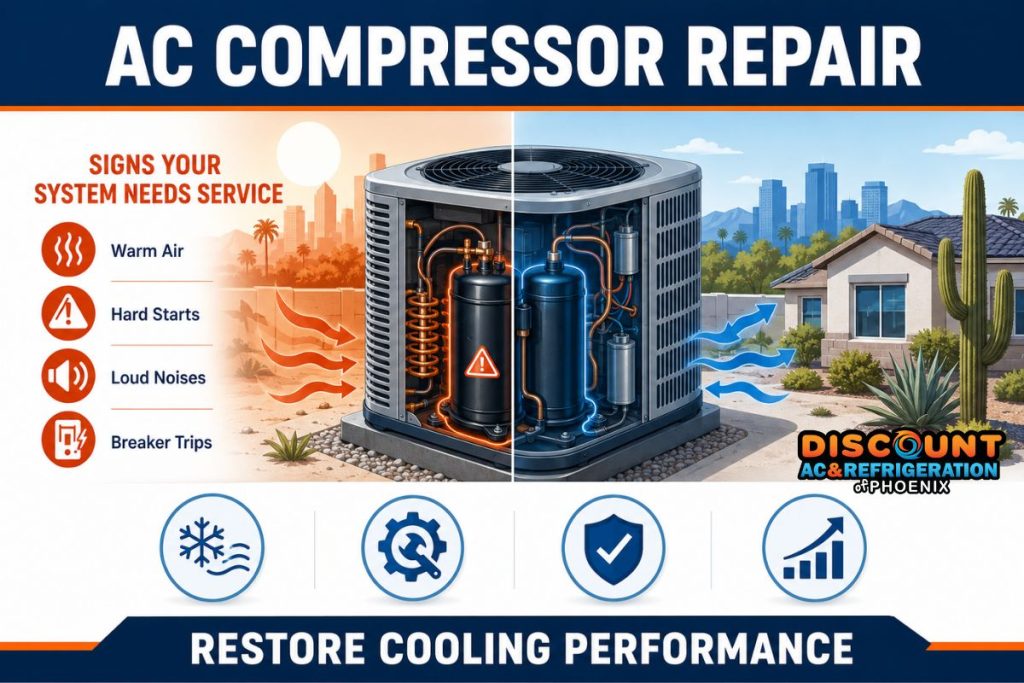
This is especially important when a system is showing compressor-related symptoms. Hard starting, humming, overheating, or poor cooling can involve the compressor, but they can also involve voltage, capacitors, contactors, airflow, or system pressure. Replacing a major component without confirming the cause can leave the original problem unresolved.
Phoenix Conditions Change the Repair Conversation
Phoenix air conditioners operate through extended periods of high outdoor temperature. Outdoor coils collect dust and debris, rooftop equipment receives intense solar exposure, and filters may load faster during dusty weather. After monsoon activity, windblown debris and fine dust can reduce heat transfer or expose weakened electrical components. These conditions do not prove that a specific part has failed, but they matter when interpreting system performance.
Ask whether the technician has considered the equipment location, maintenance history, airflow, and recent weather exposure. If the unit has not been professionally evaluated after a demanding summer, preventive HVAC maintenance may reveal conditions that contributed to the current complaint.
Compare Repair Recommendations Carefully
Two estimates are only comparable when they address the same verified problem and scope. One proposal may replace a failed component, while another may include correcting the condition that caused the failure, cleaning affected equipment, or testing operation after the repair. Ask each company to identify the diagnosis, recommended work, excluded work, parts involved, and post-repair verification.
A responsible company should also explain when repair and replacement are both reasonable options. Equipment age, condition, repair history, refrigerant type, comfort problems, energy use, sizing, duct performance, and ownership plans may influence that decision. If replacement is being considered, review the scope of commercial AC installation or the corresponding residential solution instead of comparing equipment labels alone.
Questions to Ask Before Approving AC Repair
- What condition did the testing confirm? The answer should be more specific than “the unit is old.”
- Could another system issue have contributed? Airflow and electrical problems can damage components over time.
- What will be tested after the repair? Operation should be verified under an active cooling call.
- Does the recommendation address comfort throughout the property? Uneven temperatures may involve ducts or distribution.
- Is maintenance also needed? A repair restores a failed function; maintenance addresses condition and cleanliness.
Residential and Commercial AC Repair Are Not Identical
A residential system usually serves comfort zones within a home. Commercial systems may serve larger loads, multiple zones, occupied workspaces, kitchens, retail areas, or temperature-sensitive operations. Access, controls, ventilation, rooftop placement, and operating schedules can change both diagnosis and planning. Businesses should look for a provider familiar with commercial services and rooftop unit service.
Restaurants and food-service businesses may also have refrigeration equipment affected by indoor temperature and ventilation. A company with experience in commercial refrigeration can help distinguish a comfort-cooling issue from a refrigeration-specific complaint instead of treating every cooling problem the same way.
When the Problem May Be Refrigerant Related
Low cooling capacity, ice on the evaporator or refrigerant line, extended run times, or repeated loss of performance can be associated with refrigerant-side problems, but these signs are not proof of low charge. Airflow restrictions and control problems can create similar effects. Refrigerant should not be added automatically without determining why system conditions are abnormal.
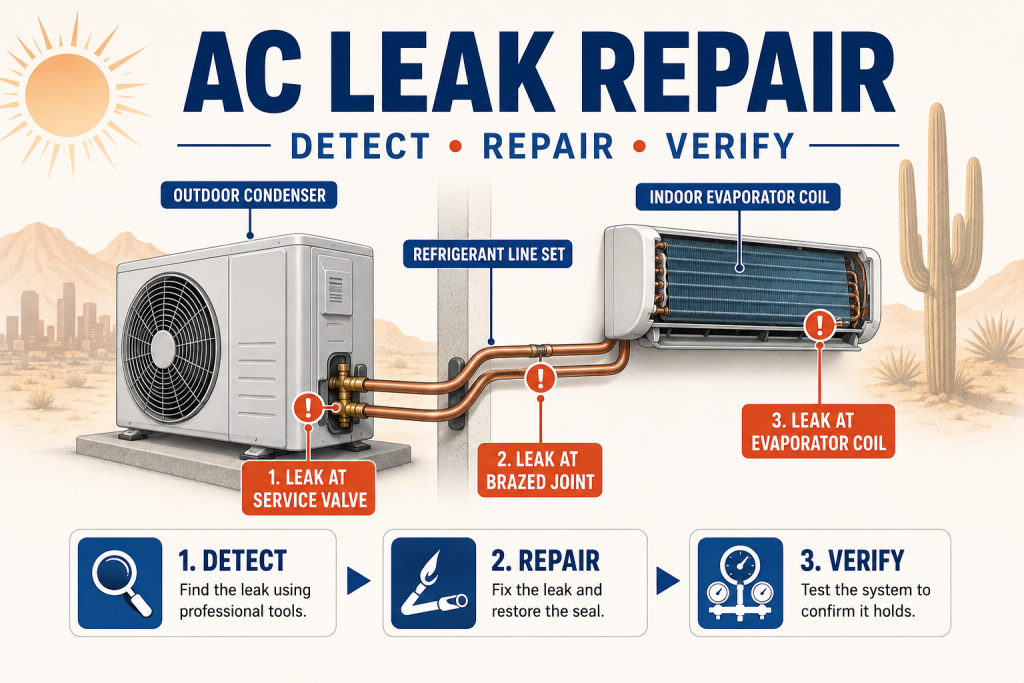
Our guide to AC leak repair explains why leak detection and system evaluation matter. Refrigerant work requires appropriate tools, training, and handling practices; it is not a homeowner troubleshooting step.
Red Flags When Choosing an AC Company
Be cautious when a recommendation is made without inspecting the equipment, when a major component is blamed without supporting tests, or when the explanation relies on pressure rather than evidence. Also avoid relying only on a generic promise that does not identify who will perform the work, what equipment is being serviced, or how the result will be checked.
Online reviews and business information can provide context, but they do not replace a diagnosis. Use them to evaluate patterns in communication, professionalism, and relevance to your equipment type. Then base the repair decision on the actual condition of your system.
Frequently Asked Questions
How do I choose AC repair near me in Phoenix?
Confirm the company serves your location, works on your equipment type, performs diagnostics before recommending repairs, and can explain the findings and scope clearly.
Should I turn off an AC that is blowing warm air?
If the system is running continuously without cooling, has ice, produces burning odors, leaks water near electrical components, or trips a breaker, turn it off and request service.
Does weak airflow always mean the AC is failing?
No. Filters, blower operation, indoor coil condition, dampers, ducts, or blocked registers may affect airflow. A technician should identify where the restriction or loss occurs.
Can dust cause AC problems in Phoenix?
Dust can load filters and coils and may reduce airflow or heat transfer. The effect depends on equipment condition, placement, filtration, and maintenance.
Is ice on an AC system a refrigerant leak?
Possibly, but restricted airflow and other faults can also produce freezing conditions. Do not chip the ice; turn cooling off and arrange an evaluation.
When should AC replacement be discussed?
Replacement may be considered when condition, age, repeated repairs, refrigerant availability, comfort, sizing, or ownership goals make continued repair less practical.
Do commercial rooftop units need specialized service?
Yes. Rooftop access, controls, ventilation, multiple stages, and business operating conditions require commercial HVAC experience.
What information should I give the technician?
Share when the symptom began, thermostat behavior, noises, odors, water, ice, breaker activity, affected rooms, prior repairs, and recent maintenance.
Choose Diagnosis Before Guesswork
The most useful result from an AC repair near me search is a local company that connects symptoms to verified system conditions. A careful evaluation helps determine whether the next step is a focused repair, maintenance, airflow correction, or a broader equipment discussion.
Schedule AC Service in the Phoenix Metro
Contact Discount AC & Refrigeration of Phoenix to discuss your cooling symptoms and request professional service.
Learn more about our company on the About Us page or explore additional guidance in our Phoenix HVAC and refrigeration blog.