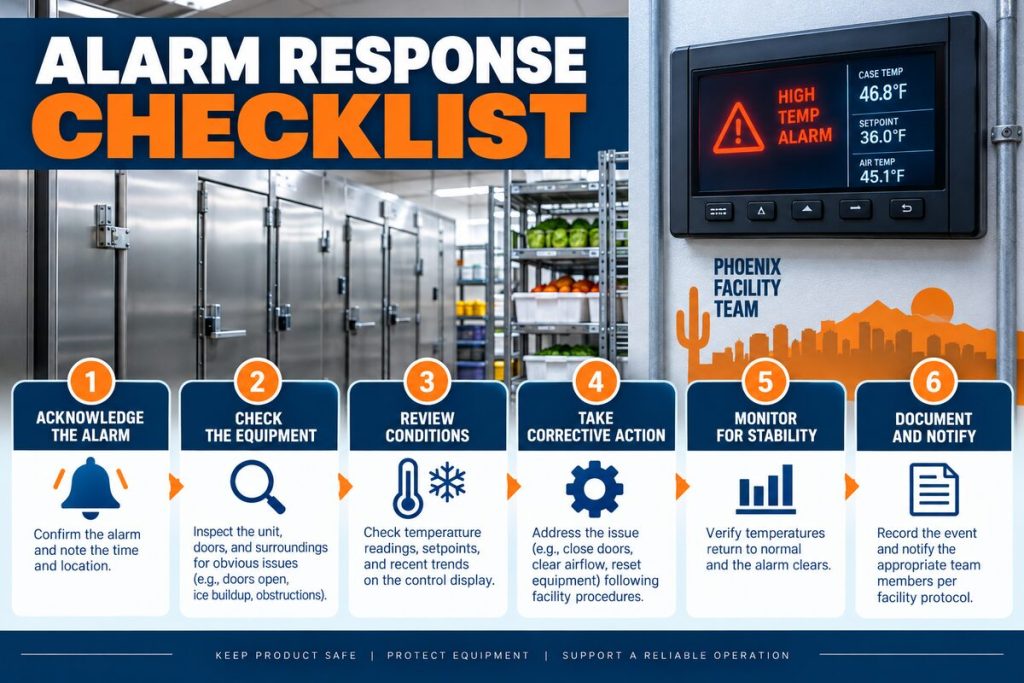

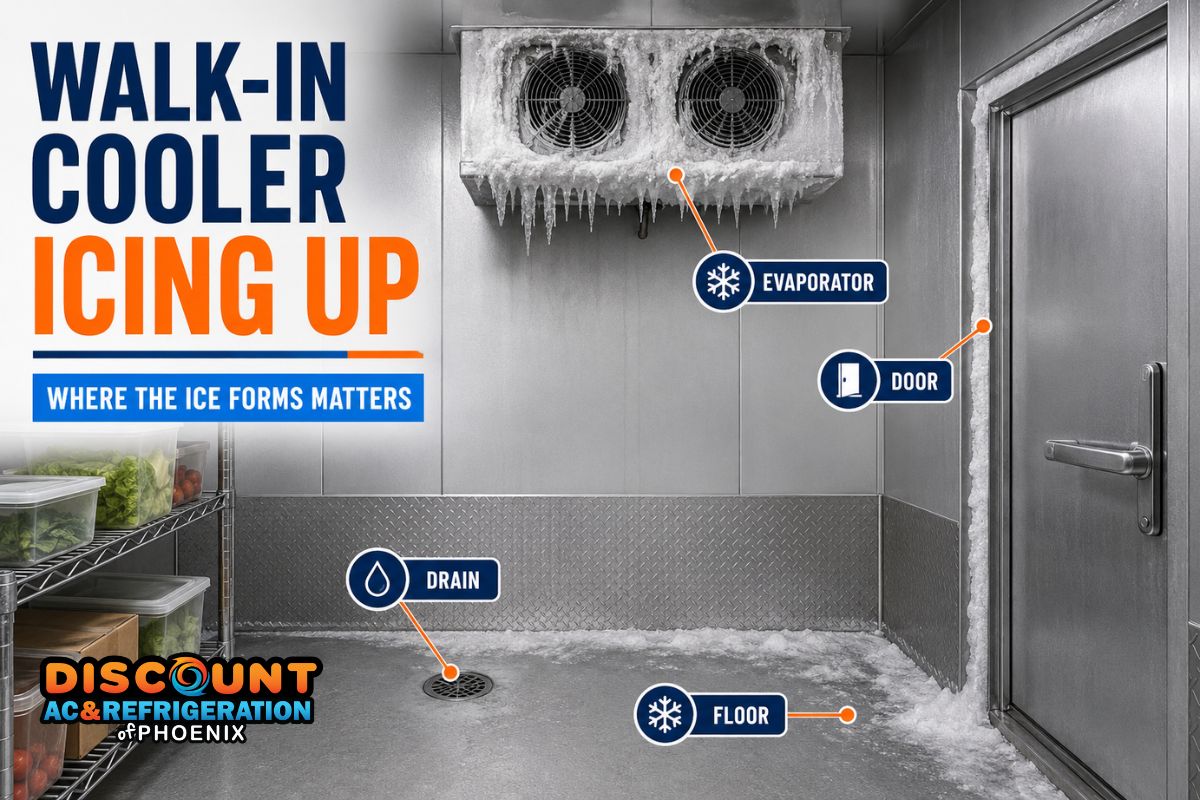
A walk in cooler icing up is not one single problem. Ice on the evaporator coil can point toward airflow or defrost issues, while frost around the entrance more often suggests warm, humid air entering through the door. Ice near the drain or across the floor introduces another set of possibilities.
The location, shape, and speed of the buildup provide useful clues, but they do not confirm the cause by themselves. Phoenix business owners should document what they observe, protect temperature-sensitive inventory, and arrange a professional assessment when ice returns, temperatures rise, or water creates an unsafe floor.
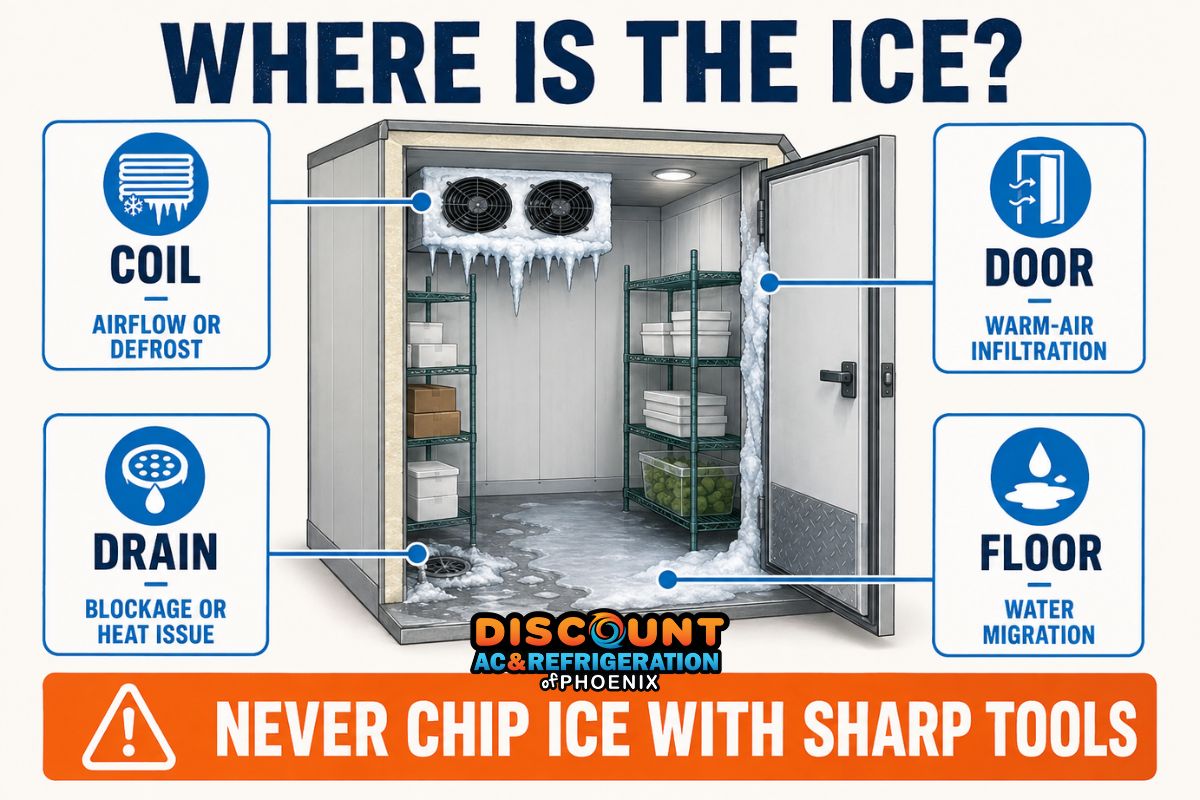
Walk In Cooler Icing Up: What the Location May Indicate
| Ice location | Observable pattern | Possible categories | Safe response |
|---|---|---|---|
| Evaporator coil | White frost or a solid ice layer | Restricted airflow, fan issue, defrost fault, or another refrigeration condition | Keep vents clear and request diagnosis |
| Door or frame | Frost concentrated near an edge or corner | Warm-air infiltration, gasket fit, hinge, closer, or door alignment | Inspect the seal without forcing the door |
| Drain area | Frozen water around the drain opening or pan | Drain restriction, poor slope, drain-line heat problem, or refreezing water | Keep the area clear and avoid chemicals |
| Floor or threshold | Ice sheet, frozen puddle, or recurring slick area | Water migration, drainage issue, door infiltration, or condensation | Restrict access because of slip risk |
This table is a visual guide, not a substitute for testing. Different faults can produce similar ice patterns, and one problem can create buildup in more than one location. A technician may need to inspect airflow, controls, drainage, door operation, system pressures, and the defrost sequence before identifying the corrective action.
Ice on the Evaporator Coil
The evaporator absorbs heat from the air inside the cooler. Its fans pull room air through the coil and distribute cooled air throughout the box. A light, temporary frost pattern may appear during normal operation, but a thick layer that covers the fins, fan housing, or surrounding surfaces can restrict heat transfer and airflow.
As the ice becomes thicker, airflow may weaken even though the fans can still be heard. Products close to the evaporator may remain cold while areas farther away begin warming. This uneven performance is one reason it is helpful to understand the difference between ice buildup and general walk-in cooler temperature fluctuations.
Restricted Airflow
Boxes, trays, or shelving positioned too close to the evaporator can interfere with air circulation. Dirty coil surfaces, damaged fan blades, a non-operating fan motor, or an obstruction around the return-air path may also reduce airflow. When insufficient air moves through the coil, its temperature can fall low enough for moisture to freeze.
Staff can safely check whether products are blocking visible vents and listen for an unusual change in fan sound. They should not remove protective covers or reach into fan compartments. Moving inventory away from the evaporator may improve circulation, but it will not correct a failed motor, control, or refrigeration component.
Defrost Problems
Commercial refrigeration systems use a defrost process to remove frost that accumulates during normal operation. Depending on the equipment, that process may involve off-cycle, electric, or another manufacturer-designed method.
Ice can continue accumulating when a timer, controller, sensor, heater, termination control, or related component does not complete the intended sequence. An incorrect schedule can also allow ice to remain on the coil. A technician must evaluate how the installed system is designed before changing any defrost settings.
Refrigeration Conditions That Require Testing
An iced coil is sometimes associated with a refrigerant, metering, or operating-pressure problem. However, the appearance of the ice alone cannot verify a refrigerant leak or justify adding refrigerant. Professional testing is necessary. If a leak is suspected, review the importance of proper commercial refrigerant leak detection rather than relying on visual assumptions.
Frost Around the Door, Frame, or Threshold
Frost concentrated near the entrance often indicates that warm, moisture-laden air is entering the refrigerated space. When that moisture contacts colder surfaces, it condenses and may freeze. Frequent loading periods can temporarily increase infiltration, but persistent frost deserves closer inspection.
The gasket may be dirty, torn, hardened, distorted, or no longer making consistent contact with the frame. Door alignment matters as well. Even a new gasket may not seal correctly when worn hinges allow the door to sag or when the closer does not pull it fully shut.
A paper test may help identify an obvious weak point: close the door on a strip of paper and gently pull it. Resistance should feel reasonably consistent around the perimeter. This test has limitations, however. It does not measure pressure, verify alignment, or determine whether the gasket is appropriate for the door. Learn more about the interaction among the gasket, hinge, and closer in this guide to walk-in cooler door seal problems.
Staff should also observe whether the door closes on its own, remains partially open, or requires lifting to latch. These details help distinguish routine cleaning needs from a gasket replacement or door adjustment assessment.
Ice Around the Drain or Drain Pan
Water removed during defrost should travel through the pan and drain line. Ice around the drain may develop when debris restricts that path, the line lacks proper slope, water backs up, or a component intended to prevent freezing is not operating correctly.
Repeated freezing near the drain can eventually send water beyond the pan and across the cooler floor. Restaurant staff may safely note whether the drain is visibly covered, but they should not pour boiling water or drain chemicals into the system. Excessive heat can damage components, while chemicals can create contamination or material-compatibility concerns.
Drain ice should not automatically be treated as a simple clog. If the evaporator contains heavy ice as well, the drainage symptom may be the result of a larger defrost problem. A complete commercial refrigeration inspection can evaluate both the source of the water and the reason it is refreezing.
Ice on the Floor or Along Wall Panels
A frozen puddle or sheet of ice on the floor is an immediate slip hazard. Restrict access to the affected area and use a safe alternate path until the surface can be addressed. If water is moving near electrical equipment, stop and request professional service.
Floor ice may originate at the drain, evaporator, entrance, or another condensation point. The ice itself may appear far from the source because water can travel along seams or follow the slope of the floor before freezing.
Ice along a wall or ceiling panel can be related to humid-air entry, a panel joint, insulation deterioration, or water migration. These patterns require attention because treating only the visible surface may leave the source unchanged.
Safety warning: Never chip, pry, or scrape ice with a knife, screwdriver, chisel, or another sharp tool. A sharp object can puncture an evaporator coil, damage a drain pan, cut wiring, or injure the person using it. Do not remove equipment panels or apply an open flame to accelerate thawing.
Safe Observations Your Staff Can Make
Business owners and employees do not need to dismantle equipment to provide useful information. Before contacting a refrigeration company, record the following observations:
- The exact location where the ice first appeared.
- Whether the buildup is soft frost, clear ice, or a solid white layer.
- The displayed temperature and a separate product or air-temperature reading, when available.
- Whether evaporator fans can be heard and whether airflow feels weaker than usual.
- Whether the door closes completely without being pushed.
- Whether water appears during or after a defrost period.
- Recent changes in deliveries, inventory arrangement, door traffic, or controller settings.
- How quickly the ice returned after it was previously removed or thawed.
Photographs taken from a safe distance can help document the progression. Do not stand on wet or frozen surfaces to obtain them. For additional inventory-protection steps, consult this safe guide for a walk-in cooler that is not cooling.
What Not to Do When a Walk-In Cooler Is Icing Up
Improvised ice removal can transform a repairable condition into equipment damage. Avoid the following actions:
- Do not use sharp or pointed tools to break the ice.
- Do not use a torch, heat gun, or open flame.
- Do not change defrost schedules without understanding the controller and equipment design.
- Do not bypass controls, switches, sensors, or door components.
- Do not add refrigerant based only on the visible frost pattern.
- Do not allow employees to continue walking across an icy floor.
- Do not assume that manually thawing the coil corrected the underlying problem.
If the cooler is still maintaining temperature, continue monitoring it while arranging an assessment. If the temperature is increasing, follow your business’s food-safety or product-storage procedures. The appropriate temperature range depends on the products being stored; this overview of walk-in cooler temperature settings provides additional context.
When Professional Walk-In Cooler Service Is Needed
Arrange professional service when the ice returns after thawing, spreads across the evaporator, blocks the fans, appears with rising temperatures, or creates water on the floor. Unusual noises, a fan that stops, a door that will not close, or repeated drain freezing also justify an inspection.
A technician can evaluate the full operating sequence instead of treating the most visible symptom. The assessment may include:
- Evaporator airflow and fan operation.
- Coil condition and frost distribution.
- Defrost timing, sensors, heaters, and termination controls.
- Drain-pan condition, drain-line slope, and flow.
- Door gasket contact, hinge condition, closer operation, and alignment.
- System pressures, temperatures, and refrigerant-circuit performance.
If the equipment is unable to maintain a safe temperature or water is approaching electrical components, contact an emergency commercial refrigeration service. For a broader overview of repair warning signs and system components, visit the company’s walk-in cooler repair guide for Phoenix businesses.
Preventing Recurring Ice Buildup
Preventive maintenance cannot eliminate every unexpected failure, but it can identify developing conditions before they produce extensive ice. A practical plan should include cleaning accessible gasket surfaces, checking door closure, maintaining clear airflow around the evaporator, monitoring temperatures, and scheduling professional inspection of the coil, fans, drains, and controls.
Staff practices matter as well. Keep the entrance closed between trips, organize deliveries to reduce unnecessary door-open time, and avoid placing warm products directly in front of the evaporator. Shelving and inventory should not block the intended air path.
When a walk in cooler icing up becomes a recurring event, documenting the location and timing of each occurrence can help the technician distinguish door-traffic patterns from mechanical, drainage, or defrost problems. Discount AC & Refrigeration of Phoenix services commercial walk-in coolers and freezers throughout the Phoenix area.
Request a Walk-In Cooler Assessment in Phoenix
If ice is returning, temperatures are changing, or water is creating a safety concern, have the system inspected before the buildup causes additional operating problems.
Call (602) 889-1367 Request ServiceFrequently Asked Questions
Why is my walk-in cooler icing up?
Possible categories include restricted airflow, a defrost problem, warm-air infiltration, drainage trouble, or another refrigeration-system condition. The location and pattern of the ice help narrow the inspection, but testing is needed to confirm the cause.
What does ice on the evaporator coil mean?
Heavy ice on the evaporator may be associated with insufficient airflow, a fan problem, an incomplete defrost cycle, a control issue, or a refrigeration-circuit condition. Ice alone does not establish which component has failed.
Why is frost forming around the cooler door?
Frost near the door often develops when warm, humid air enters through a gap. The gasket may be dirty or damaged, but worn hinges, a weak closer, poor alignment, or frequent door traffic can produce a similar pattern.
Can blocked airflow cause a walk-in cooler to freeze?
Yes. Inventory placed too close to the evaporator can reduce circulation. Dirty coils, obstructions, or non-operating fans may also reduce airflow and contribute to frost or ice accumulation.
Why does the drain in my walk-in cooler keep freezing?
A frozen drain may involve debris, improper drainage, poor slope, a drain-line heat issue, or water from an incomplete defrost process. The drain and evaporator should be evaluated together when both areas contain ice.
Is it safe to chip ice off an evaporator coil?
No. Never use a knife, screwdriver, chisel, or other sharp tool. Puncturing a coil can release refrigerant and turn the original problem into a more extensive repair. Sharp tools can also damage wiring and injure the user.
Can I pour hot water on walk-in cooler ice?
Pouring hot or boiling water onto the equipment is not recommended. It may damage components, introduce excess water, create electrical hazards, or cause the water to refreeze elsewhere.
Will manually defrosting the cooler solve the problem?
Thawing may remove visible ice, but it does not necessarily correct the cause. If the underlying airflow, door, drain, control, or refrigeration problem remains, the ice is likely to return.
Should the cooler remain in operation while it has ice buildup?
That depends on temperature, ice severity, airflow, water location, and the products stored. Continue monitoring temperatures and follow the business’s inventory-safety procedures. Request prompt service if the temperature rises or water approaches electrical equipment.
When should I call a commercial refrigeration technician?
Request service when ice returns, blocks the evaporator or fans, appears with temperature changes, causes water on the floor, or prevents the door from sealing. An inspection is also appropriate when the source cannot be identified through safe external observations.