

An emergency refrigeration problem can put food, ingredients, beverages, medicine, or other temperature-sensitive inventory at risk. For Phoenix businesses, high ambient temperatures and busy operating schedules can make a developing refrigeration fault more serious if staff do not respond in an organized way.
The safest response prioritizes people, product-temperature records, closed doors, appropriate inventory decisions, and professional diagnosis. At Discount AC & Refrigeration of Phoenix, we service commercial refrigeration equipment throughout the Phoenix metro. This guide explains what staff can safely observe and what should be left to a qualified technician.
First-Response Priorities for Refrigeration Problems
| Priority | Safe staff action | Avoid |
|---|---|---|
| Protect people | Keep staff and customers away from water, damaged wiring, smoke, or overheated equipment. | Do not touch wet electrical equipment or repeatedly reset breakers. |
| Protect inventory | Record product and air temperatures, follow the organization’s food-safety or product-safety plan, and limit door openings. | Do not assume products are safe based only on how they look or feel. |
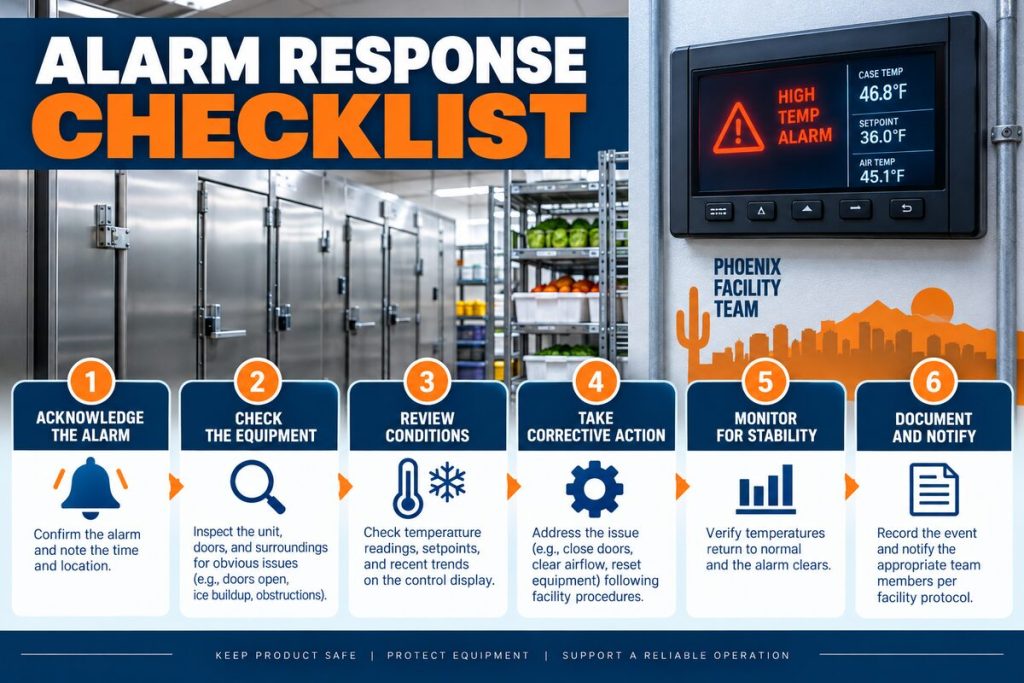
| Preserve evidence | Note alarms, display codes, sounds, odors, frost location, and when the problem began. | Do not change multiple setpoints or erase controller history. |
| Reduce heat entry | Keep walk-in and reach-in doors closed when safe and verify that they seal. | Do not prop doors open while waiting for service. |
| Request diagnosis | Provide equipment type, location, symptoms, temperatures, and any recent service history. | Do not open sealed systems or add refrigerant. |

Confirm the Problem Without Delaying the Response
Begin with the information already available: controller display, independent thermometer, product-temperature logs, alarm history, and staff observations. Compare current conditions with the facility’s established operating and safety procedures. A single display may be inaccurate, so note the reading source.
If a walk-in temperature is rising, review our guide to walk-in cooler temperature fluctuations. Door activity, loading, defrost, sensor placement, airflow, and mechanical faults can create different patterns that require different responses.
Keep Doors Closed and Control Traffic
Every open door allows warm, humid air into the refrigerated space. During a suspected failure, assign one person to manage access and avoid repeated checks by multiple employees. If inventory must be moved under the business’s safety plan, organize the move before opening the door.
A door that does not close or seal can be part of the emergency. Inspect only visible, accessible conditions such as an obstruction, damaged sweep, loose handle, or torn gasket. Our resources on a walk-in cooler door not sealing and door gasket replacement explain the difference between sealing and alignment problems.
Follow the Business’s Product-Safety Plan
Temperature-sensitive inventory decisions should follow applicable health requirements, manufacturer instructions, internal HACCP or safety procedures, and direction from the responsible manager. HVAC and refrigeration technicians diagnose equipment; they do not replace the authority responsible for deciding whether a product is safe to sell or use.
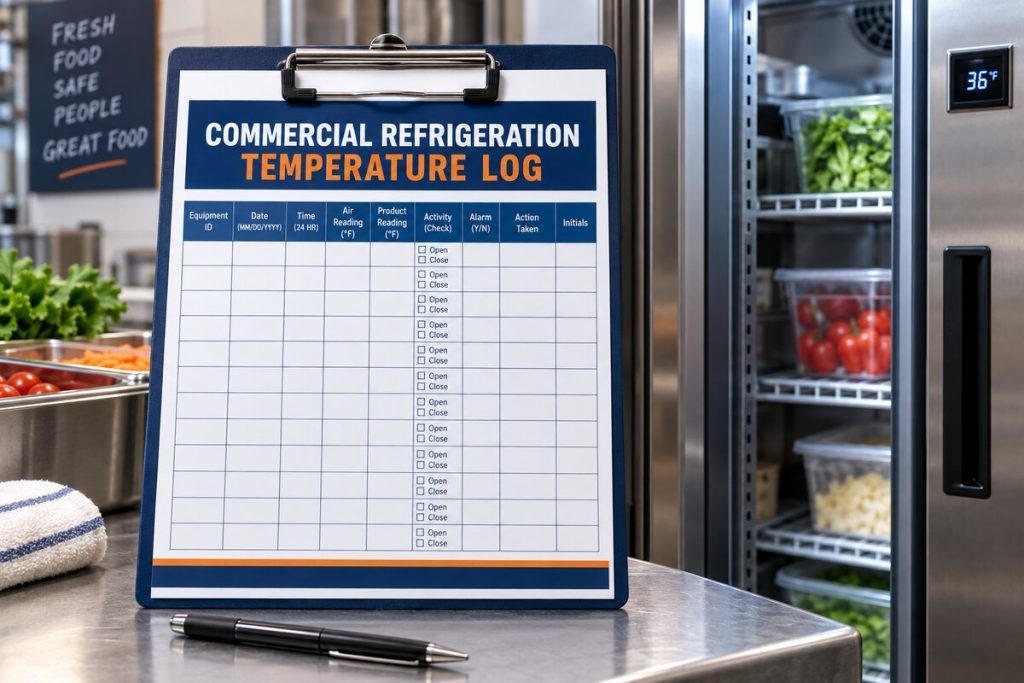
Document temperatures, times, affected cases or racks, and any relocation. Avoid taste-testing or relying on appearance. Clear records help the business make defensible decisions and help technicians understand how rapidly conditions changed.
Observe the Evaporator and Airflow From a Safe Distance
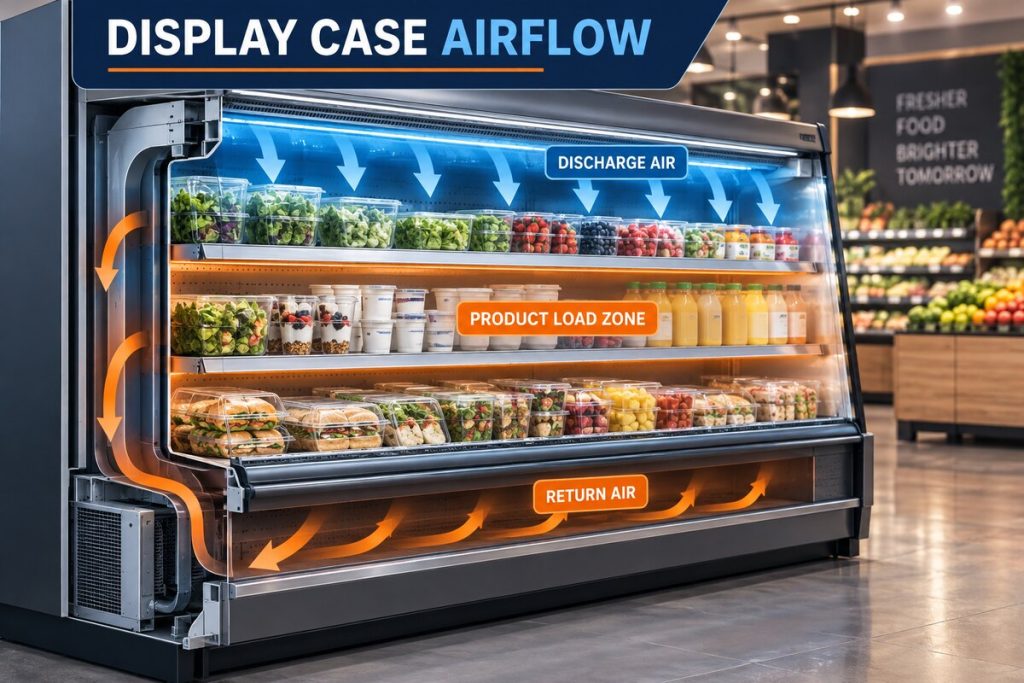
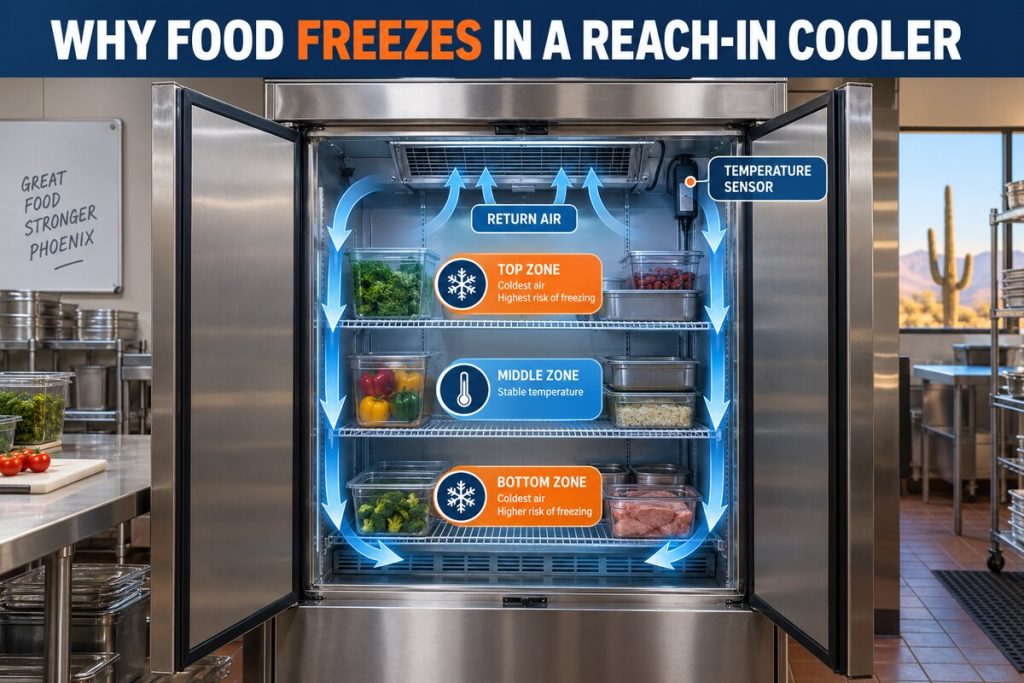
Weak airflow, a silent evaporator fan, unusual fan noise, or frost blocking the coil can help narrow the diagnosis. Do not remove guards or reach near rotating components. A fan problem can produce warm zones even when the condensing unit is operating.
Review evaporator fan warning signs and our guide to a walk-in cooler icing up. The location of ice matters because door infiltration, airflow, drainage, defrost, controls, and refrigerant conditions create different patterns.
Listen for Changes, but Do Not Diagnose by Sound Alone
Buzzing, rattling, squealing, clicking, or banging may come from motors, fan blades, panels, relays, contactors, bearings, compressors, or loose components. Staff should note where the sound seems strongest and whether it occurs continuously or during startup.
Our walk-in cooler noise guide organizes common sounds by equipment area. Severe mechanical noise, smoke, or burning odors justify shutting equipment down when it is safe to do so.
Do Not Treat Every Failure as Low Refrigerant
Loss of cooling, ice, long run times, or bubbles in a sight glass do not independently prove a refrigerant shortage. Airflow, load, controls, defrost, dirty coils, failing fans, restrictions, leaks, or compressor performance may produce overlapping symptoms.
A technician should determine why system conditions are abnormal. Read about walk-in cooler refrigerant leaks and why simply adding refrigerant without locating a leak can delay the correct repair.
Check for Water and Drainage Hazards
Water may come from a blocked drain, overflowing pan, melting frost, damaged insulation, door infiltration, or a plumbing source unrelated to the refrigeration system. Protect people from slip hazards and keep water away from electrical equipment.
Our article on a walk-in cooler leaking water explains how location and timing help distinguish causes. Do not dismantle drain systems or apply heat to frozen components.
Provide Useful Information When Calling for Service
Tell the service company the business name and location, equipment type, affected box or case, current readings, product concern, alarms, noises, ice or water, door condition, and whether the equipment is running. Mention recent repairs, cleaning, power interruptions, or loading changes.
Direct the technician to the electrical disconnect, roof or equipment access process, controller, maintenance records, and responsible on-site contact. Clear access and accurate history support efficient emergency refrigeration service without encouraging staff to perform technical work.
Diagnosis Should Cover the Complete Refrigeration System
Commercial refrigeration is a connected system. The technician may need to assess controls, sensors, evaporator airflow, defrost, drains, condenser airflow, electrical components, compressor operation, refrigerant conditions, door sealing, and operating load.
If compressor symptoms are present, review the role of testing before commercial refrigeration compressor replacement. A major component should not be condemned solely from a temperature complaint or noise.
Preventive Maintenance After the Immediate Repair
Once operation is restored, ask what caused the failure and whether other conditions require attention. Cleaning, door adjustments, drainage, electrical wear, fan performance, controls, temperature logging, and condenser airflow may affect recurrence.
A structured walk-in cooler preventive maintenance program helps businesses identify changes before they become interruptions. Phoenix heat and dust make condenser condition and ventilation especially important.
Frequently Asked Questions
What counts as an emergency refrigeration problem?
A rapid temperature rise, complete loss of cooling, electrical hazard, severe noise, smoke, major leak, door failure, or risk to temperature-sensitive inventory may require urgent professional attention.
What should staff do first when a walk-in gets warm?
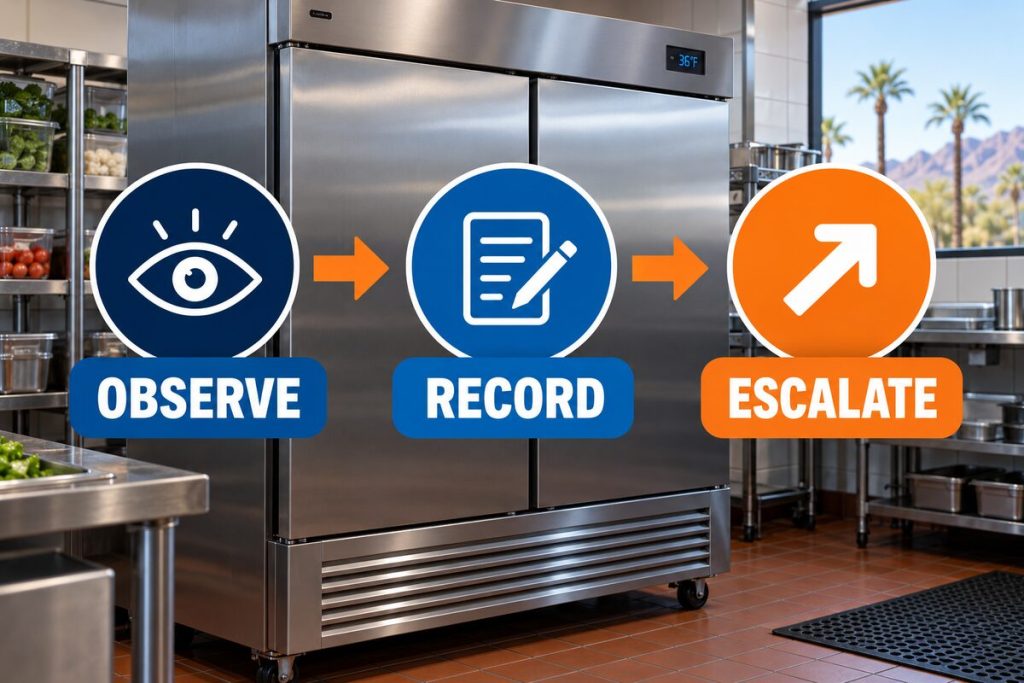
Record temperatures and alarms, limit door openings, follow the business’s product-safety plan, document symptoms, and request qualified service.
Can employees move food to another cooler?
Follow the facility’s approved food-safety plan and management direction. Organize the move before opening doors and document times and temperatures.
Should we reset the refrigeration breaker?
Do not repeatedly reset a breaker. A trip can indicate an electrical or mechanical fault. Keep people clear and arrange professional evaluation.
Does ice mean the system needs refrigerant?
No. Ice may result from airflow, door infiltration, defrost, controls, drainage, or refrigerant-side problems. The location and operating conditions must be evaluated.
Why should we avoid changing the setpoint repeatedly?
Multiple changes can obscure the original operating pattern and do not repair a fault. Record the existing setting and displayed readings for the technician.
What information should we provide the service company?
Share the equipment type, location, temperatures, alarms, noises, odors, ice, water, door condition, operating status, recent service, and on-site contact.
How can businesses reduce future refrigeration emergencies?
Use temperature logs, door inspections, staff reporting procedures, planned coil and drain service, electrical checks, and preventive maintenance appropriate to the equipment.
Use a Calm, Documented Emergency Response
The first minutes of an emergency refrigeration problem should focus on safety, temperature records, closed doors, inventory procedures, and qualified diagnosis. Organized observations help protect the business and give the technician a clearer starting point.
Request Commercial Refrigeration Service
Contact Discount AC & Refrigeration of Phoenix for commercial refrigeration diagnosis and service across Phoenix and the East Valley.
Learn more about our company or review additional guidance in our Phoenix HVAC and refrigeration blog.